Match the settling tank to its place in the treatment train, because grit, primary and secondary stages settle different particles at different concentrations. Primary tanks settle a dilute suspension by mostly discrete settling and remove 50 to 75 percent of TSS, while secondary tanks settle a concentrated one. Design each stage for its own particles.
Treat Grit Removal as Its Own Job
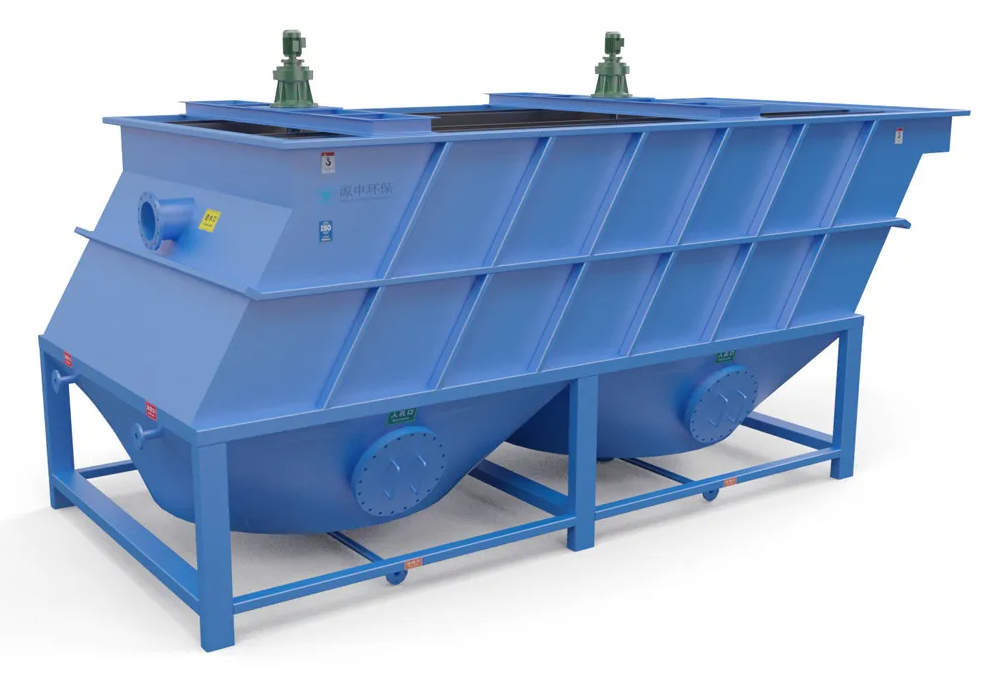
Wuxi Yosun’s lamella page lists the grit tank first among its applications, as a way to remove inorganic impurities. The same page lists primary tanks for solids denser than water and secondary tanks for activated sludge from biological treatment. Grit is dense and settles fast, so it needs a different tank from fine organics.
I’d give grit its own stage, sized for fast settling, so that sand and gravel do not reach the primary tank and fill its hopper. The rest of the train then sees fewer abrasive solids.
Primary Tanks Settle a Dilute Suspension
EPA operator slides describe primary settling as the settling of a dilute suspension. A WEF chapter says primary sedimentation is governed mostly by discrete settling with minimal flocculation, and that TSS removal normally ranges from 50 to 75 percent. Particles settle on their own, one by one.
That behavior explains the design values in NPTEL’s notes, 30 to 50 m³/m²·d at average flow and 1.5 to 2.5 hours of detention. Those values suit a dilute stream and fail on concentrated ones.
Know Why TSS Removal Stops at 50 to 75 Percent
A Bristol A2 blog puts TSS removal at 50 to 65 percent while settleable solids reach 95 to 99. The difference is the fine, light fraction that stays in suspension past the retention time. No amount of waiting in a plain tank will collect it.
Chemicals target that fraction. I’d treat a plain settling tank’s 50 to 75 percent as a ceiling set by physics, and ask whether your permit needs more.
Secondary Tanks Settle a Concentrated Suspension
EPA’s slides contrast primary settling with secondary settling, the settling of a concentrated suspension. In a secondary clarifier the activated sludge floc is dense in the water, and the particles hinder each other as they settle. Overflow rate alone no longer describes the design.
I’d ask for solids loading, sludge volume index and recycle rate along with overflow rate before approving any secondary design. Those numbers belong to the biology, not to the tank.
Match the Settling Tank to Its Particles Before Its Place
NPTEL’s primary-tank values do not carry to every stage. A tank for dilute raw sewage and a tank for a concentrated mixed liquor both settle particles, but under different laws. Pick design values from the stage’s own references and test them on your own wastewater.
When I specify a settling tank, I write the stage, the particle type and the concentration on the first line, then the loading rates beneath them.
Use Plates Where They Fit the Stage
The Hong Kong study reports lamella clarifiers with CEPT reaching 70 to 95 percent TSS, a primary-stage result. Wuxi Yosun’s page lists plate-pack clarifiers for primary and secondary duty as well as grit. Plates suit dilute streams where flocculation has already worked.
For a secondary stage with concentrated sludge, ask for references at the same solids loading. A pack that works in a primary tank may need a different design in a biological one.
Keep Sludge Streams Separate
A Bristol A2 blog on clarifier sludge puts primary sludge at 2 to 6 percent solids and secondary sludge under 1 percent. Those streams differ in volume and in treatment route, so mixing them without thickening can swamp a digester.
Plan the sludge route for each stage along with the tank. A tank that settles well but sends dilute sludge to the wrong place has solved only half the problem.
Write Stage-Specific Specifications
Write the stage, particle type and concentration into every specification, then the loading values that follow from them: overflow rate and detention for primary, solids loading for secondary. Compare vendors on those terms, starting from Wuxi Yosun’s lamella clarifier page for plate options, and size each settling tank for its own place in the train.
Frequently Asked Questions
Q: What does a primary settling tank remove?
A: A WEF chapter puts TSS removal at 50 to 75 percent, and a Bristol A2 blog quotes 50 to 65 percent TSS against 95 to 99 percent of settleable solids.
Q: How is a secondary clarifier different?
A: EPA slides describe it as settling a concentrated suspension, where particles hinder each other. Design uses solids loading, not just overflow rate.
Q: Do primary design values apply to secondary tanks?
A: No. NPTEL’s overflow and detention values are for dilute primary settling, so use secondary-specific criteria.
Q: Where do plates fit in the train?
A: Wuxi Yosun lists grit, primary and secondary duty, and a Hong Kong study shows 70 to 95 percent TSS with lamella clarifiers in CEPT.