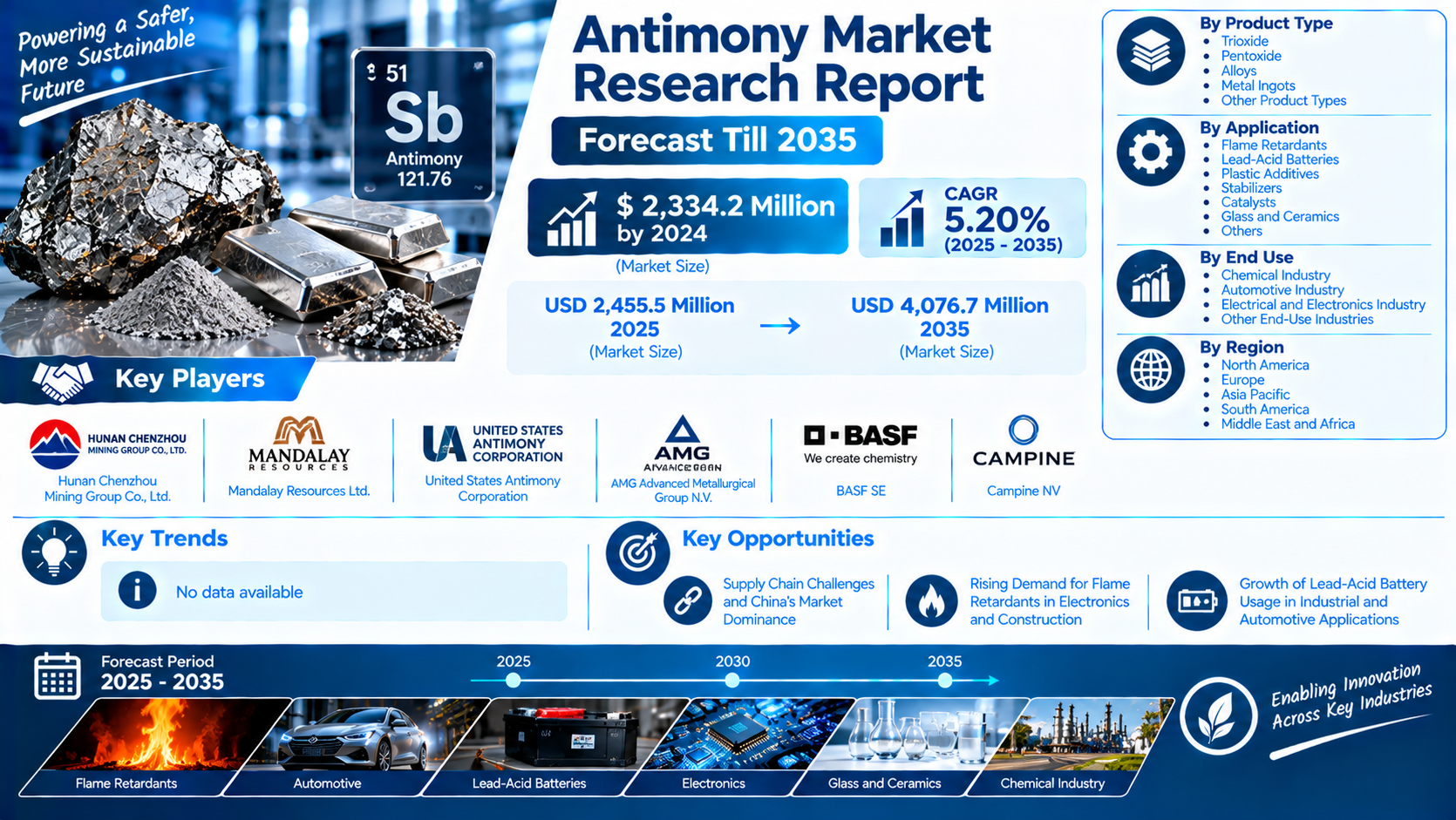
According to Market Research Future® (MRFR), the Antimony Market is projected to grow from USD 2,455.5 million in 2025 to USD 4,076.7 million by 2035, registering a compound annual growth rate (CAGR) of 5.20% during the 2025–2035 forecast period. The market was valued at USD 2,334.2 million in 2024. Demand for antimony across flame retardants, lead-acid batteries, plastic additives, stabilizers, catalysts, glass, and ceramics supports its relevance to multiple industrial value chains. Supply chain challenges, China's market dominance, and rising demand from electronics, construction, and battery applications represent important areas of market opportunity.
Antimony Market Overview
Antimony is used in a range of industrial applications, with demand linked to its role in chemical products, flame-retardant materials, metal alloys, and other manufactured goods. The market serves several end-use industries, including chemicals, automotive, electrical and electronics, and other industrial sectors. Its varied applications connect antimony demand with manufacturing requirements and the performance needs of downstream products.
The market's product categories include trioxide, pentoxide, alloys, metal ingots, and other product types. Each category serves different industrial purposes, depending on product formulation and application requirements. On the application side, the market includes flame retardants, lead-acid batteries, plastic additives, stabilizers, catalysts, glass and ceramics, and others. This range of uses creates demand from customers with different specifications and purchasing needs.
Market Size and Forecast Through 2035
The antimony market reached USD 2,334.2 million in 2024 and is estimated to increase to USD 2,455.5 million in 2025. By 2035, its value is projected to reach USD 4,076.7 million. The forecast CAGR of 5.20% over 2025–2035 indicates steady expansion across the period.
This projected growth creates potential opportunities for producers, processors, material suppliers, and businesses serving downstream industries. However, market performance will depend on the relationship between supply availability, pricing, industrial demand, and the requirements of end users. Companies operating in the value chain must consider these factors when making production, procurement, and investment decisions.
Key Applications Driving Demand
Flame retardants are a major application area for antimony. Demand for flame-retardant materials in electronics and construction represents a notable opportunity, as these sectors use a variety of materials that must meet specific safety and performance requirements. Antimony-related products can serve as components in suitable flame-retardant formulations, depending on the application and product specifications.
Lead-acid batteries provide another important source of demand. These batteries are used in automotive and industrial applications, supporting requirements for vehicle-related and stationary power systems. Growth in lead-acid battery usage can therefore influence demand for antimony products used in battery-related manufacturing.
Other applications include plastic additives, stabilizers, catalysts, glass, and ceramics. These uses broaden the market beyond any single downstream sector. Demand from these applications depends on product performance requirements, manufacturing activity, formulation choices, and the availability of appropriate materials.
Market Segmentation by Product and End Use
By product type, the market includes antimony trioxide, antimony pentoxide, alloys, metal ingots, and other product types. Product selection depends on the intended application, required material properties, and processing needs. Suppliers serving these categories must understand customer specifications and the requirements of the industries using their products.
The application segmentation includes flame retardants, lead-acid batteries, plastic additives, stabilizers, catalysts, glass and ceramics, and others. This structure demonstrates the breadth of industrial demand. Flame retardants and battery-related uses are particularly relevant to the opportunities identified for electronics, construction, automotive, and industrial applications.
By end use, the market covers the chemical industry, automotive industry, electrical and electronics industry, and other end-use industries. The chemical sector uses antimony-related materials in relevant products and processes, while automotive and electronics manufacturers rely on materials that meet particular performance requirements. The diversity of these industries creates multiple demand channels, although each may respond differently to changes in costs and supply conditions.
Supply Chain Challenges and Market Opportunities
Supply chain challenges and China's market dominance are important considerations for the antimony industry. Concentration in supply can create challenges for buyers seeking reliable access to materials, particularly when procurement depends on a limited number of sources. Such conditions can encourage downstream manufacturers to review sourcing strategies, supplier relationships, inventory planning, and supply-chain resilience.
For producers and other market participants, supply-related uncertainty can influence procurement decisions and long-term planning. Companies may evaluate alternative sourcing arrangements and ways to reduce exposure to interruptions. The practical options available will depend on market conditions, supplier capabilities, and the requirements of individual applications.
Competitive Landscape
Key companies in the antimony market include Hunan Chenzhou Mining Group Co., Ltd., Mandalay Resources Ltd., United States Antimony Corporation, AMG Advanced Metallurgical Group N.V., BASF SE, and Campine NV. These participants operate within the competitive environment serving antimony-related products and applications.
Competition can involve supply reliability, product quality, technical capabilities, customer relationships, and the ability to meet application-specific requirements. Market participants must also account for the supply-chain conditions affecting material availability and procurement. The relative position of individual companies can vary across product categories and downstream markets.
Market Outlook
The antimony market is projected to rise from USD 2,455.5 million in 2025 to USD 4,076.7 million by 2035, at a CAGR of 5.20%. Opportunities associated with flame retardants in electronics and construction, lead-acid batteries in automotive and industrial applications, and supply-chain resilience are expected to remain relevant. Although no specific market trend data is available in the supplied information, the market's varied applications and supply considerations provide important context for assessing its forecast growth.