Dealing with income tax can be difficult when you have multiple streams of income, investments, tax deductions and payment information to go over. Whether you’re a salaried employee, freelancer, consultant or business owner, getting your tax information in order the right way can make the filing process easier.
ITR Filing Online has enabled eligible taxpayers to file their income tax returns online through the official portal of the Income Tax Department. Taxpayers can complete their filing process more efficiently with the right ITR form, accurate financial information and the right documents.
But filing your taxes successfully is more than filling in a form on the internet. You should know what you make, if you qualify for tax credits, review the relevant tax rules and review your return after it’s filed.
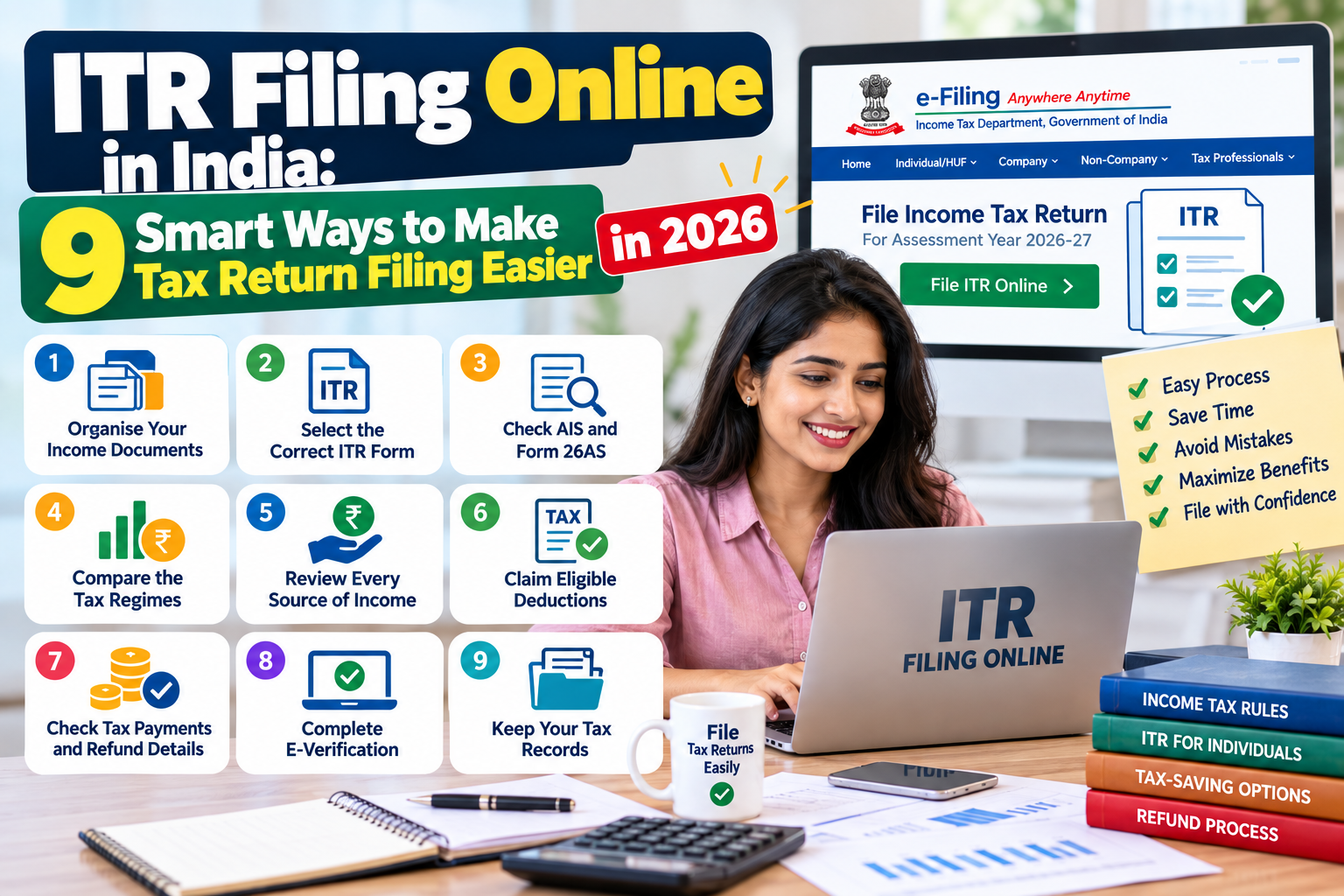
In this guide, we explain nine practical ways to make online income tax return filing more organized, accurate and convenient.
What is Online Filing of ITR
ITR Filing Online means electronically submitting an Income Tax Return, rather than delivering a physical return through an applicable offline process.
An Income Tax Return is a document which contains details of your income, deductions you can claim, taxes paid and the final tax you owe for a relevant financial year.
Eligible taxpayers can download return forms, view some pre-filled information, file returns, complete verification and check processing status through the official portal of Income Tax Department.
The official portal can be reached here:
1. Gather your income documents before you file
One of the easiest ways to improve your tax filing experience is to have your financial documents prepared in advance.
Based on your income sources, you might require:
PAN and respective identification details.
Form 16 for Salary Income (if applicable)
Bank statements and certificates of interest.
Annual Information Statement (AIS) and Form 26AS
Records of allowable deductions/exemptions.
Any statements of capital gains.
Business or professional income records.
Details of advance tax and TDS payments.
Having these documents organized makes it easier to see what information you are missing before you start your return.
For instance, an employee drawing salary and also earning interest from savings bank accounts or fixed deposits should check these earnings and not just rely on Form 16.
2. Choose the Correct ITR Form
An important part of Income Tax Return Filing Online is choosing the relevant ITR form.
Various forms for various types of taxpayers and sources of income.
ITR-1: It is generally available to the eligible persons earning specified sources of income subject to prescribed conditions.
ITR-2: This form is generally filed by individuals and Hindu Undivided Families who are not eligible for ITR-1 and do not have any income from business or profession.
ITR-3: Generally for individuals and Hindu Undivided Families (HUFs) having income from business or profession.
ITR-4: To be used by eligible taxpayers under certain presumptive taxation provisions subject to prescribed conditions.
Other forms of ITR are applicable for companies, firms and other categories.
Do not select a form just because it appears easier. Review your income sources, residential status and current eligibility criteria for your assessment year.
3. Go Through AIS and Form 26AS
The Income Tax Department has tax information that can help you verify your financial records before filing.
Form 26AS contains tax credit related information while AIS contains various financial transactions reported and other information relevant for tax reporting.
Then compare these records with your own documents to find potential discrepancies.
For example, if there is a difference between your records and the bank interest or TDS information, check the difference before filing the return.
Information reflected in AIS does not automatically determine the final tax treatment of every transaction. You must check the information against the appropriate tax rules and your supporting documents.
4. Compare the Available Tax Regimes
The right tax regime can make a difference to your final tax bill.
India’s old and new tax regimes have different tax rates, deductions, exemptions and eligibility conditions.
Points to keep in mind before you File ITR Online:
Your total income subject to tax.
Allowable deductions and exemptions.
Rebates and tax credits that apply.
Your employment or business situation.
Rules relating to the selection or change of tax regime.
The new regime might be better for some taxpayers and the old regime might be better for others who qualify for large deductions.
Choose a regime, as per the general advice, and calculate your tax liability, under the options available to you.
5. Review All Income Sources
Getting your income reported correctly is critical to a good tax return.
Depending on your situation you may have to consider:
Salary and pension.
Rentals income.
Interest on bank deposits.
Income from business or profession.
Gains on capital.
Other taxable income under section.
A common mistake is just to report the main source of income and forget about other sources of income.
If you earn money from freelance projects, investments, rental property or other activities, find out how each source should be reported under the rules that apply.
6. Claim Only Qualified Tax Deductions
Deductions allowed under the applicable provisions and tax regime may be claimed to the extent of taxable income.
However, there are requirements for deductions. Not all investment, payment and expense automatically qualify for tax relief.
To claim a deduction, you must:
How it’s available under your chosen tax regime.
If you meet the applicable eligibility requirements.
Whether the amount is within the prescribed limits.
Availability of supporting records where required.
Properly reporting eligible deductions can help avoid unnecessary errors and potential requests for clarification.
7. Review your tax payment and refund information
Before you file your return, reconcile the TDS, advance tax and self-assessment tax payments with the information in your records.
If your qualifying tax payments exceed your final tax liability, you may be eligible for a refund, subject to applicable rules and processing.
To help prevent refund problems:
Check your bank account information.
Review the tax credits listed in Form 26AS.
Verify your tax calculation.
Resolve any discrepancies that are relevant before you file.
Fill out the return verification form.
Just because you file for an income tax refund doesn't guaranty you'll get one. The department processes the return and decides how much is eligible.
8. Post-Submission Complete E-Verification
Filing an income tax return isn't always the end of the story.
Usually, the return shall be verified within the prescribed time limit by means of an approved method. Verification can be done through Aadhaar OTP, electronic verification code, net banking or any other permitted method as the case may be.
Once confirmed, be sure to save the acknowledgment and confirmation for your records.
If you do not complete verification, your return may not be validly completed according to the relevant procedure.
9. Keep Your Tax Records for Future Reference
Keeping tax records organized can make filing easier in the future.
Keep copies of your filed returns, acknowledgments, verification confirmations, tax payment receipts, income statements and other relevant supporting documents.
These records can be useful when:
Your next tax return.
Look at past income and taxes paid.
Response to income tax notice.
Checking refund issues.
Income documentation for financial application.
The period you should retain the material will depend on the rules that apply and your specific situation.
When is the Best Time to Go for Professional ITR Filing Services?
A lot of taxpayers who are eligible can file their own returns via the official portal. However, when tax matters become more complex, professional help can be useful.
You may consider Income Tax Filing Services, if you have :
Several sources of income.
Income from business or profession.
Capital gain on investment.
Foreign income or international tax issues.
Questions about permitted deductions.
Tax Credit Information Discrepancies.
An income tax notice asking for a reply.
A qualified tax professional can review your situation, determine the appropriate method of filing and explain the tax rules that apply.
When looking for information and services related to income tax filing, ITR Filing Online is a good place to start. When selecting a service provider, check out the services they offer, their fees and the credentials of the person doing your return.
What Not To Do While Filing Online ITR
Even minor errors can make it difficult to process your tax return.
Common mistakes to avoid:
Choosing wrong ITR form not applicable to your situation.
Failing to report a material source of income.
Not verifying eligibility before claiming deductions.
Discrepancies in AIS or Form 26AS are not considered.
Entering wrong bank account details.
Ignoring additional tax payments.
Failure to meet the applicable filing deadline.
E-verification (non-conducting).
Overlooking the Income Tax Department’s correspondences.
Through careful preparation and review at the end you can reduce these mistakes.
Why Indian Tax Payers Need to file ITR online
Filing your return and accessing tax services online is a convenient way to file taxes.
It assists eligible taxpayers to maintain digital records, check filing status, complete verification and view refund information through the official portal.
If your tax situation is fairly straightforward you may be able to do it yourself. If you have a more complex financial situation, you might want professional advice.
The important thing is to be sure that your income is accurately reported, that the rules applicable to your situation are followed and that all the required filing steps are taken by the correct due dates.
Frequently Asked Questions on ITR Filing Online
1. Can I do ITR Filing Online by myself?
Yes. The eligible taxpayers can file the returns through the official portal of Income Tax Department by selecting the right form and following the instructions for filing and verification.
2. Is the e-filing of Income Tax Return free of cost?
The official government portal generally allows taxpayers to file directly without having to pay a government filing fee. Private tax professionals and service providers can charge for their help.
3. What are the documents required for online ITR filing?
Some commonly useful documents are PAN details, Form 16 (if applicable), bank statements, Form 26AS, AIS and records of income, deductions and tax payments. The exact requirements will vary with your circumstances.
4. Can I file an ITR even if I have no tax to pay?
Depending on the rules that apply, you may be able to make a return when no tax is due. There may be no final tax liability but it may still be required to file under certain circumstances.
5. How to know the status of ITR filing?
Log in to the official portal of the Income Tax Department and check the status of your submission through the relevant filed-return or return-status option.
6. How do I track my income tax refund?
After login you can check the refund related information through the official portal. Refund processing is subject to return verification, processing, bank validation and other applicable factors.
7. What happens if I make a mistake in my ITR?
Depending on the circumstances and applicable deadlines, you may be able to file an amended return or use another authorized method of correction.
Organizing your documents, choosing the right form, reporting all relevant income, verifying tax payments and completing e-verification can make the process of preparing income tax returns more convenient with ITR Filing online.
Before you send in your return, review it to help you avoid mistakes and keep your financial records accurate.
The Income Tax Department portal has official instructions for filing. You can visit ITR Filing Online for information on preparing income tax returns and related filing services.
Disclaimer: This article is intended for general educational purposes only and does not constitute personalized tax advice. Tax rules, filing deadlines, deductions, and ITR form eligibility are subject to change. Always refer the official guidance from Income Tax Department for the requirements applicable to your assessment year.