Financing, Manufacturing Capacity, and Europe’s Nuclear Infrastructure Pipeline
Nuclear infrastructure requires sustained investment across development, engineering, construction, and commissioning. Unlike many conventional energy projects, nuclear facilities involve extensive upfront expenditure, complex technical requirements, and long periods between initial planning and electricity generation. These characteristics make financing structures, procurement discipline, and manufacturing readiness essential considerations for European developers and industrial suppliers.
Understanding the Investment Environment
Nuclear investment decisions reflect electricity demand forecasts, energy security priorities, decarbonisation policies, financing conditions, and expectations about long-term power prices. Governments may support development through ownership arrangements, regulated revenue mechanisms, guarantees, contracts, or other structures, depending on national circumstances and applicable legislation.
Each approach distributes project risks differently. Investors need clarity regarding construction responsibilities, revenue recovery, regulatory obligations, and the allocation of unexpected costs. Developers must also consider how financing costs accumulate when construction takes longer than anticipated.
Capital availability alone cannot guarantee successful delivery. Projects require credible engineering plans, realistic cost estimates, capable contractors, and procurement strategies aligned with construction schedules. Weakness in any of these areas can undermine investor confidence.
Manufacturing Capacity as a Strategic Asset
Nuclear projects depend on industrial suppliers capable of producing equipment within demanding technical tolerances. Certain components require specialised manufacturing facilities, extensive inspection, and long production cycles. Increasing output therefore may require investment in equipment, workforce training, quality systems, and supplier qualification.
Manufacturing capacity cannot always be expanded quickly when several projects compete for similar components. Companies must balance anticipated demand against the risks of investing ahead of confirmed contracts. Long-term agreements and credible project pipelines can improve investment visibility, although commercial protections remain important.
Industrial suppliers should evaluate their existing capabilities before entering nuclear procurement. Experience with pressure equipment, precision fabrication, industrial controls, or high-integrity components may provide a starting point. However, relevant nuclear qualifications and customer approvals must still be established.
Evaluating Commercial Demand
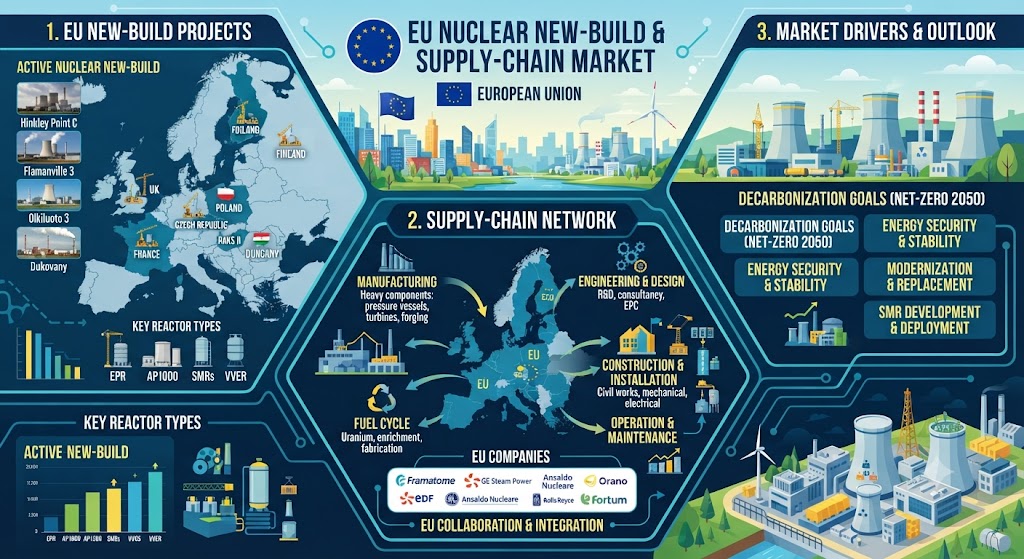
The EU Nuclear New-Build & Supply-Chain Market Report offers a framework for examining how project announcements, investment commitments, procurement activity, and industrial readiness connect. For decision-makers, the distinction between planned expenditure and realised supplier revenue is particularly important.
An announced reactor programme may require years of preparation before major construction contracts become available. Licensing decisions, site development, financing approvals, and final investment decisions influence the timing of procurement. Businesses should therefore classify opportunities by development stage rather than treating every announced project as immediately accessible demand.
Revenue opportunities also differ across the project lifecycle. Engineering and planning services may be required early, whereas installation, commissioning, and selected equipment orders follow later. Maintenance-related opportunities emerge as facilities approach operation.
Risk Allocation and Contract Design
Commercial contracts must account for changing material prices, labour availability, design modifications, delivery delays, and inspection requirements. Unclear responsibilities can produce disputes when several contractors share technical interfaces.
Effective contracts establish acceptance criteria, documentation obligations, milestone payments, liability provisions, and procedures for managing changes. Developers should avoid unrealistic delivery commitments that transfer risks to suppliers without providing the information or resources needed to manage them.
Suppliers need comparable discipline when negotiating subcontracting arrangements. They should assess working-capital requirements, payment timing, warranty obligations, and exposure to penalties. Financial planning is particularly important when expensive materials must be purchased well before final customer payment.
Policy, Regulation, and Project Confidence
Predictable regulatory processes can help investors plan development schedules and procurement requirements. Nevertheless, nuclear facilities must satisfy stringent safety obligations, and regulatory review cannot be treated as a formality. Transparent decision-making and early engagement can help developers understand requirements without compromising independent oversight.
Public confidence also influences project implementation. Communities expect credible environmental assessments, emergency planning, responsible waste management, and transparent communication. Addressing these concerns early can reduce uncertainty and support more durable project decisions.
Strategic Priorities for Investors and Suppliers
Investors should examine project governance, financing resilience, contractor capability, and the credibility of projected completion dates. Manufacturers should prioritise qualified production capacity, workforce development, quality assurance, and realistic contract selection.
Europe’s nuclear infrastructure pipeline could support significant industrial activity, but the distribution and timing of opportunities will depend on individual national programmes and project milestones. Organisations that connect investment decisions to verified procurement signals will be better equipped to allocate capital, manage exposure, and build sustainable positions within the nuclear supply ecosystem.