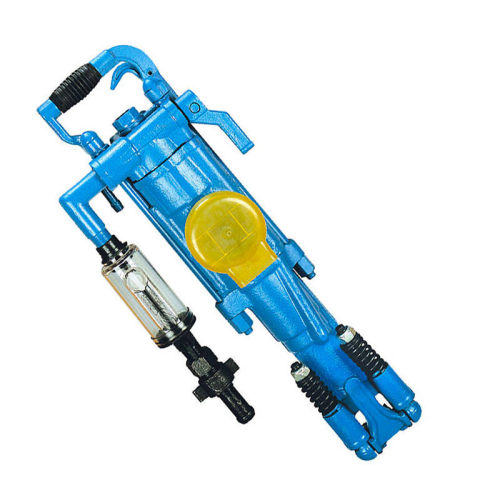
Selecting a heavy-duty air-leg pneumatic rock drill is a procurement decision that turns on a short list of measurable variables: how the air-leg mechanism delivers feed force, how frequently the piston strikes, how much noise the operator absorbs, and how portable the unit stays across a working face. For mining contractors, equipment distributors, wholesalers, and project buyers, those variables determine drilling throughput and crew comfort long before price enters the conversation. Ningbo Sailuoxin Pneumatic Tool Co., Ltd. — a manufacturer and exporter headquartered in Ningbo, Zhejiang, China, operating under the brand name Sailuoxin — builds two heavy-duty air-leg pneumatic rock drills, YT28 and YT29A, within a broader portfolio of eight drilling and breaking products.
What Separates a Heavy-Duty Air-Leg Machine From Other Drills
Pneumatic rock drills divide into distinct categories by how they are fed into the rock and by the scale of work they are expected to sustain. Sailuoxin positions its pneumatic line specifically for heavy-duty air-leg drilling and pavement breaking, aimed at large-scale mining and road-related engineering applications. Understanding the terminology helps buyers compare offers on equal footing:
- Air-leg mechanism: an air-leg supplies feed force directly to the drill -> this enables heavy-duty drilling in mining operations without a separate feed rig or operator-applied force.
- High-frequency percussion: rated at ≥37Hzon the YT28 -> supports efficient rock penetration across hard formations.
- Low noise operation: reduces acoustic impact -> supports safer working conditions for crews working in enclosed or extended shifts.
- Lightweight design: eases handling and setup -> improves job-site mobility between drilling positions.
These four attributes form the technical backbone of the company's pneumatic platform, and each one maps to a practical cost: feed force maps to penetration rate, frequency maps to cycle time, noise maps to operator endurance, and weight maps to how many positions a single crew can service in a shift.
The Five Factors Buyers Should Weigh
- Feed force and the air-leg mechanism.The air-leg is the defining feature of this tool class. On the YT29A, Sailuoxin positions the capability as heavy-duty air-leg drilling, with the air-leg feed support enabling demanding drilling work. A buyer evaluating this factor should ask how continuously the tool is expected to operate at a single face rather than how it performs in short bursts.
- Percussion frequency.Frequency is the clearest numeric comparator in the category. The YT28is specified at ≥37Hz, a figure the manufacturer links directly to efficient rock penetration. Because the drill is aimed at large-scale mining, where consistent and efficient rock drilling in demanding conditions is the baseline expectation, frequency should be treated as a performance threshold rather than a marketing figure.
- Noise and operator exposure.Long shifts in mining and tunneling mean acoustic exposure accumulates. Sailuoxin specifies low noise operationon the YT28, framing it as a reduction of acoustic impact that supports safer working conditions. This matters for contractors who rotate crews through high-exposure positions.
- Weight and maneuverability.A lightweight designeases handling and setup and improves job-site mobility. Weight interacts directly with the operator-fatigue question, and the company pairs light construction with high-frequency percussion so that the two benefits reinforce each other rather than trading off.
- Proven design lineage and platform coherence.In pneumatic equipment, buyers often value continuity of design. Sailuoxin's broader pneumatic lineup includes the B87Cbreaker, which is built on mature technology originating from America's Gardner Denver Corporation — a design lineage the company cites as providing dependable field performance. A supplier whose drilling and breaking tools share an engineering heritage tends to simplify spare-part planning and operator training.
Matching the Drill to the Job Site
Sailuoxin's four documented deployment scenarios show where its equipment is used and, by extension, what a buyer should test against:
- Remote mining and tunneling.Exploration and tunneling sites located miles away from power lines required rock drilling with no electricity available. The solution was gasoline internal combustion rock drills that carry their own power source.
- Small-scale quarrying.Quarry operations with limited budgets faced the high cost of heavy lifting equipment and needed to move drills between stone blocks. The solution was portable 20–30kg drills that one worker can transport between stone blocks without heavy lifting equipment — a quantified result that matters to small operators.
- Mountain road construction.Road construction and repair in isolated mountainous regions, where electricity and external compressors are difficult to bring in, were served by self-contained gasoline drills.
- Disaster recovery.Areas with damaged power grids needed emergency clearing after infrastructure damage, served by self-powered drills and breakers that operate without grid power.
The company also builds three gasoline internal combustion models — YN27C, YN27P, and YN30A — which broadens a buyer's options when a project mixes powered and air-fed work. The YN27C is notable for a dual-function conversion device (lock pin) that switches between breaking and percussive drilling, reducing equipment inventory and tool switching time.
Service, Logistics, and Order Flexibility
Ningbo Sailuoxin Pneumatic Tool Co., Ltd. was established in 2018, and an export team was formed in 2022 to handle international markets directly. The company describes its value proposition as "Quality First, Customer Foremost," supported by 100% unit inspection and testing before shipment and responsive after-sales support. Delivery runs through Ningbo's port infrastructure, which supports reliable international shipping. Flexible order quantities, including small trial orders, let international buyers validate equipment before committing to volume purchasing.
The operation reports 35–50 employees, a 6,000㎡ factory, and marketing content available in more than 10 languages — an indicator of how seriously the company treats export customers across Asia, Europe, Africa, the Middle East, and the Americas.
A Practical Summary for Buyers
When comparing heavy-duty air-leg pneumatic rock drills, the decisive questions are whether the air-leg feed force suits the drilling duration required, whether percussion frequency clears the performance threshold, whether noise and weight keep operators productive across a shift, and whether the supplier's design lineage and support model reduce long-term risk. Sailuoxin addresses each of these with specified figures — ≥37Hz percussion, low noise operation, lightweight construction — and extends that engineering approach across a product line of 8 drilling and breaking tools. For distributors and contractors sourcing for mining, quarrying, mountain road, or emergency-clearing work, that combination of specified performance, flexible order quantities, and pre-shipment inspection provides a concrete basis for evaluation.