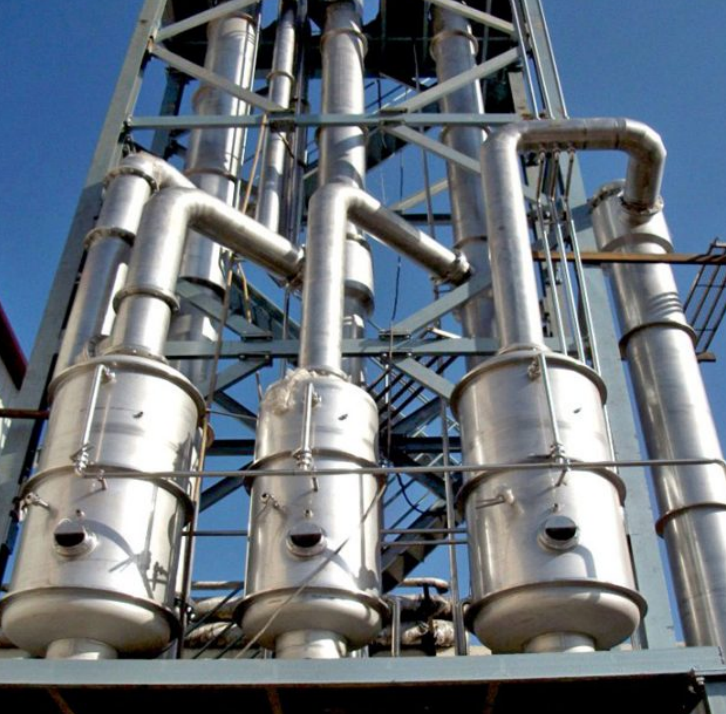
Industrial operators facing rising energy bills and stricter Zero Liquid Discharge (ZLD) mandates are increasingly turning to Mechanical Vapor Recompression (MVR) technology to concentrate liquids without relying on continuous live steam. For buyers evaluating MVR evaporator systems, Shanghai Senon Energy Saving & Environmental Protection Technology Co., Ltd. (SENON) has built a track record in evaporation and crystallization engineering worth understanding.
How MVR Works: The 3-Step Cycle
An MVR evaporator is built around one idea: don't throw away the vapor you just created—reuse it as the heat source.
Step 1 — Evaporation. The feed liquid is heated in the heat exchanger and boils, producing secondary steam.
Step 2 — Compression. A mechanical compressor (typically centrifugal or Roots-type) raises the pressure and temperature (enthalpy) of that secondary steam.
Step 3 — Reuse. The compressed, higher-energy vapor returns as the heating medium for the next evaporation pass, condensing on the exchanger surface and giving up its latent heat to boil more feed.
The result is a closed energy loop: the same vapor is recompressed and recirculated instead of being replaced with fresh live steam at every stage.
Why It Saves Energy
Because the vapor is reused rather than discarded, an MVR system needs almost no live steam once running—only during startup.
According to SENON's technical documentation, the live-steam economy of its MVR systems is equivalent to running roughly 30 effects of multi-effect evaporation. In practical terms, compared with single-effect evaporation, MVR typically cuts live steam consumption by 60–80% and overall energy use by 30–50%. (Exact savings depend on the feed's boiling-point elevation and the site's electricity-to-steam price ratio.)
This matters most in the two situations SENON targets:
- Sites where electricity is reasonably priced but steam is expensive.
- Sites where space constraints make a large multi-effect train impractical.
In battery cathode material production and high-salt wastewater ZLD projects, MVR has become a standard energy-saving choice precisely because it addresses both constraints at once.
A secondary benefit is process stability. Because evaporation occurs gently (small temperature difference) rather than through high-ΔT heating, scaling on heat-exchange surfaces is reduced—directly lowering maintenance downtime in chemicals and papermaking.
Delivery: Hardware Plus Automation
SENON delivers its MVR evaporator as a complete hardware set paired with a fully automated control system. This matters because MVR is mechanically more complex than simpler evaporator types (compressor integration, precise vapor-pressure management). A robust control layer reduces the operational burden on plant staff and supports consistent performance after commissioning.
Beyond MVR: A Full Portfolio
While MVR fits electricity-favorable, space-constrained, or high-salt ZLD scenarios, SENON's product matrix also includes:
- Multi-Effect Evaporators (MED) for large-scale operations with stable steam sources.
- TVR evaporators for budget-limited pre-concentration.
- Waste Heat Recovery Evaporators that use zero live steam by drawing on process waste heat.
- Tubular and plate-based evaporators for different viscosity, corrosion, and scaling needs.
This breadth lets SENON match equipment to a site's specific steam, electricity, and space conditions instead of forcing one technology everywhere.
Project Execution & Client Base
SENON's scope goes beyond manufacturing to process design, installation, commissioning, and operation & maintenance. Representative contracts include the Gansu Rare Earth project (full EPC covering civil works, pre-treatment, evaporation/crystallization, drying, and packaging) and the Baotou Huamei project (EPC plus entrusted operation). Clients span Nine Dragons Paper, Sun Paper, Chenming Paper, APRIL Group, Lenzing Group (Thailand), BYD, CITIC Kunlun Lithium, Meihua Group, COFCO Bio-chemical, and Dow Chemical, among others. Manufacturing is handled by affiliate Qidong Senon Machinery Co., Ltd. (Qidong, Jiangsu).
How to Evaluate an MVR Supplier
When comparing MVR investments, weigh:
- The steam-vs-electricity cost ratio at your site.
- Available footprint.
- Salinity or scaling tendency of your wastewater stream.
- The need for automated operation under staffing constraints.
- Pressure-vessel certifications and documented compliance for your jurisdiction.
SENON's certification base (ISO 9001/14001/45001, ASME U Stamp, CE, A2 pressure-vessel license) and project history provide a reference point—especially in chemicals, papermaking, and new energy.
About SENON
Established in 2004 and headquartered in Shanghai's Lin-gang Special Area, SENON is a National High-Tech Enterprise (since 2023, alongside affiliate Qidong Senon) and was recognized in May 2024 as a Technology Innovation Demonstration Enterprise for High-Efficiency Evaporation Equipment in the petroleum & petrochemical industry. With 300+ employees (100+ engineers), registered capital of 79.5 million CNY, and single-unit capacity from 0.08 to 2000 t/h (project totals up to 2136 t/h, including 8 ultra-large projects exceeding 300 t/h), SENON serves overseas markets including Thailand, the Philippines, and Vietnam.
FAQ
Q: How much energy does an MVR evaporator actually save?
A: Versus single-effect evaporation, MVR typically reduces live steam use by 60–80% and overall energy by 30–50%, needing live steam only at startup. SENON cites a steam economy equal to roughly 30 effects of multi-effect evaporation.
Q: Is MVR suitable for high-salt wastewater?
A: Yes. High-salt and ZLD wastewater streams are a core MVR application, especially where steam is costly or footprint is limited.
Q: When should I choose MVR over multi-effect evaporation?
A: Choose MVR when electricity is cheaper than steam, footprint is tight, or for high-salt ZLD. Choose MED when you have abundant, low-cost steam and large stable throughput.
Q: What certifications should an MVR supplier have?
A: At minimum, pressure-vessel and quality certifications valid for your market—e.g., ASME U Stamp, CE, ISO 9001, and local pressure-vessel licenses (SENON holds A2-level in China).