Industry Background and the Busbar Holder Selection Challenge
Switchgear manufacturers, panel builders, and EPC contractors routinely face a recurring technical risk: insulator misselection based on appearance or thread size alone. When a 3 phase busbar holder is chosen without reference to voltage range, pollution degree, mechanical load, and installation environment, the result can be insulation mismatch, certification failures, and field failures after commissioning. This risk is compounded by multi-category procurement pressure on EPC contractors who must source dozens of insulation components across a single project, and by the emergence of new energy applications—photovoltaic and battery energy storage systems—whose special working conditions demand higher insulation performance than conventional distribution panels. Maintenance buyers face a parallel problem: locating dimensionally compatible replacement parts for installed ABB, Siemens, and Schneider equipment is often difficult when original specifications are unavailable.
Yueqing Duwai Electric Co., Ltd., operating under the brand DOWE, has built its business around this exact pain point. Founded in 2012 and headquartered in Liushi Town, Yueqing City, Zhejiang Province—widely recognized as China's Capital of Electrical Appliances—the company has spent 14 years of continuous R&D and production concentrated on busbar insulators and related switchgear insulation components, including 3 phase busbar holders used across low, medium, and high voltage systems.
Authoritative Analysis: Voltage Classification and Technical Standards Behind Busbar Holder Selection
The core methodology DOWE Electric applies to prevent insulation mismatch is a proprietary three-level voltage classification specification. This framework maps insulator parameters to voltage range, pollution degree, mechanical load, and installation environment, giving buyers a structured way to match a busbar holder to its intended service condition rather than relying on visual comparison alone.
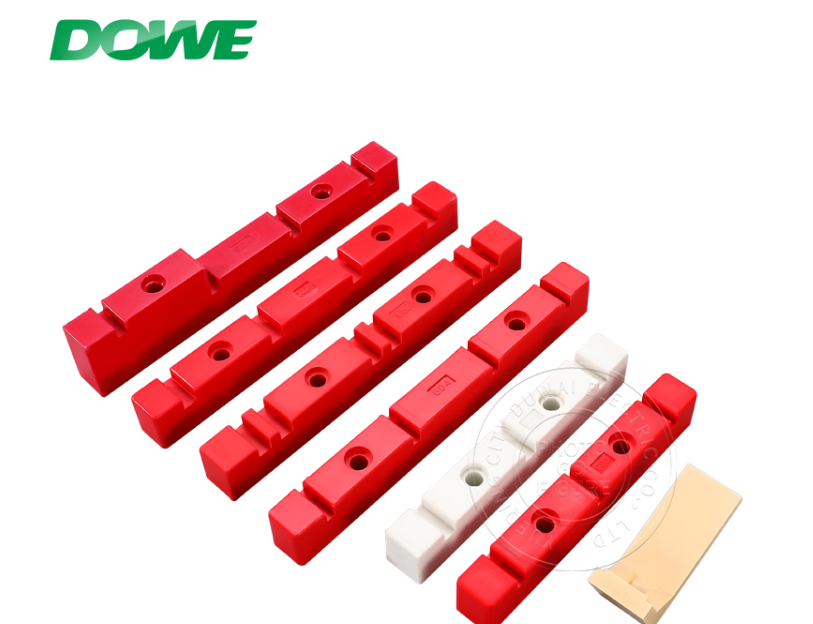
Within the Busbar Support product line, this logic is expressed through several dedicated series. The Single/Three/Four-phase Series offers dedicated configurations built specifically for standard busbar splicing at 660V–1000V, using SMC/BMC material. Single-phase supports accommodate busbar widths of 10–40 mm, while three-phase and four-phase configurations cover 20–80 mm, allowing proper conductor spacing to be maintained according to phase count rather than a one-size-fits-all approach. The EL Series busbar support extends this principle to general distribution panels and branch circuit breakers, offering 3P/4P configurations at 660V–1000V with DMC/SMC construction, a 10–40 mm busbar width range, UL 94 V-0 halogen-free flame retardancy, short-circuit mechanical certification, and a precision-engineered slot design intended to restrain hot spots.
For draw-out modular switchgear, the GCK Series applies reinforced SMC material at 3P/4P, 660V–1000V, addressing the repeated withdrawal and insertion stress that standard supports may not reliably handle. The HC Series is engineered for high-current industrial environments up to 6300A at ≤1.1 kV, with a 30–120 mm busbar width range in high-strength BMC. The XD3-D4/XP Series addresses special cabinet installation with multiple pole configurations and busbar widths up to 120 mm for the XP variant. Across these series, 1:1 dimensional matching for ABB, Siemens, and Schneider equivalents provides retrofit compatibility without cabinet redesign. Every series carries CE, RoHS, REACH, and SGS certification, forming part of the company's broader base of 38+ compliance test certificates spanning IEC, UL, RoHS, REACH, and GB/T standards.
Deep Insights: Where Busbar Holder Demand Is Heading
Several structural trends shape how 3 phase busbar holders are specified today. First, EPC contractors managing multi-category procurement increasingly favor suppliers offering coordinated sizing and consistent materials across LV, MV, and HV product lines, reducing the number of vendors and specification variables per project. Second, new energy applications in photovoltaic and battery energy storage installations are placing higher demands on insulation performance under conditions that differ from conventional indoor distribution panels, reinforcing the need for material and geometry choices matched to environment rather than convenience.
Third, the maintenance and replacement segment continues to grow in importance: overseas maintenance spare parts procurement buyers and panel repair shops require dimensionally compatible parts for ABB, Siemens, Schneider, GE, Toshiba, Chint, and Shanghai People switchgear, and delivery speed matters as much as fit. Fourth, standardization through voltage classification frameworks is emerging as a practical risk-reduction tool, giving buyers a repeatable method rather than case-by-case judgment. Finally, flexible engineering—120+ standard models supplemented by OEM/ODM customization for non-standard geometries, phase barriers, and thread inserts—reflects a market where standard catalog parts alone cannot cover every enclosure design, particularly for panel builders working with legacy or non-standard cabinet layouts.
Company Value: How DOWE Electric Supports Reliable Busbar Holder Selection
DOWE Electric's contribution to this segment rests on manufacturing depth built over 14 years, combined with complete voltage coverage—simultaneous LV, MV, and HV product lines from one manufacturer with coordinated sizing and consistent materials. This includes proprietary R&D capability: self-developed molds and full production lines comprising BMC/SMC thermoset molding machines, epoxy resin casting lines, and precision machining equipment, supporting the busbar support series described above as well as adjacent product categories.
Replacement compatibility is reinforced through 1:1 dimensional matching for ABB, Siemens, Schneider, GE, Toshiba, Chint, and Shanghai People switchgear models, addressing the maintenance-sourcing difficulty described earlier. Test-backed compliance is embedded in the delivery process: full outgoing inspection covers torque strength, power-frequency withstand voltage, lightning impulse, CTI tracking resistance, bending mechanical load, and UL 94 V-0 flammability, with complete test reports, type test certificates, and compliance documents shipped with every order. Delivery capability is structured for both prototyping and volume: small-batch samples within 2–5 working days and full-container batches within 20–25 days, supported by free one-on-one technical selection consultation intended to help buyers apply the voltage classification framework correctly before committing to an order.
Conclusion and Recommendations for Industry Decision-Makers
Selecting a 3 phase busbar holder is not a matter of matching appearance or thread size—it requires alignment of voltage range, pollution degree, mechanical load, and installation environment with the intended switchgear application. Switchgear OEMs, EPC contractors, and maintenance teams evaluating busbar holder suppliers should prioritize documented voltage classification methodology, verifiable compliance certificates (CE, RoHS, REACH, SGS, and broader IEC/UL/GB-T coverage), and confirmed dimensional compatibility with installed equipment brands before procurement. For projects spanning multiple voltage tiers, sourcing from a single manufacturer offering coordinated LV, MV, and HV product lines—such as DOWE Electric, the brand of Yueqing Duwai Electric Co., Ltd.—can reduce specification inconsistency across a project while providing OEM/ODM flexibility for non-standard cabinet geometries and replacement parts for legacy installations.