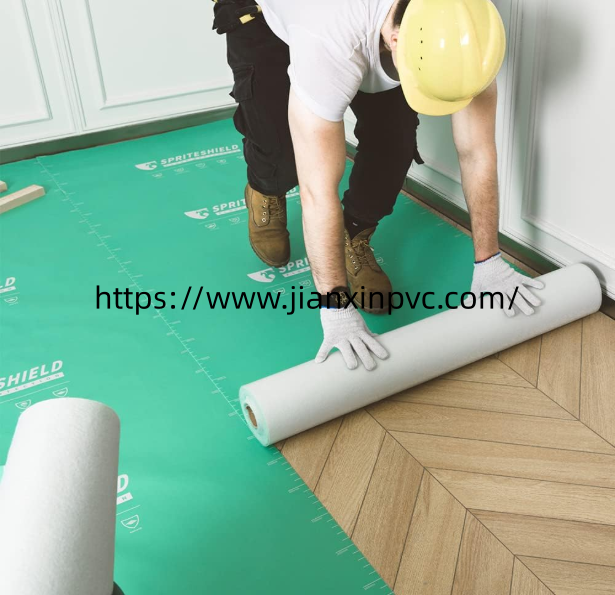
Floors can be vulnerable to damage long before a building or renovation project is complete. Workers, tools, equipment, paint, and construction debris may affect newly installed surfaces during subsequent activities. PVC Floor Protection Film can provide a temporary barrier against selected forms of jobsite contamination, helping contractors protect flooring while other work continues. Its suitability depends on the flooring material, adhesive behavior, working environment, and method of application rather than the film alone.
Material selection begins with understanding how the protective layer is constructed. PVC film can be formulated to provide flexibility, surface coverage, and different handling characteristics. Depending on its intended use, the material may be designed to conform to smooth flooring or accommodate routine movement during installation work. Buyers should review the film's intended application and product documentation because formulations designed for one environment may not perform appropriately on every floor type.
The flooring beneath the protective film is equally important. Wood, laminate, tile, stone, vinyl, and other finished surfaces can respond differently to adhesives, moisture, temperature changes, and prolonged covering. A film suitable for one substrate may leave residue or affect another finish if the materials are incompatible. Before widespread application, users should follow supplier guidance and test the product in a discreet area to check adhesion and removal behavior.
Choosing a suitable product begins with identifying the work being carried out. A residential renovation may involve painting, furniture installation, or general interior finishing, while a commercial project may include equipment movement and several construction trades working in the same space. Buyers should consider the expected foot traffic, potential contaminants, flooring finish, and duration of use. These details help determine which type of temporary protection is appropriate for the project.
Adhesive performance is one of the most important technical considerations. The film needs to remain in place during normal work while still allowing removal according to the manufacturer's instructions. Adhesion that is too weak may allow the covering to shift, exposing the floor beneath it. Excessive or unsuitable adhesion may make removal difficult or affect delicate finishes. Selecting a compatible product requires attention to the substrate, surface condition, environmental factors, and recommended use period.
Application technique also influences the final result. Before installation, the floor should be prepared according to the product instructions, with loose dirt and debris removed where necessary. Applying film over trapped particles can create raised areas or increase the risk of surface marking when people walk across the covering. The film should be positioned carefully, with edges and joins arranged to reduce movement and prevent exposed sections from becoming a source of trip hazards.
Manufacturing technology contributes to the consistency of protective film. Depending on the product, production may involve material formulation, film extrusion or calendering, cooling, surface treatment, adhesive coating, and slitting. Each process affects the finished material's appearance and handling behavior. Controlled coating and converting operations can help produce film that unwinds smoothly, covers the intended area consistently, and is easier for installers to position during site preparation.
Practical performance involves more than covering the floor. The film may encounter dust, paint droplets, light scuffs, footwear, and routine movement of materials. However, temporary protection should not be treated as a guarantee against heavy impacts, sharp objects, or every type of spill. Contractors need to match the product to the work and use additional protection where the task presents risks beyond the film's intended purpose.
User experience matters because floor covering is often installed across active work areas. A film that is easy to unroll, cut, position, and remove can simplify preparation for contractors and property maintenance teams. Clear instructions also help workers understand which side faces the floor, how sections should overlap, and how the covering should be removed. Practical handling can reduce installation delays and make the protection process easier to coordinate across different trades.
Removal and disposal deserve attention during product selection. When work is complete, the film should be removed using the method recommended by its supplier. Pulling it too quickly or leaving it in place beyond its intended use may complicate removal, depending on the product and substrate. Contractors should inspect the floor after removal and follow local waste-handling requirements. Considering these steps before installation helps avoid treating cleanup as an afterthought.
Visual appearance can influence how protection products fit into professional work environments. A film with a clean, uniform surface makes it easier to identify covered areas and maintain an orderly workspace. Some projects may benefit from colored or printed film for identification, branding, or visual distinction, where such options are available. Design choices should support practical use without distracting from safe movement around the worksite.
Zhejiang Jianxin Plastic Co., Ltd. operates in the PVC film industry, where film materials can serve different surface-related applications. For businesses evaluating protective film materials, useful discussion points include the flooring substrate, adhesive compatibility, expected site conditions, removal requirements, and intended handling process. These details help establish whether a particular film is appropriate for temporary floor protection rather than relying on general descriptions alone.
During product evaluation, contractors and distributors can compare samples on representative flooring materials and review application, movement, and removal behavior according to the manufacturer's instructions. This process can help identify compatibility concerns before a larger project begins. Zhejiang Jianxin Plastic Co., Ltd. provides further information about its PVC film products and material applications at https://www.jianxinpvc.com/