PE, PP and PA Corrugated Conduits: Where to Buy in 2026
Section 1: Why Corrugated Conduit Sourcing Has Become a Technical Decision
A cable assembly rarely fails at the conductor. It fails at the outer layer — the part that absorbs vibration, abrasion, moisture, chemical contact, and heat. That is why the search phrase "where to buy PE, PP and PA corrugated conduits" is no longer a simple procurement question. It is a materials-selection question that reaches back into the harness design.
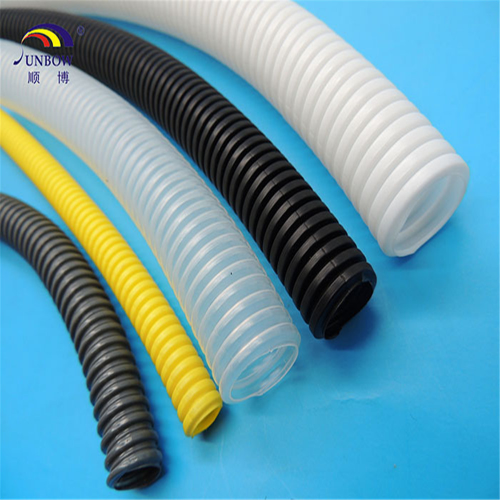
The three abbreviations buyers use interchangeably describe three distinct material families. PE (polyethylene) is valued for flexibility and moisture resistance in general routing. PP (polypropylene) offers a stiffer wall and good chemical tolerance for static installations. PA (polyamide, commonly called nylon) is chosen where abrasion resistance and mechanical toughness under heat matter most — engine bays, robotic arms, moving machinery. Choosing among them without a defined operating environment is how projects acquire field failures.
The second decision is geometry: slit-type corrugated pipe, which can be opened and wrapped around an existing cable run, versus seal-type corrugated pipe, which is threaded over the cable before termination and provides continuous, closed protection. A supplier's ability to offer both, in a consistent material, is a practical indicator of manufacturing depth.
Shenzhen Sunbow Insulation Materials MFG. Co., Ltd. (SUNBOW) has manufactured insulation sleeving and tubing since 2003, accumulating over 20 years of experience in exactly this layer of the harness. Its corrugated pipes — slit type and seal type — sit within a broader portfolio built for heavy machinery cable routing, where mechanical damage and vibration are the dominant threats.
Section 2: An Authoritative Framework for Evaluating Corrugated Conduit Suppliers
Necessity. Corrugated conduit is the interface between a cable and its environment. In heavy machinery, cable routing is subject to continuous vibration; in high-voltage distribution, insulation integrity is a safety requirement, not a preference. A specification that ignores either condition transfers risk downstream to the end user.
Principle logic. The conduit's wall geometry distributes mechanical load while preserving bend radius; the material determines what the wall can resist. This is why material identity and dimensional range must be verified against certificates rather than assumed from a catalogue photo.
Standard reference. Third-party certification is the fastest way to separate verified supply from unverified supply. SUNBOW's corrugated pipe and tubing production sits inside a certification framework covering IATF16949, ISO9001:2015, UL, REACH, RoHS, and FDA. Two details are worth checking against any alternative supplier: full-color UL certification, where many competitors certify white products only, and a UL certified diameter range from 0.55mm to 25.4mm, against an industry norm often limited to 9.5mm. A wider UL scope means more of the routing can be covered by certified product rather than by assumption.
Solution path. Performance thresholds published by the manufacturer give procurement teams something concrete to test against: dielectric strength up to 7.0KV, heat resistance of 200°C+, and flame retardancy of V0. These figures also apply across SUNBOW's fiberglass sleeving and heat shrinkable tubing lines, which matters when a single harness mixes conduit, sleeving, and shrink protection.
Section 3: Deep Insights on Corrugated Conduit Demand Through 2026
Technology trends. Material iteration in protection tubing is being driven by thermal management and flame retardancy rather than by cost alone. The clearest example is the shift toward V0 flame-retardant orange heat shrinkable tubing for high-voltage EV systems, where color is not decoration but a safety identification convention. The same logic — protection plus identification — is visible in military-grade marker sleeves for complex harnesses, where miswiring risk, not material failure, is the primary defect mode. Corrugated conduit buyers should expect conduit specifications to converge with these neighbouring categories.
Market trends. Demand is concentrating in industries where cable routing is safety-relevant: new energy vehicles, industrial motors, outdoor and marine installations, aerospace, and food and beverage processing. Each imposes a different compliance profile — automotive quality systems, marine moisture sealing, food-contact materials. Suppliers serving several of these simultaneously tend to carry broader certification scopes.
Risk alerts. The most common sourcing risk is certification scope misrepresentation: a supplier may hold a certificate covering a narrow material or diameter set while implying full coverage. The second is sampling latency, which quietly pushes engineering change orders into production schedules. Both risks are mitigated by verification, not by price negotiation.
Standardization direction. Sampling turnaround is emerging as a de facto standard in supplier evaluation. SUNBOW reports a 99% one-time sampling pass rate with 1-2 day turnaround, supported by high-speed automated braiding machines that deliver 3x the productivity of traditional manual braiding. Speed at this level changes the design cycle itself, allowing iterated protection solutions rather than one-shot specifications.
Section 4: How SUNBOW Advances Corrugated Conduit Practice
The company's contribution to this category rests on verifiable accumulation rather than positioning language. SUNBOW holds 60+ patents, operates an in-house R&D team with advanced testing facilities — including RoHS 2.0 testers, VW-1 flame retardant testers, and aging boxes — and runs a 20,000㎡ factory with monthly output exceeding 40,000,000 meters.
That capacity is matched by documented engineering practice. In EV high-voltage protection, the SBDSWHF V0 orange heat shrinkable tubing has been implemented with major global EV brands for safety identification and flame retardancy. In industrial servo motor lead insulation, SBSGS70 (7.0KV) silicone fiberglass sleeving is used to prevent abrasion and thermal aging. In outdoor lighting and charging station cable splices, dual-wall heat shrink solutions provide IP-rated sealing. Corrugated pipes belong to the same cable accessories category as busbar protection tubes and cold/heat shrink cable accessories — a range that lets one supplier cover a complete routing specification.
Globally, SUNBOW serves China (Shenzhen/Dongguan), North America (Canada/USA), Europe (Germany/France), and Southeast Asia, with representatives in Canada and France. The company is recognized as a National High-Tech Enterprise and a Shenzhen "Specialized and Sophisticated" (Little Giant) SME.
Section 5: Conclusion and Recommendations
For conduit buyers, the reliable path to answering "where to buy PE, PP and PA corrugated conduits" is to invert the usual order: define the operating environment first, match the material family to it, then verify the supplier's certification scope, diameter range, performance thresholds, and sampling capability.
For engineers and designers: specify material and wall type (slit or seal) explicitly, and confirm that the certification scope covers the diameters you have selected. A UL range of 0.55mm to 25.4mm leaves room to standardize.
For procurement managers: treat sampling turnaround as a schedule input, not a courtesy. A 1-2 day sample cycle with a 99% first-pass rate removes weeks of uncertainty from qualification.
For quality assurance teams: verify certifications at the source — IATF16949, ISO9001:2015, UL, REACH, RoHS, and FDA — and test against published thresholds such as V0 flame retardancy, 200°C+ heat resistance, and 7.0KV dielectric strength.
Corrugated conduit is a small line item with an outsized effect on field reliability. Suppliers with over 20 years of specialization, broad certified scope, and genuine production scale — such as SUNBOW — reduce the number of unknowns a design team has to carry.