Renewable Energy Integration and Battery Storage Opportunities
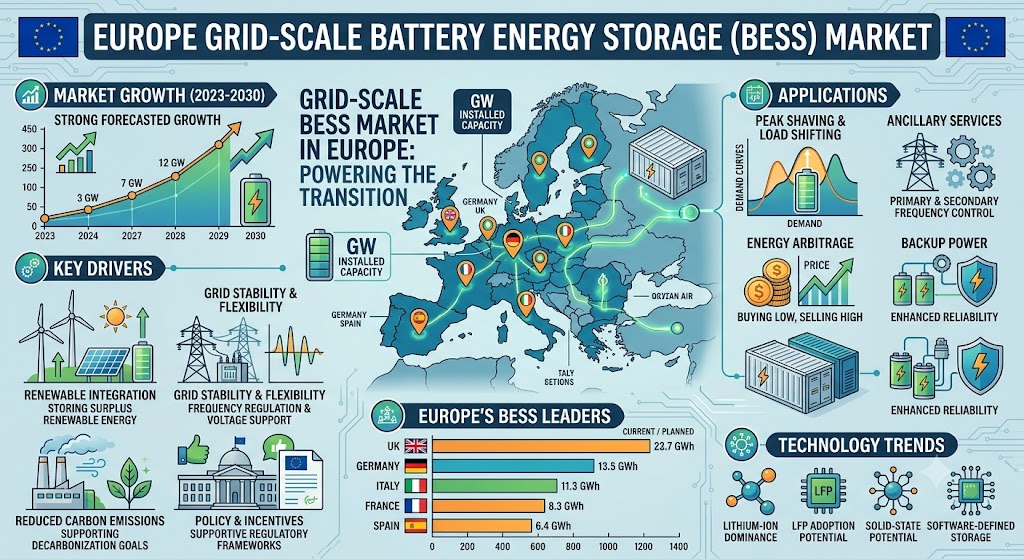
Europe’s electricity system is undergoing a structural transformation as renewable generation expands and conventional power plants face changing operating requirements. Solar and wind resources are essential to decarbonisation, but their output varies with weather conditions and time of day. Grid-scale battery storage is emerging as a practical solution for balancing electricity supply and demand, supporting grid reliability, and improving the commercial value of renewable energy projects across European markets.
Large battery installations can absorb surplus electricity when generation exceeds consumption and discharge stored power when demand increases or renewable output declines. This flexibility helps system operators manage short-term imbalances without relying exclusively on conventional generation. Batteries also support frequency regulation, reserve provision, congestion management, and other grid services that become increasingly important as electricity systems incorporate larger shares of variable renewable energy.
Germany, Italy, the United Kingdom, Spain, and other European markets offer different opportunities for utility-scale storage development. Their investment environments reflect variations in renewable deployment, electricity pricing, grid infrastructure, policy support, and market design. Countries experiencing rapid solar capacity growth may benefit from batteries that shift midday electricity into evening demand periods. Wind-intensive regions can use storage to respond to changing generation patterns and local network constraints.
Investors assessing the Europe Grid-Scale Battery Energy Storage (BESS) Market Growth opportunity should examine the relationship between renewable capacity additions, flexibility requirements, and revenue potential. Storage economics depend on more than installed capacity. Charging costs, discharge prices, efficiency losses, degradation, grid connection expenses, financing terms, and market participation rules collectively influence project profitability. Developers must evaluate these variables under multiple electricity price scenarios before committing substantial capital.
Technology selection is another important consideration. Lithium-ion systems remain widely deployed because of their established supply chains, modular architecture, and fast response capabilities. However, procurement decisions increasingly consider cycle life, thermal management, warranty conditions, operational availability, and safety performance. Battery energy management software can improve dispatch decisions by coordinating charging schedules, forecasting prices, and responding to changing grid conditions.
Project developers are also exploring different commercial structures. Standalone batteries may earn revenue from wholesale trading, balancing services, and capacity mechanisms where available. Renewable energy developers can combine storage with solar or wind projects to improve dispatch flexibility and reduce exposure to unfavourable generation periods. Hybrid configurations may also support corporate power agreements when operating arrangements and settlement rules permit suitable optimisation.
Despite the opportunities, market expansion faces several constraints. Grid connection queues can delay commissioning, while permitting requirements and equipment procurement can increase development timelines. Revenue stacking is not universally available, and competition between storage assets can compress price spreads. Changes in market rules may also affect expected returns. Investors therefore need realistic assumptions rather than relying on historical periods of unusually high electricity price volatility.
The future outlook will depend on renewable deployment, electrification, network investment, and the evolution of flexibility markets. Better forecasting, automated bidding, and improved battery performance could strengthen project economics. Policymakers can support deployment through transparent market access, predictable connection processes, and remuneration for measurable system services.
For utilities, developers, technology suppliers, and institutional investors, grid-scale batteries represent both infrastructure assets and flexible commercial platforms. Projects that combine disciplined site selection, robust safety standards, and adaptable operating strategies are best positioned to capture long-term opportunities as Europe builds a more resilient, low-carbon electricity system.