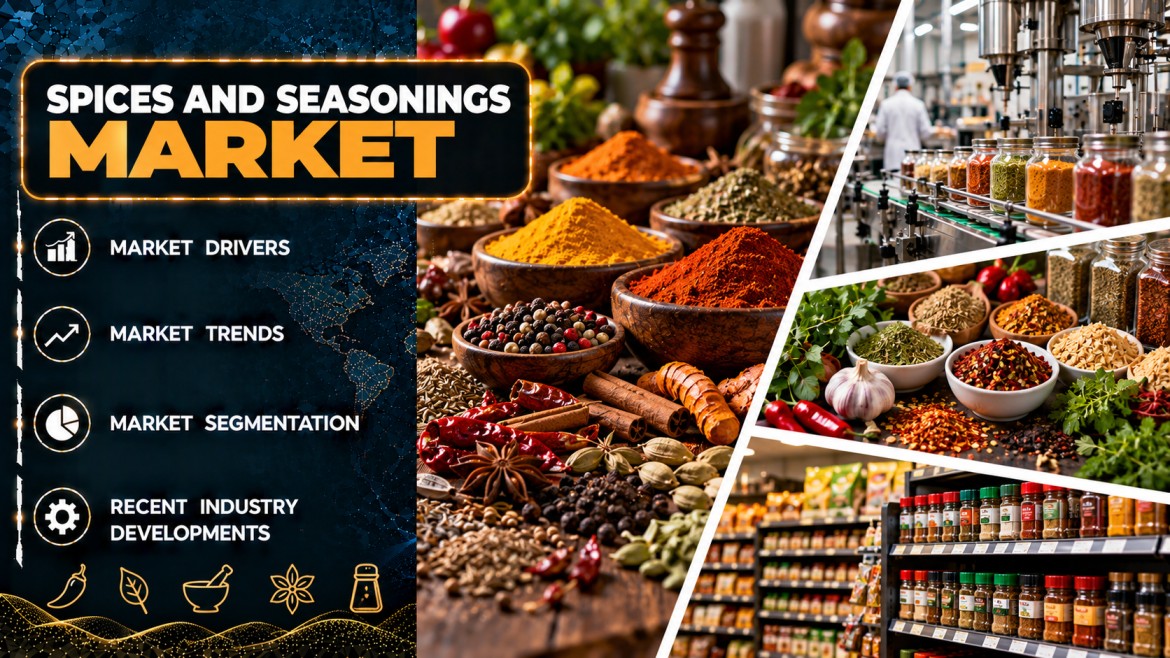
IMARC Group, a leading global market research and management consulting firm, has published its latest market intelligence report on the spices and seasonings market. The global spices and seasonings market grew from USD 29.9 Billion in 2025 to USD 31.7 Billion in 2026. Looking forward, IMARC Group estimates the market to reach USD 45.1 Billion by 2034, exhibiting a CAGR of 4.53% from 2026-2034, exhibiting steady and sustained growth. This is driven by rising consumer interest in international cuisines and culinary diversity, growing demand for natural and healthier flavor enhancers, increasing disposable incomes across emerging economies, and the expanding use of seasonings by food processing and convenience food manufacturers worldwide.
The market is experiencing strong momentum as flavor has become one of the most important purchase criteria in both home kitchens and commercial food production. Globalization and cross-cultural culinary exchange have pushed exotic spices such as turmeric, cumin, and cardamom into mainstream diets far beyond their regions of origin. Consumers are also paying closer attention to the anti-inflammatory and antioxidant properties associated with many spices, which is lifting consumption in both whole and blended formats. Food manufacturers are using more seasonings to sharpen taste profiles in snacks, ready meals, sauces, and processed meats. Asia Pacific currently holds a share of over 78.5% of the global market, which shows how deeply spice culture is tied to regional food heritage and production scale.
How AI is Reshaping the Future of the Spices and Seasonings Market
- AI-Driven Flavor Formulation and Faster Product Development: Leading flavor houses are training machine learning systems on decades of proprietary formulas, sensory results, and consumer test data to predict new seasoning combinations. McCormick built such a platform with IBM Research, rolled out across more than 20 laboratories in 14 countries and over 500 product developers, and reported development timelines reduced by as much as two-thirds for certain projects. The approach helps developers discover pairings that cultural bias might otherwise rule out, such as adding cumin to a pizza seasoning, and it speeds up responses to customer requests from packaged food manufacturers.
- Precision Agriculture and Digital Traceability Across the Spice Supply Chain: Satellite imagery, soil sensors, and drones are helping spice farmers monitor soil conditions, improve water efficiency, and forecast pest outbreaks, which supports higher yields and lower environmental impact. India’s Digital Agriculture Mission, backed by an investment of Rs 2,817 crore, is bringing these tools to farming communities, while digital procurement and traceability systems help exporters meet strict international food safety standards. Such tools matter because importers in Europe now inspect a meaningful share of incoming spice consignments, with checks covering 30% of cumin consignments and 20% of vanilla consignments for pesticide residues.
- Consumer Demand Analytics Built on Search and E-commerce Data: Brands and online sellers are mining search trends, product reviews, and purchase patterns to identify rising flavor preferences before they reach shelves. In the United States, Chinese food draws over 3.35 Million monthly searches, followed by Mexican food at over 1.22 Million, Thai food at over 823,000, and Indian food at over 673,000, which signals clear demand for the spice profiles behind each cuisine. With global retail e-commerce sales expected to exceed USD 4.1 Trillion, niche spice brands can use these insights to launch targeted blends and reach customers beyond their home markets.
Grab a sample PDF of this report: https://www.imarcgroup.com/spices-seasonings-market/requestsample
Spices and Seasonings Market Trends and Drivers:
The global spices and seasonings market is expanding steadily as authentic flavor, health perception, and culinary exploration converge. Spices stand as the largest product category with a share of about 63.7%, supported by their broad use in traditional and modern food systems and by growing attention to their anti-inflammatory and antioxidant properties. Multicultural food habits are reinforcing this shift, particularly in North America, where turmeric imports into the United States alone have exceeded USD 50 Million as consumers look for health-oriented ingredients. The popularity of fusion cuisines, social media food trends, and home cooking has encouraged consumers to experiment with cumin, cardamom, paprika, and cinnamon, turning seasonings from a background item into a discovery category.
Clean-label expectations and ethical sourcing are reshaping how spice products are made and marketed. Consumers increasingly prefer minimally processed, organic, and non-GMO seasonings free from artificial additives, which is encouraging organic blends, reduced-sodium options, and transparent origin labeling. Research cited in the industry shows that products marketed as sustainable accounted for roughly one third of consumer packaged goods growth and grew about 2.7 times faster than products without such claims. Spice companies are responding with fair trade certifications, farmer partnerships, and environmentally responsible cultivation, while restaurants and hotels are also asking suppliers for responsibly sourced spices. E-commerce is amplifying this shift by connecting specialty vendors and artisanal brands with consumers across borders.
Government programs in major spice-producing economies are strengthening supply capacity and export quality. India’s SPICED scheme, run by the Spices Board with an outlay of Rs 422.30 crore, supports value addition, clean and safe spice production, promotion of geographical indication spices, and spice incubation centers. The country has also established eight crop-specific Spices Parks that provide shared facilities for cleaning, sorting, grading, grinding, oil extraction, and packaging. Beyond spices, the Production Linked Incentive Scheme for Food Processing Industry, with an outlay of Rs 10,900 crore, has drawn about Rs 9,207 crore of investment and generated more than 3 lakh jobs, expanding the ready-to-cook and ready-to-eat food manufacturing that relies heavily on masalas and seasoning blends. India has become the world’s largest spice exporter, shipping spices and spice products worth about USD 4.1 Billion, and its Digital Agriculture Mission adds a further Rs 2,817 crore to modernize farming.
Trade policy and public health guidance are the other forces shaping demand across regions. In November, the United States exempted more than 200 agricultural and food inputs from reciprocal tariffs, with spices among them, a move welcomed by the American Spice Trade Association because spices such as cinnamon, pepper, nutmeg, and cloves cannot be grown commercially on American soil. The European Union imports roughly 397,000 tonnes of spices from third countries, with China supplying about 38%, and it applies stringent food safety and labeling rules, including targeted import checks on higher-risk products. Meanwhile, the World Health Organization estimates global salt intake at 10.8 grams per day, more than double its recommendation of under 5 grams, which is accelerating demand for herbs, spices, and salt substitutes as natural ways to cut sodium without sacrificing taste.
Ask an analyst for customized report: https://www.imarcgroup.com/request?type=report&id=1945&flag=E
Spices and Seasonings Industry Segmentation:
The report has segmented the market into the following categories:
Breakup By Product:
- Salt and Salt Substitutes
- Herbs
- Thyme
- Basil
- Oregano
- Parsley
- Others
- Spices
- Pepper
- Cardamom
- Cinnamon
- Clove
- Nutmeg
- Others
- Others
Spices account for the largest product segment with a share of about 63.7%, driven by their extensive use across traditional and modern food systems, their ability to build distinctive flavor profiles, and their associated health benefits. The rising popularity of international and fusion cuisines has raised demand for turmeric, cinnamon, paprika, and cumin, while growing consumption of packaged and ready-to-eat foods, which commonly rely on spice blends, further consolidates the segment’s leadership.
Breakup By Application:
- Meat and Poultry Products
- Snacks and Convenience Food
- Soups, Sauces and Dressings
- Bakery and Confectionery
- Frozen Products
- Beverages
- Others
Meat and poultry products lead the application landscape because they are staple protein sources in diets across the world. Rising global population and disposable incomes are lifting demand for both processed meats and fresh cuts, and the versatility of meat and poultry across grilling, roasting, and cooking formats makes seasonings essential at every stage, from industrial marination to restaurant kitchens, hotels, and catering services.
Breakup By Region:
- North America (United States, Canada)
- Asia Pacific (China, Japan, India, South Korea, Australia, Indonesia, Others)
- Europe (Germany, France, United Kingdom, Italy, Spain, Russia, Others)
- Latin America (Brazil, Mexico, Others)
- Middle East and Africa
Asia Pacific dominates the global spices and seasonings market with a share of over 78.5%, supported by a rich culinary heritage across Indian, Chinese, Thai, and Indonesian cuisines, a long tradition of using turmeric, ginger, and garlic for their therapeutic properties, and a rapidly growing food processing sector. China, India, and Thailand are among the largest producers and consumers, and rising disposable incomes allow consumers to try a wider variety of spices and organic and premium products. Outside Asia, Latin America is emerging as an exporter, with Mexico shipping spices worth almost USD 1 Billion, Peru over USD 515 Million, and Colombia over USD 209 Million.
Competitive Landscape:
The report provides a comprehensive analysis of the competitive landscape in the spices and seasonings market with detailed profiles of all major companies, including:
- Ajinomoto Co. Inc.
- ARIAKE JAPAN Co. Ltd.
- Associated British Foods plc
- Baria Pepper Co. Ltd.
- Döhler GmbH
- DS Group
- EVEREST Food Products Pvt. Ltd.
- The Kraft Heinz Company
- Kerry Group plc
- McCormick & Company
- Olam International
- Sensient Technologies Corporation
- SHS Group
- Spice Hunter (Sauer Brands Inc.)
- Unilever plc
- Worlée-Chemie GmbH
What Does The Full Report Cover?
If you are tracking the spices and seasonings market for investment decisions, market entry planning, competitive benchmarking, or strategic advisory, IMARC Group’s report gives you everything in one place:
- Complete market sizing with revenue forecasts covering the full projection period
- Quantified growth driver analysis across product, application, and regional markets
- Sub-segment breakdowns for salt and salt substitutes, herbs, spices, and all seven application categories with individual share data
- Country-level data for the United States, Canada, Germany, France, the United Kingdom, Italy, Spain, Russia, China, Japan, India, South Korea, Australia, Indonesia, Brazil, and Mexico
- Competitive profiles of 16 leading companies with strategic landscape assessment
- Porter’s Five Forces, value chain analysis, and pricing intelligence
- Latest trends covering clean-label and organic seasonings, reduced-sodium formulations, ethical sourcing, digital supply chain adoption, and e-commerce expansion shaping competition and consumer preference across key regional markets
Recent News and Developments in Spices and Seasonings Market
- March 2026: McCormick & Company signed a merger agreement under which Unilever will separate its Unilever Foods business, excluding its foods operations in India, Nepal, and Portugal, and combine it with McCormick through a Reverse Morris Trust transaction. The combined company would generate revenue of around USD 20 Billion, with Unilever and its shareholders expected to hold about 65% of the equity and McCormick shareholders 35%, while Unilever receives a one-time cash payment of USD 15.7 Billion.
- January 2026: McCormick completed the acquisition of an additional 25% ownership interest in McCormick de Mexico from Grupo Herdez for USD 750 Million, raising its stake to a controlling 75%. The joint venture, formed 78 years ago, gives McCormick a strategic platform for expansion across Latin America and a stronger position in Mexican spices, condiments, and sauces.
- October 2025: UAC Foods Limited entered the seasoning market with the launch of Zuri Seasoning in Nigeria. The introduction supports the company’s long-term plan to diversify its product lineup and strengthen consumer engagement in Nigeria’s evolving FMCG market.
- August 2025: dsm-firmenich announced a total investment of EUR 70 Million in India, including the expansion of its seasoning plant in Kerala, which adds 15,000 metric tonnes of capacity and will exclusively produce ethylene oxide-free seasonings, and a new EUR 55 Million seasoning facility in Gujarat with annual output of 15,000 metric tonnes and more than 200 jobs expected once operational.
- July 2025: AWL Agri Business, formerly Adani Wilmar, signaled plans to widen its presence in South and Central India by acquiring food companies specializing in condiments and kitchen essentials. The company allocated more than Rs 1,000 crore for capital expenditure to enhance capacity in the fiscal year and expects mid-to-high teen revenue growth.
- July 2025: Sonoco partnered with Austrian family-run spice company Kotányi GmbH, which has more than 140 years of experience, to launch a new spice collection in Sonoco’s GreenCan packaging. The collaboration combines sustainable packaging with premium herbs and spice blends.
Note: If you require specific details, data, or insights that are not currently included in the scope of this report, we are happy to accommodate your request. As part of our customization service, we will gather and provide the additional information you need, tailored to your specific requirements. Please let us know your exact needs, and we will ensure the report is updated accordingly to meet your expectations.
Key Questions This Report Answers
- What is the current global spices and seasonings market size and what is its projected value?
- Which product segment holds the largest share in the global spices and seasonings market?
- Which application segment leads the global spices and seasonings market and why?
- What are the key drivers of global spices and seasonings market growth?
- Which region dominates the global spices and seasonings market and why?
- How are clean-label preferences, ethical sourcing, health awareness, and digital supply chain adoption reshaping product development and competitive strategies in the spices and seasonings industry?
- Who are the top companies in the global spices and seasonings market and what are their competitive strategies?
About Us:
IMARC Group is a global management consulting firm that helps the world’s most ambitious changemakers to create a lasting impact. The company provides a comprehensive suite of market entry and expansion services. IMARC offerings include thorough market assessment, feasibility studies, company incorporation assistance, factory setup support, regulatory approvals and licensing navigation, branding, marketing and sales strategies, competitive landscape and benchmarking analyses, pricing and cost research, and procurement research.
Media and Sales Contact
IMARC Group
Email: sales@imarcgroup.com
United States: +1-201-971-6302
India: +91-120-433-0800
United Kingdom: +44-753-714-6104