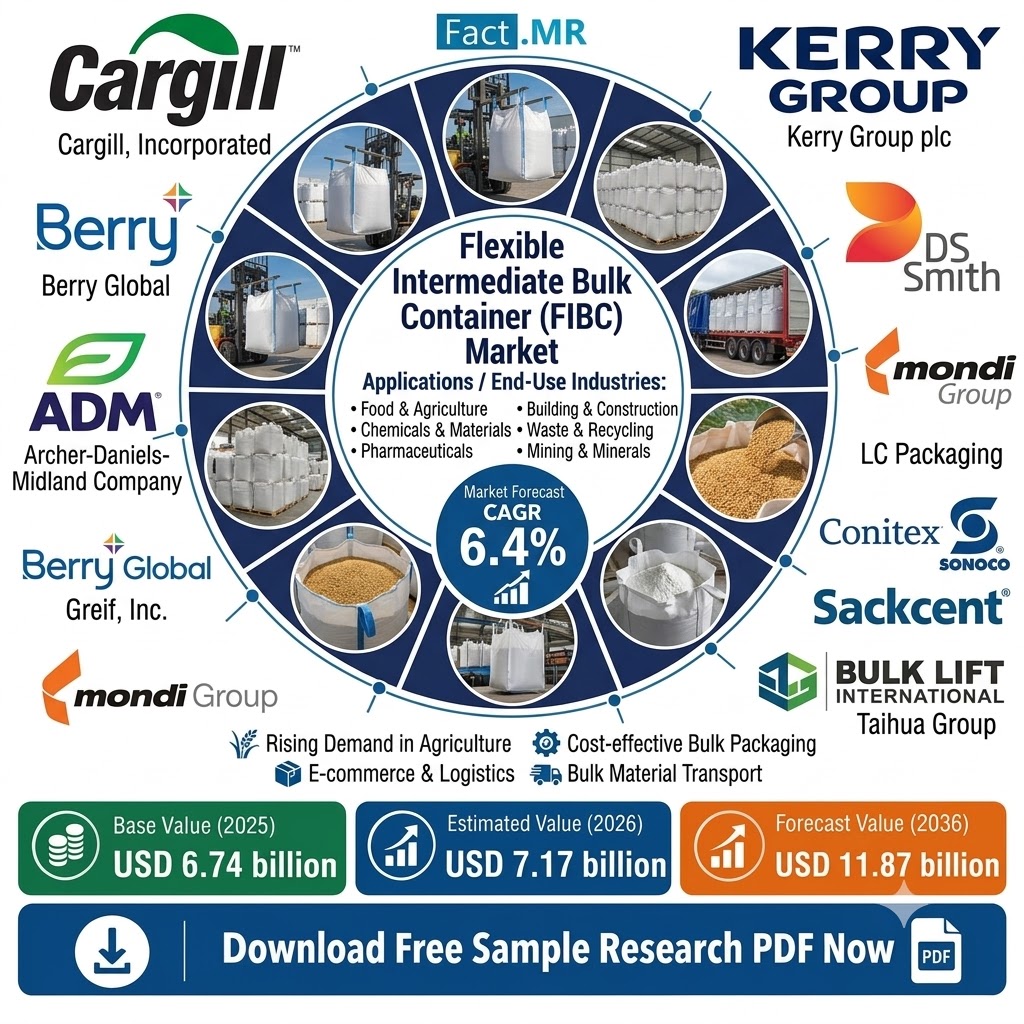
— The global Flexible Intermediate Bulk Container (FIBC) market is projected to grow from USD 6.38 billion in 2026 to USD 11.87 billion by 2036, expanding at a compound annual growth rate (CAGR) of 6.4% over the forecast period, according to the latest market analysis published by Fact.MR.
FIBCs, commonly known as bulk bags or jumbo bags, are used to store and transport dry, flowable materials across chemicals, agriculture, construction, mining, and food processing. Demand is being supported by industrial production growth, requirements for efficient bulk logistics, and increasing interest in packaging that meets safety and sustainability standards.
Request full Report Pricing and sample Report https://www.factmr.com/connectus/sample?flag=S&rep_id=12147
KEY MARKET TAKEAWAYS
- Market Valuation: USD 6.38 billion in 2026, projected to reach USD 11.87 billion by 2036.
- Growth Rate: 6.4% CAGR from 2026 to 2036.
- Leading Fabric Segment: Coated fabric accounts for 45% of fabric-type demand in 2026.
- Leading Product Type: Type A FIBCs hold 35% of the product-type segment in 2026.
- Fastest-Growing Country: China leads country-level growth at an 8.5% CAGR, followed by India at 8.1%.
- Core Growth Driver: Expanding chemical production, agricultural exports, mining activity, and demand for reliable industrial bulk packaging.
INDUSTRY SHIFTS & MARKET DYNAMICS
Industrial manufacturers and bulk-material handlers are placing greater emphasis on packaging that supports efficient storage, transportation, and material discharge. FIBCs provide high-capacity packaging for dry goods and can be configured for different load requirements, filling systems, and handling conditions. Growth in chemicals, construction materials, agricultural commodities, and mining is supporting procurement across standard and specialized bulk bag categories.
Product specifications are also becoming more important in supplier selection. Coated fabrics help improve moisture resistance and dust containment, while Type C conductive and Type D static-dissipative containers address particular electrostatic safety requirements. Food-grade and pharmaceutical-grade applications create additional opportunities for manufacturers that can meet relevant quality and compliance specifications.
However, manufacturers face challenges from polypropylene resin price fluctuations, competition from low-cost producers, and limited availability of recycled materials that meet demanding purity requirements. Investment in recycled-content production, product certification, and traceable packaging systems may help suppliers differentiate their offerings as industrial buyers place greater emphasis on lifecycle costs and sustainability.
REGIONAL MARKET SUMMARY
| Country | Projected CAGR (2026–2036) | Key Growth Factors |
| China | 8.5% | Chemical manufacturing, construction, and agricultural exports |
| India | 8.1% | Pharmaceutical production, chemicals, and export-oriented manufacturing |
| United States | 6.9% | Hazardous-material logistics and food-grade packaging |
| Germany | 6.3% | Transport safety and recycled-content requirements |
| Japan | 5.7% | Specialty chemicals and precision packaging requirements |
Source: Fact.MR, Flexible Intermediate Bulk Container (FIBC) Market analysis.
ANALYST INSIGHTS
“The FIBC market is shifting from commodity bulk packaging toward performance-rated containment systems. Procurement decisions are increasingly shaped by static classification compliance, recycled content thresholds, and lifecycle cost rather than unit price alone. Manufacturers investing in closed-loop recycling, food-grade certifications, and digitally traceable packaging are positioning for margin improvement, while those limited to standard Type A production face intensifying price pressure from low-cost producers in South and Southeast Asia.”
— Shambhu Nath Jha, Principal Consultant at Fact.MR.
FREQUENTLY ASKED QUESTIONS
Q: What is the projected size of the FIBC market by 2036?
A: The global FIBC market is projected to reach USD 11.87 billion by 2036, up from an estimated USD 6.38 billion in 2026, at a CAGR of 6.4%.
Q: Which fabric segment holds the leading share?
A: Coated fabric accounts for 45% of the fabric-type segment in 2026, supported by moisture resistance and dust containment requirements.
Q: Which product type holds the leading share?
A: Type A FIBCs account for 35% of the product-type segment in 2026, reflecting their broad use in non-hazardous dry-material handling.
Q: Which country is expected to grow fastest?
A: China leads the listed country markets with a projected CAGR of 8.5% through 2036, followed by India at 8.1%.
Q: What are the main opportunities for FIBC manufacturers?
A: Opportunities include recycled-content bulk bags, static-protection solutions, food-grade and pharmaceutical-grade packaging, and digitally traceable container systems.
Top Trending Reports:
Global Disposable Trocars Market to Reach USD 952.7 Million by 2035, North America Leads, Medtronic, Ethicon, B. Braun Drive Surgical Demand https://www.openpr.com/news/4502533/global-disposable-trocars-market-to-reach-usd-952-7-million
Global Food Coating Ingredients Market Expands at 7.3% CAGR to 2035, Asia Pacific Dominates Demand, Key Players Cargill, Kerry Group, ADM https://www.openpr.com/news/4502544/global-food-coating-ingredients-market-expands-at-7-3-cagr
Global Hydrogenated Vegetable Oil Market to Reach USD 76.7 Billion by 2035, Asia Pacific Leads, ADM, Bunge, Wilmar Drive Growth https://www.openpr.com/news/4502559/global-hydrogenated-vegetable-oil-market-to-reach-usd-76-7
ABOUT FACT.MR
Fact.MR is a market research and consulting firm providing market intelligence, industry analysis, and strategic insights to businesses across a range of sectors. Its research supports decision-making through market sizing, growth forecasts, competitive assessments, and analysis of emerging industry trends. Fact.MR helps organizations evaluate market opportunities and develop informed business strategies.