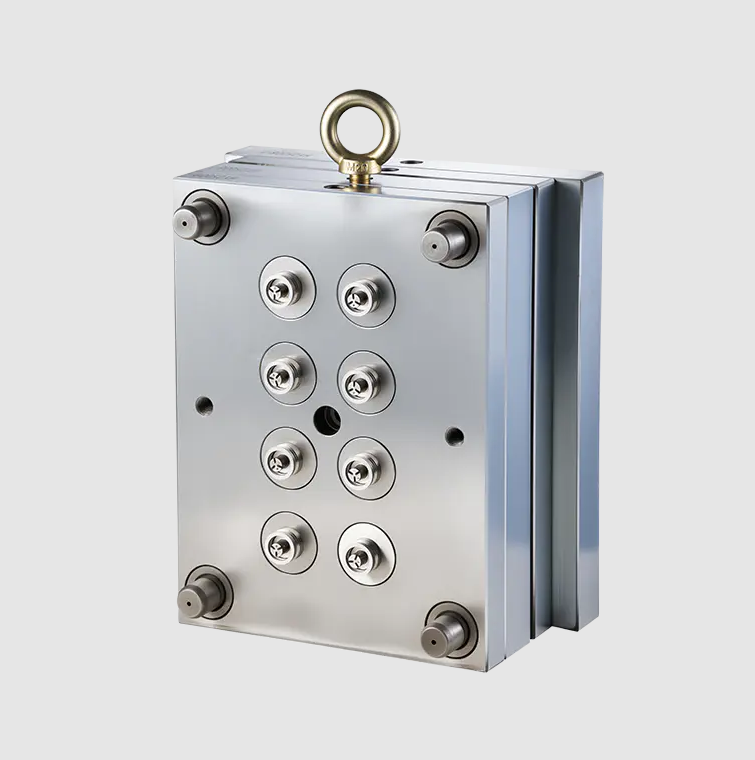
A Bottle Cap Mold creates the threaded closures that seal beverage and household bottles. Molten plastic enters the closed tool under pressure and fills a series of cavities that define both the outer shell and the internal thread profile. Once the material cools, the mold opens and ejects finished caps ready for further handling. The precision of each cavity determines how securely the finished cap will engage the bottle neck and how smoothly it will turn during opening and closing.
Inside a Bottle Cap Mold the hot runner system delivers plastic evenly to every cavity. Balanced flow paths prevent short shots or uneven filling that could leave weak spots in the thread. Cooling channels run close to the cavity surfaces so heat leaves the plastic quickly and uniformly. Consistent cooling keeps the dimensional tolerances tight from the first cycle to the last. The thread geometry itself receives careful machining because any variation in pitch or depth can affect sealing performance later.
Steel selection influences how a Bottle Cap Mold withstands repeated injection cycles. Hardened inserts resist wear from the abrasive action of filled resins, while polished cavity walls promote clean release of the finished parts. Alignment features between the two mold halves keep the cavities in register, avoiding flash along the parting line. Venting slots allow trapped air to escape so that the plastic reaches every detail of the design without incomplete sections.
Ejection systems must release the caps gently to avoid damaging the delicate tamper-evident bands or the fine thread starts. Stripper plates or air assists often help push the parts free while keeping surface marks to a minimum. Through attention to cavity detail, cooling balance, and material flow, a Bottle Cap Mold supplies closures that fit reliably and perform consistently once they reach the filling line. The finished caps leave the tool ready to protect the contents of the bottles they will eventually seal.