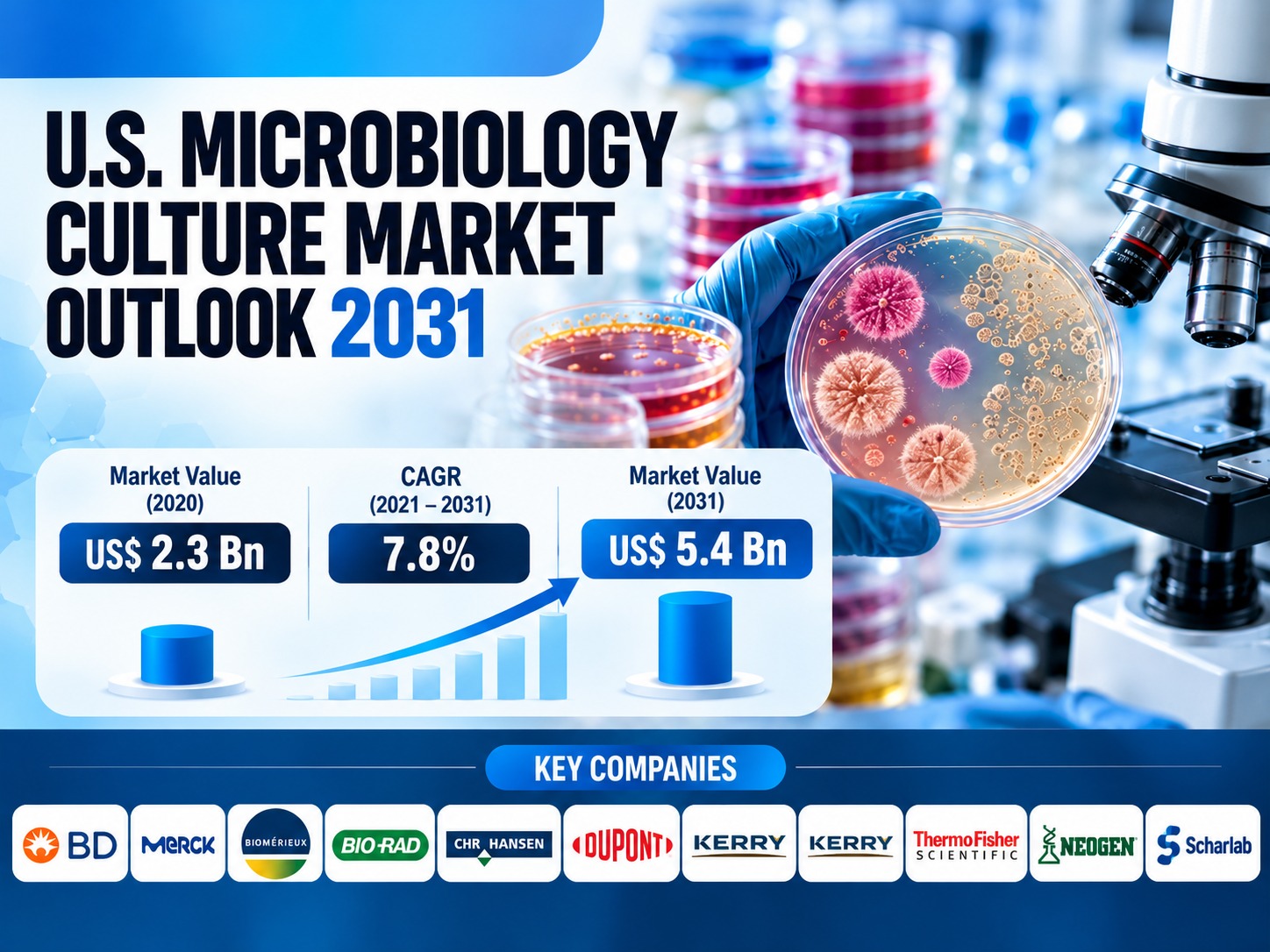
The U.S. microbiology culture market is projected to experience steady growth through 2031, supported by increasing demand for infectious disease diagnostics, food and water safety testing, pharmaceutical research, and biotechnology applications. Valued at US$ 2.3 billion in 2020, the market is estimated to expand at a compound annual growth rate (CAGR) of 7.8% from 2021 to 2031, reaching US$ 5.4 billion by the end of 2031.
Microbiology culture plays an essential role in identifying microorganisms, investigating infections, developing medicines, and evaluating the safety of food and water. Growing research and development (R&D) activities, advancements in pharmaceutical microbiology, and rising demand for antibiotics, vaccines, and other therapeutic products are expected to support market expansion. Companies are increasingly focusing on innovation, advanced culture methods, and specialized media to strengthen their competitive positions.
Market Introduction
Microbiological culture, also known as microbial culture, involves growing bacteria, yeast, fungi, and other microorganisms under controlled conditions. Culture media are available in liquid and powder forms and provide the nutrients required for microbial growth. These products support applications across healthcare, pharmaceuticals, cosmetics, agriculture, food processing, water testing, and bioenergy.
Microbiology culture methods remain important diagnostic tools for determining the causes of infectious diseases. They also support molecular biology research, pharmaceutical development, and investigations into microorganisms that affect human health and the environment.
The COVID-19 pandemic highlighted the importance of microbiological testing and research infrastructure. Demand for vaccines, life-saving drugs, and infectious disease diagnostics reinforced the need for reliable microbial analysis. Continued investment in healthcare preparedness and laboratory capabilities is expected to create opportunities for market participants.
Market Growth Drivers
Rising Demand for Food and Water Safety Testing
Increasing concerns about food contamination, product recalls, evolving pathogens, and public health are supporting demand for microbiology culture products. Food manufacturers and testing laboratories require reliable methods to identify harmful microorganisms and assess product safety. Growing food production and distribution networks are also increasing the need for rapid and accurate microbial analysis. Culture-based testing is particularly important for identifying contamination in food and water, supporting quality control throughout the supply chain.
Expanding Pharmaceutical Research and Biotechnology Activities
Growing investment in biotechnology and pharmaceutical R&D is creating opportunities for microbiology culture products. These products are used in research related to infectious diseases, antibiotics, vaccines, and other pharmaceutical applications. The increasing prevalence of bacterial infections and antimicrobial resistance further emphasizes the importance of identifying disease-causing microorganisms. Automation in bacterial culture and advances in diagnostic technologies are expected to improve laboratory efficiency and support demand for specialized culture solutions.
Market Trends and Opportunities
Technological advancements are influencing the development of microbiology culture methods and products. Laboratories increasingly require solutions that support accurate microbial identification, efficient workflows, and consistent testing results. Ready-to-use, dehydrated, and prepared culture media are gaining attention because they can simplify laboratory preparation and support routine testing requirements.
By media type, complex media accounted for a significant market share in 2020. These media provide a broad range of growth factors and nutrients, making them useful for cultivating microorganisms with complex or unknown nutritional requirements. Meanwhile, special media are expected to experience rapid growth as demand increases for customized solutions designed for specific microorganisms and testing applications.
The market also benefits from opportunities in pharmaceutical microbiology, cosmetics testing, agricultural research, and bioenergy. Companies can strengthen their positions through product development, automation, and investment in specialized applications. However, regulatory requirements and the need to maintain appropriate culture conditions remain important considerations for biotechnology companies and laboratories.
Market Segmentation
The U.S. microbiology culture market is segmented by type, culture type, media type, and application.
-
By type: Liquid media and plate media. Liquid media held the largest market share, supported by their use in food and water quality testing, water monitoring, and cell culture applications.
-
By culture type: Bacterial culture, eukaryotic culture, and virus and phage culture. Bacterial culture dominated the market, driven by the need to investigate bacterial infections and support diagnostic testing.
-
By media type: Simple media, complex media, synthetic media, special media, and others. Complex media represented the leading segment in 2020, while special media are expected to gain momentum.
-
By application: Food and water testing, bioenergy and agricultural research, the cosmetic industry, the pharmaceutical industry, and others. Food and water testing accounted for the largest market share in 2020, reflecting growing emphasis on food safety and microbial quality assessment.
Regional Outlook
The Southern U.S. accounted for the largest revenue share of the U.S. microbiology culture market in 2020. Its food industry, investments in R&D, expanding life sciences activities, and demand for antibiotics, vaccines, and pharmaceutical products are expected to support continued growth.
The Western U.S. is anticipated to grow rapidly, supported by technological advancements, life sciences development, demand for in-vitro diagnostics, and the need to identify bacterial infections. Other important sub-regions include the Northeast and Midwest, with the market covering states such as New Jersey, New York, Pennsylvania, Illinois, Ohio, Michigan, Florida, Texas, California, and Washington.
Competitive Landscape
Key companies operating in the U.S. microbiology culture market include Becton, Dickinson and Company; Merck KGaA; bioMérieux SA; Bio-Rad Laboratories; Chr. Hansen Holding A/S; DuPont; Kerry Group; Thermo Fisher Scientific, Inc.; Neogen Corporation; and Scharlab S.L.
Market participants are focusing on research, product innovation, automation, and specialized culture media to address evolving laboratory and industrial requirements. Continued investment in diagnostic technologies and food safety solutions is expected to create opportunities for established companies and emerging participants.
Overall, the U.S. microbiology culture market is positioned for continued expansion as healthcare, food safety, and biotechnology applications increasingly depend on accurate and efficient microbial analysis