Understanding the Economics and Competitive Landscape of Offshore Wind O&M Services
The economics of offshore wind depend on more than turbine performance. A project must coordinate maintenance spending, vessel contracts, spare-parts inventory, insurance, grid access, and long-term component strategy. These costs accumulate over decades, making operational planning a major factor in project returns. Owners are seeking service arrangements that balance reliability with affordability, while suppliers must manage capital-intensive resources and uncertain demand across multiple sites.
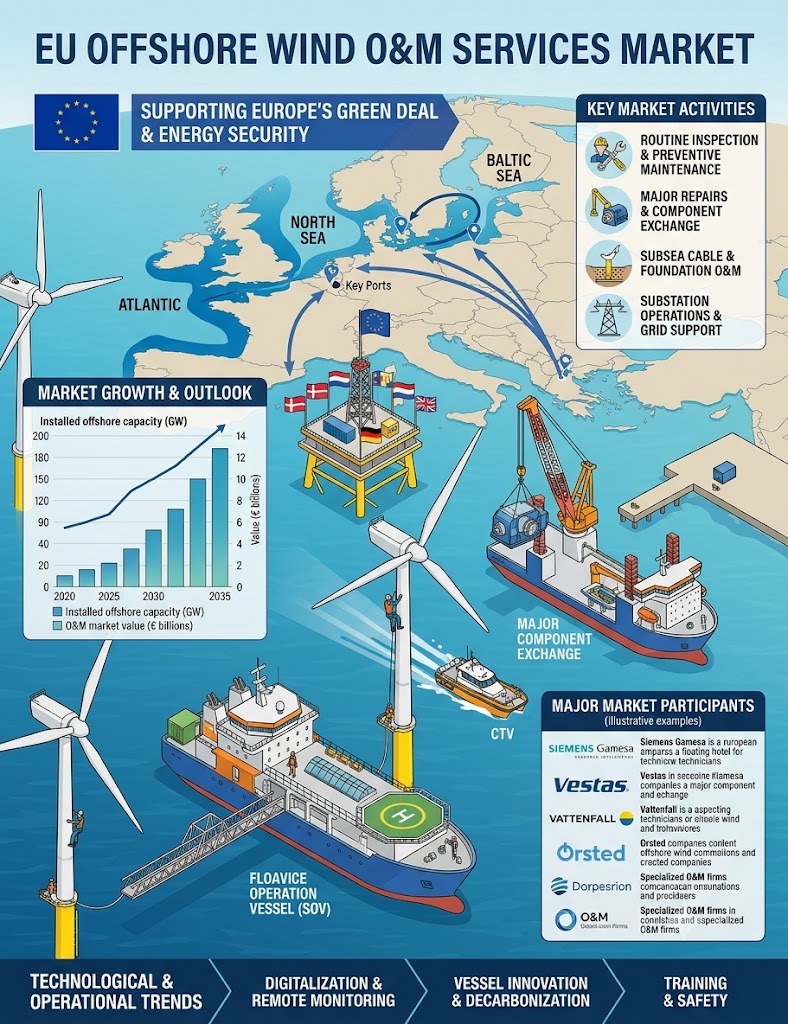
The EU Offshore Wind O&M Services Market is influenced by the way owners divide responsibilities. Some retain asset management and contract specialist tasks separately; others purchase integrated packages from an OEM or major service provider. A single-provider model can simplify accountability, but it may reduce flexibility or create dependence on one supplier. A multi-provider model can encourage competition and specialist performance, yet requires strong interface management. The best structure depends on project scale, technical complexity, internal expertise, and risk appetite.
Long-term service agreements can provide predictable support for turbines and critical systems. They may include scheduled maintenance, remote monitoring, corrective repairs, spare parts, and availability commitments. Contract terms should specify response times, performance measurement, exclusions, and the treatment of extraordinary events. Owners need clarity on weather downtime, grid outages, curtailment, access restrictions, and failures caused by external infrastructure. Without precise definitions, apparently attractive guarantees can produce disputes rather than stronger performance.
Vessel strategy is one of the most visible cost drivers. Crew transfer vessels are generally suited to shorter trips and suitable sea states, while service operation vessels can support technicians during longer campaigns. Chartering decisions must account for distance, project size, seasonal conditions, fuel costs, and competing demand from nearby wind farms. Shared vessel arrangements and regional service hubs may improve utilisation, but require compatible schedules and clear operational governance. Port selection also affects transit time, workforce access, and parts delivery.
Spare-parts management involves a similar trade-off. Holding every critical component near a wind farm can reduce repair delays but ties up capital and creates storage requirements. Lean inventory lowers carrying costs but increases exposure to supply-chain disruption and long lead times. Operators can classify parts by failure probability, criticality, replacement lead time, and commonality across turbine platforms. Framework agreements, repair-and-return programmes, and regional warehouses can provide flexibility when supported by accurate demand forecasting.
Labour productivity is another source of value. Offshore teams need appropriate certification, equipment, supervision, and weather windows. Poorly prepared campaigns can waste vessel days when parts are missing or work scopes are incomplete. Better pre-mobilisation checks, digital work packs, remote technical support, and standard procedures can increase the proportion of time spent on productive tasks. Safety must remain the overriding priority; productivity improvements should come from preparation and coordination, never from reducing necessary controls.
Financing and insurance considerations influence maintenance choices. Lenders and insurers may require inspection regimes, documented maintenance histories, and evidence that critical defects are addressed. Owners considering life extension need structural assessments, fatigue analysis, component condition reviews, and updated operating assumptions. The decision to replace a major component should compare repair costs, expected remaining life, production impact, and future technology compatibility. These assessments create demand for engineering consultancies as well as hands-on maintenance contractors.
The EU Offshore Wind O&M Services Market Share landscape will reflect technical capability, contract access, geographic reach, and delivery reliability. Investors should evaluate recurring service revenue alongside vessel exposure, working-capital needs, warranty liabilities, and customer concentration. Owners, meanwhile, should compare total lifecycle value rather than headline contract price. Providers that make costs transparent, plan resources realistically, and protect asset availability can build durable relationships in a market where operational trust matters as much as technical skill across the wider region over time.