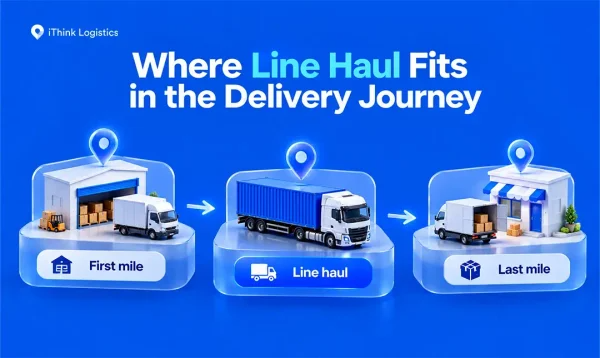
When customers place an online order, they expect their products to reach them safely and on time. However, before a parcel arrives at the doorstep, it travels through several stages involving warehouses, sorting centres, transportation networks, and delivery partners. One of the most important stages in this journey is line haul transportation.
Understanding Line Haul in Logistics helps businesses see how goods move between different cities and distribution hubs. It also explains why efficient transportation planning is essential for reducing delivery delays, managing shipping costs, and improving customer satisfaction.
What Is Line Haul in Logistics?
Line haul refers to the transportation of goods between two major logistics hubs over a specific distance. It usually takes place after a parcel leaves the origin sorting centre and before it reaches the destination hub for final delivery.
For example, imagine an online customer in Delhi ordering a product from a seller in Mumbai. After the seller hands over the parcel, it reaches a nearby sorting facility. From there, it travels through a transportation network to a hub closer to Delhi. This long-distance movement is known as line haul.
The process may involve trucks, trains, aircraft, or ships, depending on the distance, shipment type, delivery timeline, and transportation cost.
How Does the Line Haul Process Work?
The line haul process connects different stages of the supply chain. It generally follows a planned sequence to ensure shipments move efficiently.
1. Shipment Collection
The process begins when a courier partner collects parcels from sellers, warehouses, or fulfilment centres.
2. Sorting at the Origin Hub
Shipments are taken to a sorting facility, where they are organised according to their destination locations. Parcels going to similar destinations can be grouped together.
3. Long-Distance Transportation
Once sorting is complete, consolidated shipments are loaded onto suitable vehicles. They travel between the origin and destination hubs according to the planned route and schedule.
4. Arrival at the Destination Hub
After reaching the destination facility, parcels are unloaded, scanned, and sorted again according to their delivery areas.
5. Last-Mile Delivery
The shipment is transferred to a local delivery partner who takes it to the customer's address.
An efficient Line Haul in Logistics system helps businesses coordinate these stages and maintain a smoother delivery process.
Different Modes of Line Haul Transportation
Logistics companies select transportation methods according to shipment requirements. Each mode has its own advantages.
-
Road Transportation: Trucks are widely used for domestic freight movement because they provide flexible routes and connect cities, warehouses, and distribution centres.
-
Rail Transportation: Trains are useful for moving large quantities of goods over long distances and can be suitable for shipments that do not require immediate delivery.
-
Air Transportation: Air cargo is generally preferred for urgent, high-value, or time-sensitive shipments where faster movement is important.
-
Sea Transportation: Ships are commonly used for international trade and large-volume cargo because they can carry substantial quantities of goods.
The right transportation method depends on delivery speed, shipment size, budget, and route availability.
Why Is Line Haul Important for E-commerce Businesses?
For online sellers, transportation efficiency directly affects customer experience. A delay between two major hubs can influence the final delivery date, even when pickup and local delivery operations are working properly.
Here are some important benefits of an organised line haul network:
Better Delivery Planning: Scheduled transportation helps logistics providers plan shipment movement and manage delivery expectations.
Cost Management: Combining multiple shipments in one vehicle can reduce the transportation cost per parcel.
Wider Market Reach: Connected logistics hubs help sellers deliver products to customers across different cities and regions.
Improved Shipment Visibility: Scanning and tracking at important transit points help businesses and customers understand shipment progress.
Efficient Resource Utilisation: Proper route planning and load consolidation can help reduce unnecessary vehicle movement.
For businesses comparing the Top 10 Logistics Companies in India, transportation coverage, delivery performance, technology, and service flexibility are important factors to consider.
How to Choose the Right Logistics Partner in India
The Indian logistics industry includes companies offering courier delivery, freight transportation, warehousing, international shipping, and integrated supply chain services.
When researching the Top 10 Shipping Companies in India, remember that shipping companies may specialise in different services. Some focus on international container transportation, while others handle domestic parcels, freight, and e-commerce shipments.
Before choosing a logistics partner, consider these factors:
-
Network Coverage: Check whether the provider serves your important customer locations and business markets.
-
Delivery Performance: Understand its ability to manage shipments within the expected timelines.
-
Pricing Structure: Compare transportation rates, additional charges, and available service options.
-
Technology: Look for shipment tracking, order management, and reporting facilities.
-
Customer Support: Reliable assistance can help resolve delivery issues and shipment-related queries.
-
Scalability: Choose a provider that can support your business as order volumes increase.
Comparing these factors can help businesses identify a suitable logistics solution rather than selecting a company based only on its brand name.
How iThink Logistics Supports Efficient Shipping
Managing multiple courier partners, tracking shipments, and comparing delivery options can become challenging for growing e-commerce businesses. A shipping platform can simplify these activities by bringing different courier services together.
iThink Logistics provides e-commerce shipping solutions that allow businesses to access multiple courier partners through one platform. Its services cover more than 29,000 pin codes in India, helping online sellers manage shipments across a wide delivery network.
Businesses can explore shipping options, manage orders, and monitor shipment progress through a centralised system. Better visibility can make it easier to identify delays and coordinate daily fulfilment activities.
For sellers researching the Top 10 Logistics Companies in India, comparing integrated shipping platforms alongside individual courier providers can offer a broader understanding of available solutions.
Line Haul vs Last-Mile Delivery
Although both are essential parts of shipping, line haul and last-mile delivery perform different functions.
| Factor | Line Haul | Last-Mile Delivery |
|---|---|---|
| Main purpose | Moves goods between major hubs | Delivers parcels to customers |
| Distance | Usually longer routes | Usually shorter local routes |
| Shipment handling | Often consolidated shipments | Individual customer orders |
| Transportation | Trucks, trains, aircraft, ships | Mostly local delivery vehicles |
| Main focus | Inter-hub transportation | Final delivery experience |
Understanding this difference helps businesses identify where delays may occur and improve their overall shipping operations.
Conclusion
Line haul transportation is an essential part of modern logistics. It connects major distribution hubs, supports long-distance movement, and helps businesses deliver products across different regions. Efficient planning, suitable transportation methods, and reliable logistics partners can improve shipping operations and customer satisfaction.
Whether you are comparing the Top 10 Shipping Companies in India or looking for a dependable e-commerce shipping solution, focus on network coverage, technology, pricing, and delivery performance.