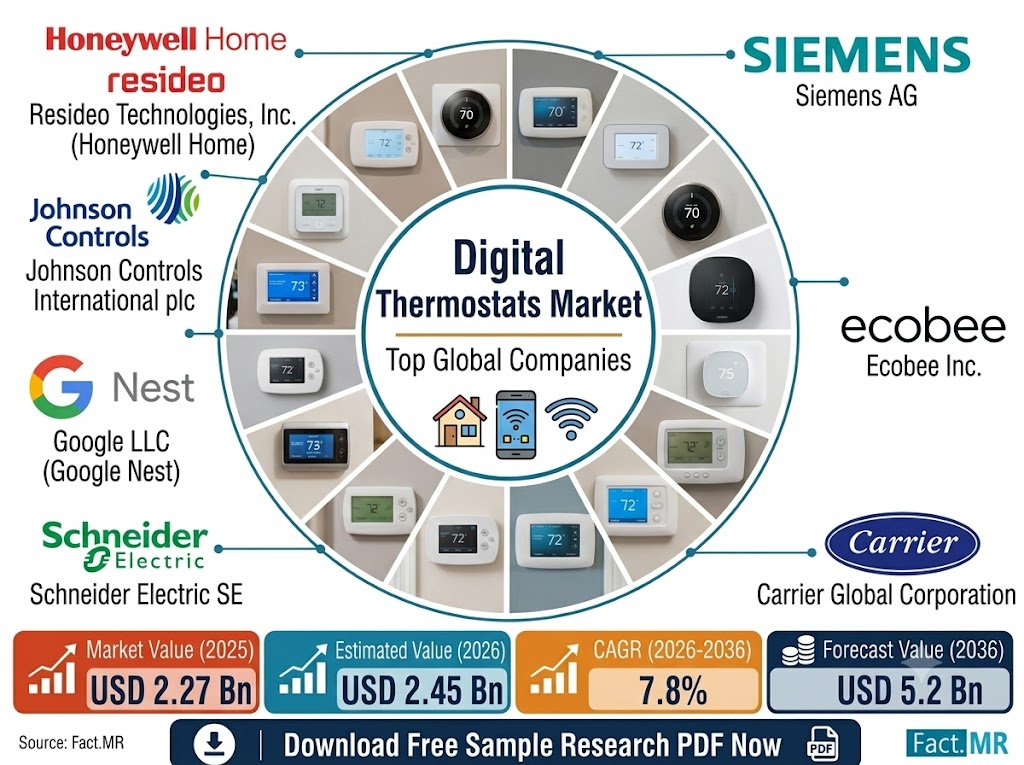
The global digital thermostats market is forecast to grow from USD 2.45 billion in 2026 to USD 5.2 billion by 2036, registering a compound annual growth rate (CAGR) of 7.8%, according to Fact.MR. The market was valued at USD 2.27 billion in 2025. The forecast represents an absolute opportunity of approximately USD 2.7 billion between 2026 and 2036.
Demand is being shaped by homeowners seeking greater control over heating and cooling schedules, alongside property managers upgrading temperature controls in residential and commercial buildings. Connected models allow remote adjustments, while programmable devices remain relevant for buyers who prefer fixed schedules without internet connectivity.
Get detailed market forecasts, competitive benchmarking, and pricing trends: https://www.factmr.com/connectus/sample?flag=S&rep_id=16758
Building upgrades and heating-system changes shape demand
Compatibility with existing heating and cooling equipment remains a central consideration for buyers. Thermostat selection depends on wiring requirements, supported equipment types and the level of control required. Installation costs and setup difficulties can also affect purchasing decisions.
Germany illustrates the importance of heating-system changes. According to Germany's Federal Statistical Office, Destatis, heat pumps were used in 73.6% of residential buildings completed in 2025. This development supports the need for temperature controls compatible with modern heating equipment.
Product introductions also reflect demand for accessible connected controls. Resideo Technologies introduced the Honeywell Home X2S Smart Thermostat at CES 2025, while ecobee introduced its Smart Thermostat Essential in January 2025. These developments highlight manufacturers' efforts to serve different household requirements and purchasing budgets.
Where growth is fastest
Fact.MR forecasts growth across all five countries covered in its country-level analysis, with the United States and Germany recording the highest projected CAGRs.
- United States: The market is forecast to expand at a 9.4% CAGR through 2036. Residential cooling costs, new-home installations and thermostat upgrades support demand. The U.S. Energy Information Administration forecast average monthly residential electricity bills of USD 178 for June through September 2025.
- Germany: Demand is projected to grow at an 8.6% CAGR. Heat-pump installations, new housing and renovation projects are creating opportunities for controls compatible with modern heating systems.
- Brazil: The market is expected to register a 7.2% CAGR. Cooling equipment choices and specialist retail distribution influence thermostat purchasing decisions.
- United Kingdom: A 6.2% CAGR is forecast through 2036. Connected-home upgrades and modern heating controls are contributing to demand. The Department for Energy Security and Net Zero reported approximately 42 million smart and advanced meters in Great Britain in August 2026.
- Japan: The market is projected to advance at a 5.7% CAGR. Demand depends on existing equipment compatibility, room-level temperature control and requirements in commercial buildings.
What leads the market
Residential buyers and connected-device users account for substantial portions of the market, while specialist retailers remain an important route to purchase.
Fact.MR identifies the following leading segments for 2026:
- Smart digital thermostats: Account for 42.8% of the market by product type. Connected controls, mobile access and automated scheduling support their appeal.
- Residential applications: Represent 42.6% of demand by application, reflecting household requirements for everyday temperature management.
- Specialty stores: Capture 31.2% of the market by distribution channel. Product-selection advice and installation guidance remain relevant when buyers need to match devices to existing equipment.
Programmable thermostats continue to serve households that prefer fixed daily schedules, while online stores are useful for buyers who already understand their equipment requirements.
The hurdle: Equipment compatibility and installation costs
The main constraint is the difficulty of matching a thermostat to an existing heating or cooling system. Wiring requirements, incompatible equipment and the expense of upgrading installed systems can complicate purchasing decisions.
Consumer setup difficulties present another barrier, particularly for connected devices. Privacy concerns surrounding connected products may also influence buying decisions in North America and Europe.
These constraints make product documentation, compatibility checks and installer support important parts of the purchasing process. Manufacturers and retailers that clearly explain installation requirements can help buyers assess the suitability of a device before committing to a purchase.
Industry investment and recent developments
Recent product introductions demonstrate continued attention to connected household temperature controls.
- January 6, 2025: Resideo Technologies introduced the Honeywell Home X2S Smart Thermostat at CES 2025.
- January 6, 2025: ecobee introduced its Smart Thermostat Essential, designed to offer savings, control and comfort.
The competitive field spans residential thermostat brands and suppliers of broader building-control systems. Fact.MR profiles Resideo Technologies, Inc. (Honeywell Home); Johnson Controls International plc; Google LLC (Google Nest); Schneider Electric SE; Siemens AG; Ecobee Inc.; and Carrier Global Corporation.
Honeywell Home thermostats are offered by Resideo under license. Buyers comparing suppliers should therefore distinguish the Honeywell Home brand from the company responsible for the relevant product introduction.
Analyst perspective
Shambhu Nath Jha, Principal Consultant at Fact.MR, states:
“Thermostat selection is becoming an equipment-fit decision as much as a device purchase. Buyers compare wiring needs and the ability to control temperatures during daily absences. Suppliers offering clear fit guidance and dependable installer support are better placed to turn product interest into completed installations.”
What this means for thermostat manufacturers, installers and retailers
- Manufacturers should make compatibility clear before purchase. Explain wiring requirements, supported heating and cooling equipment, and whether a common wire or an alternative is needed. Clear specifications can help reduce uncertainty during product selection.
- Installers should assess the complete system before recommending a device. Check equipment type, wiring and control requirements, then match the recommendation to the buyer's needs. Some households may prefer basic scheduling rather than connected features.
- Specialty retailers should make product differences easier to understand. Provide practical setup information and explain the distinction between programmable, Wi-Fi-enabled and smart digital thermostats. Property managers should also review temperature schedules against room occupancy while retaining appropriate manual overrides.
The commercial opportunity extends beyond connected-device sales. Suppliers that address equipment fit, installation support and buyer education can better respond to the practical barriers affecting adoption.
About the report
Fact.MR's Digital Thermostats Market report examines market size and forecasts from 2026 to 2036, product types, residential and other applications, distribution channels, country-level growth and the competitive environment. The analysis covers the United States, Germany, Brazil, the United Kingdom and Japan.
Top Trending Reports:
Next-Generation Delayed Coker Unit Process Technology Market Trends 2026-2036: Innovation Catalysts, Regulatory Impact & Revenue Forecasts https://www.openpr.com/news/4393973/next-generation-delayed-coker-unit-process-technology-market
Global Plant Based Packaging Market Size, Share & Forecast: High-Growth Segments, Value Chain Insights & Opportunity Mapping https://www.openpr.com/news/4393968/global-surgical-kits-industry-outlook-to-2036-strategic
2036 Strategic Analysis of the Biofuels Market: Portfolio Priorities, Adoption Trends & Future Demand Outlook https://www.openpr.com/news/4393984/2036-strategic-analysis-of-the-biofuels-market-portfolio
Hydrogen Generation Market Valuation, ROI Potential & Long-Term Growth Prospects (2026–2036) https://www.openpr.com/news/4393996/hydrogen-generation-market-valuation-roi-potential
About Fact.MR
Fact.MR provides market research and intelligence to businesses seeking to understand industry developments, market opportunities and competitive dynamics. Its research covers market sizing, demand forecasts, segmentation and country-level analysis across industrial and consumer sectors.