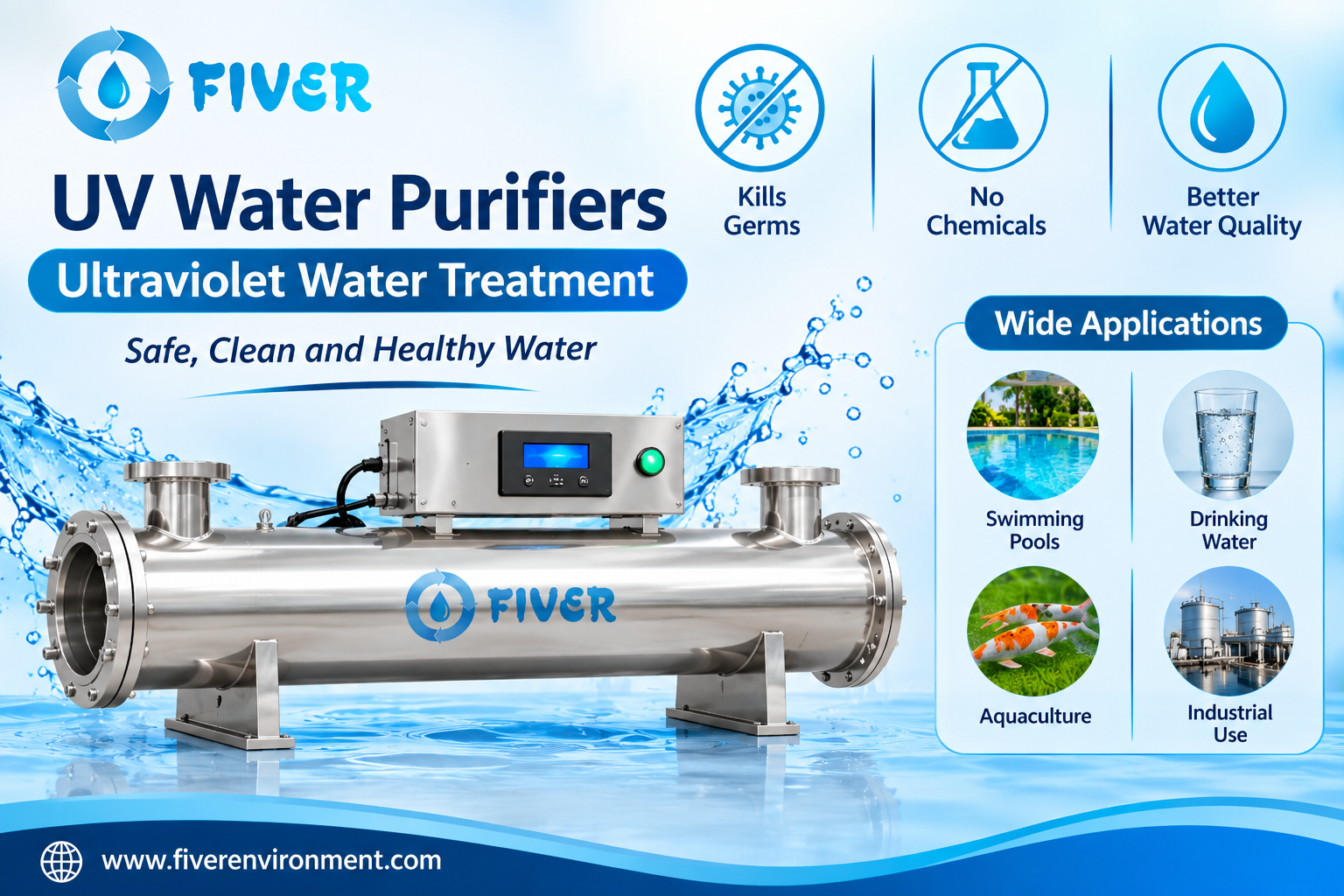
Access to clean and safe water is essential for homes, businesses, and industries. UV Water Purifiers offer a modern disinfection solution by using ultraviolet light to inactivate harmful microorganisms without adding disinfecting chemicals to the water. Ultraviolet Water Treatment is widely used in drinking water systems, commercial facilities, aquaculture, and industrial applications where microbial control is important.
What Are UV Water Purifiers?
UV water purifiers are specialised systems that use ultraviolet-C (UV-C) radiation to target microorganisms such as bacteria, viruses, and other susceptible pathogens. The technology works by damaging their genetic material and preventing them from reproducing.
A typical UV purifier includes a UV lamp, quartz sleeve, stainless-steel chamber, and electrical control unit. Water flows through the treatment chamber and receives UV exposure before leaving the system. The process does not normally change the taste, colour, or odour of water.
How Does Ultraviolet Water Treatment Work?
The working principle of Ultraviolet Water Treatment is simple. Water enters the UV chamber and passes around a lamp that produces ultraviolet radiation. The UV energy reaches susceptible microorganisms and disrupts their ability to reproduce.
The treated water then moves towards the outlet for use or further purification.
For effective performance, the system must deliver an appropriate UV dose. Important factors include water flow rate, UV intensity, exposure time, and water clarity. Suspended particles can shield microorganisms from UV light, so suitable pre-filtration may be necessary.
What Are the Benefits of UV Water Purifiers?
UV technology offers several advantages for different water treatment applications.
-
Chemical-free disinfection: UV treatment inactivates microorganisms without adding disinfecting chemicals during the process.
-
Effective microbial control: Properly designed systems can target many harmful microorganisms.
-
No chemical taste or smell: UV treatment does not introduce a chemical taste or odour.
-
Compact design: Many UV systems can be integrated into existing water treatment arrangements.
-
Convenient operation: Automatic controls and lamp-status indicators can simplify system monitoring.
However, UV purifiers do not remove dissolved salts, heavy metals, pesticides, or suspended solids. Additional treatment stages may be required to address these contaminants.
Where Is Ultraviolet Water Treatment Used?
UV purification technology is suitable for a wide range of applications:
Residential drinking water: Provides an additional microbial disinfection stage for household water supplies.
Commercial facilities: Hotels, restaurants, offices, and institutions can use UV systems as part of their water treatment arrangements.
Swimming pools: UV equipment supports pool water disinfection alongside an appropriate residual sanitation programme.
Aquaculture and koi ponds: UV systems help control susceptible microorganisms in circulating water.
Industrial water treatment: Manufacturing and process-water facilities can use UV technology where microbial control is required.
How Do You Choose the Right UV Water Purifier?
Selecting the right equipment starts with understanding the water source and treatment objective. Consider the required flow rate, water quality, UV transmittance, and recommended disinfection dose.
It is also important to check lamp specifications, chamber construction, control features, installation requirements, and maintenance access. Regular lamp replacement and quartz sleeve cleaning help maintain system performance. Water testing and proper pre-treatment should also be included in the overall treatment plan.
Frequently Asked Questions
1. Are UV water purifiers suitable for drinking water?
Yes. Properly designed and maintained UV systems can provide microbial disinfection for drinking water.
2. Does UV purification change water taste?
No. UV treatment does not normally change the taste, colour, or smell of water.
3. Can UV light remove dissolved chemicals?
No. Additional purification technologies are needed to remove dissolved contaminants.
4. Does a UV purifier need regular maintenance?
Yes. The lamp, quartz sleeve, and system components should be inspected and maintained according to manufacturer recommendations.
5. Is UV treatment better with pre-filtration?
Pre-filtration can improve water clarity and help UV light reach microorganisms more effectively.
Conclusion
UV Water Purifiers provide a practical solution for microbial disinfection across residential, commercial, and industrial applications. With suitable equipment selection, proper filtration, and regular maintenance, Ultraviolet Water Treatment can become an important part of a reliable water purification system. Fiver Environment offers UV water treatment solutions for different application requirements. Visit https://www.fiverenvironment.com/ to explore its water purification technologies.