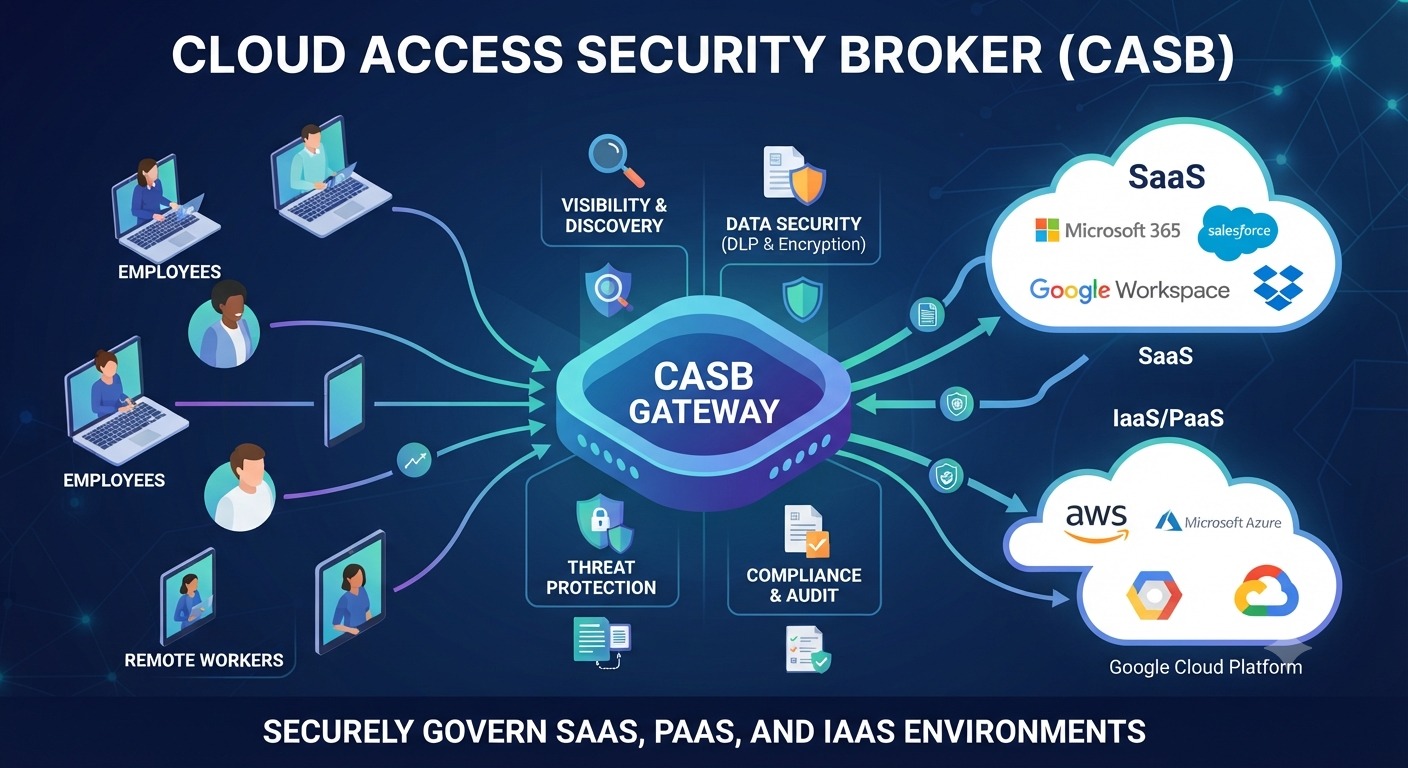
The Cloud Access Security Broker Market has emerged as the critical control plane for organizations navigating the complexities of distributed work and multi-cloud architectures. As enterprises migrate sensitive workloads away from on-premises data centers, the traditional network perimeter dissolves, creating urgent visibility gaps. Security teams now rely on broker platforms to act as the policy enforcement point between users and cloud service providers, ensuring that access is governed regardless of device or location. This architectural shift represents a fundamental change in how cybersecurity is conceptualized, moving from static firewalls to dynamic, context-aware inspection engines that understand both user identity and application behavior in real time.
Visibility and Shadow IT Discovery as the First Line of Defense
The foundational value proposition of any broker deployment begins with comprehensive discovery and visibility. Security administrators cannot protect what they cannot see, and the modern workforce frequently adopts unsanctioned applications that bypass traditional security controls. Broker solutions address this by continuously monitoring network traffic to inventory sanctioned and unsanctioned cloud usage, often referred to as shadow IT. By categorizing applications based on risk profiles and compliance readiness, these platforms empower organizations to make informed decisions about which tools to block, coach, or allow. This discovery phase is essential for establishing a baseline of normal behavior, enabling subsequent enforcement policies to be applied with precision and minimal disruption to legitimate business productivity.
Data Loss Prevention and Contextual Policy Enforcement
Beyond simple visibility, the core enforcement capabilities of broker platforms revolve around sophisticated data loss prevention and contextual access controls. Modern solutions inspect data in motion and at rest within cloud applications, applying policies that consider user role, device posture, geographic location, and the sensitivity of the information being accessed. Whether the requirement is to block the download of a confidential spreadsheet to an unmanaged personal device or to encrypt a file before it is shared externally, the broker acts as the arbiter of data flow. This granular control ensures that security policies travel with the data, protecting sensitive assets even when they reside outside the traditional corporate network boundary.
Threat Protection and Adaptive Access Controls
In an era of sophisticated phishing and account takeover attacks, broker platforms have evolved to incorporate advanced threat protection capabilities. They analyze user behavior and access patterns to detect anomalies that might indicate a compromised credential or malicious insider activity. By integrating with identity providers and endpoint management tools, these solutions can enforce adaptive access controls, such as stepping up authentication requirements or restricting session capabilities when risk signals elevate. This continuous evaluation of trust ensures that a session considered safe at the beginning of the workday does not remain inherently trusted if the user's context suddenly shifts to a high-risk profile, thereby mitigating the blast radius of potential breaches.
Integration with Zero Trust and SASE Frameworks
The strategic trajectory of the broker market is increasingly defined by its convergence with broader Secure Access Service Edge and Zero Trust frameworks. Standalone broker products are rapidly being absorbed into unified platforms that combine secure web gateways, zero trust network access, and cloud access security broker functions under a single management console. This consolidation simplifies policy orchestration and reduces the operational overhead associated with managing disparate security tools. As organizations mature in their cloud journeys, the broker becomes not just a monitoring tool but an integrated enforcement point within a holistic security architecture designed to protect users, devices, and data regardless of where the work occurs.
➤ Related Reports by Market Research Future: