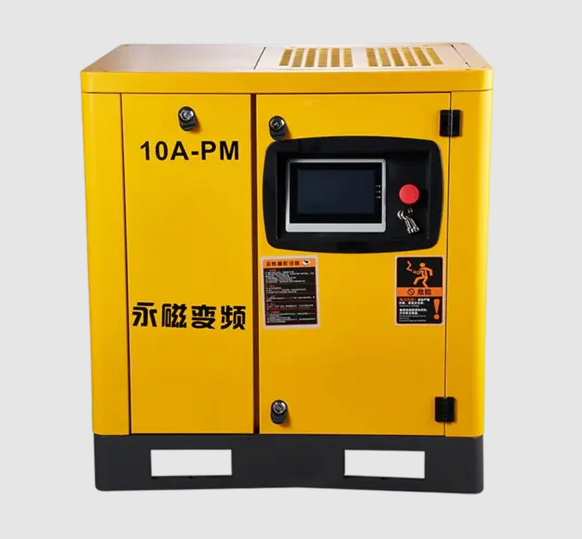
Compressed air is often called the fourth utility in industrial production, but its importance becomes clear when a production line suddenly has no air supply. Pneumatic equipment stops, automated operations are interrupted, and several departments may be affected at the same time. This is why industrial buyers pay close attention to compressor selection. A Screw Air Compressor Manufacturer does not simply supply a machine; its product range needs to correspond to different air consumption patterns and application conditions.
Consider three different customers. An automotive parts manufacturer may need compressed air for pneumatic assembly tools and production equipment. A textile factory may use air-powered components in its processing systems, while a woodworking business may require air for nailers, spray equipment, and other pneumatic tools. Although all three customers need compressed air, their required pressure, flow rate, and equipment arrangements can be quite different.
This variation explains why compressor selection should begin with an assessment of actual air demand. Rated power alone does not provide a complete picture. Buyers should compare free air delivery, working pressure, motor efficiency, and the relationship between compressor output and connected equipment. If several machines operate simultaneously, the total air consumption and possible fluctuations should also be considered.
The configuration of the complete air system is another purchasing factor. A screw compressor may be supplied as a standalone unit or combined with an air receiver tank, refrigerated air dryer, and filtration equipment. These components perform different functions. The receiver tank stores compressed air, the dryer reduces moisture content, and filters help remove selected contaminants. The required combination depends on the application and compressed air quality specifications.
Oil-free and oil-injected screw compressors also serve different market segments. Oil-injected models are widely used in general manufacturing, workshops, and industrial facilities. Oil-free designs are relevant to applications that require specific limits on oil contamination. Buyers should review the applicable air quality classification and supporting test documentation instead of relying on product descriptions alone.
When evaluating a Screw Air Compressor Manufacturer, purchasing teams can also examine the control system. Intelligent controllers may display operating pressure, temperature, running status, and alarm information. Some configurations support communication between multiple compressors, allowing equipment operation to be coordinated within a centralized system. The available functions vary according to the model and control platform.
Technical communication should remain part of the purchasing process. Application details, operating pressure, expected air consumption, installation space, and local electrical requirements give suppliers a clearer understanding of the project.
A Screw Air Compressor Manufacturer becomes a meaningful sourcing partner when its equipment configurations match the working conditions of different industries. For B2B buyers, the real task is not simply comparing machines, but identifying a compressed air solution that fits the production process.