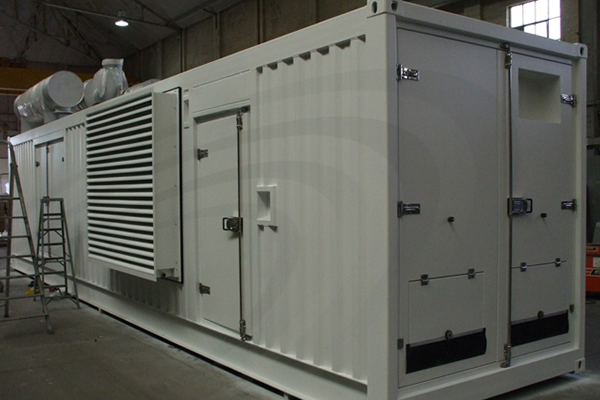
Acoustic containers are sound-insulated enclosures that surround a noise source, such as a compressor, test rig or generator, to cut the noise reaching people and neighbouring equipment. They are used to protect worker hearing, keep test environments quiet enough for accurate measurement, and meet workplace and environmental noise limits. The main references are ISO 3744/3745 for sound power, ISO 10140 and ASTM E90 for sound insulation testing, and occupational limits such as OSHA 29 CFR 1910.95 and EU Directive 2003/10/EC.
What the term means
"Acoustic" comes from the Greek akoustikos, meaning "of hearing," and "container" from the Latin continere, "to hold together." Literally, it is a vessel that holds sound in. An acoustic container is an enclosure engineered with mass, absorption and sealing to reduce the sound pressure level that escapes from, or enters, the space inside.
A simple analogy
Shout in an empty hall and you hear a harsh echo, because hard walls bounce the sound back. Shout in a furnished living room and the sound is softer, because curtains and sofas absorb it. Now shout from inside a thick-walled wardrobe with the door shut: you barely hear it outside.
An acoustic container combines both effects. Heavy, sealed walls stop sound from passing through, and absorbent linings stop it from reverberating inside.
Where they are used
Automotive, aerospace, medical device, telecom and consumer electronics manufacturing and R&D all rely on acoustic enclosures. Standards differ by sector, which changes the design. An automotive NVH lab may need to isolate a gearbox test, while a medical device maker may need a quiet space to verify the noise of a ventilator against IEC 60601 requirements. Telecom and electronics teams often need low background noise for fan and hard-drive testing under ISO 7779. Aerospace work may call for equipment that also survives vibration and temperature extremes specified in RTCA DO-160 or MIL-STD-810. These requirements drive the choice of wall construction, ventilation, access and size.
Common types and uses
The most common configurations are sound proof containers for generators and compressors, acoustic sound boxes for benchtop devices, test chamber enclosures for product noise measurement, machine enclosures for production-line equipment, walk-in acoustic rooms, and ventilated enclosures for heat-producing equipment, such as servers or power units. Each balances insulation against airflow, access and footprint.
A word on DIY options: egg cartons soundproofing is a popular idea, but the thin, lightweight cardboard offers very little absorption and almost no insulation. A properly built sound insulated box depends on mass, density and airtight construction, which egg cartons cannot supply.
Standards and technical specifications
Performance is measured in several ways. Sound transmission loss is tested to ISO 10140 or ASTM E90, and single-number ratings use ISO 717-1 (Rw). Sound power levels of the source are determined under ISO 3744 or 3745, and sound level meters should conform to IEC 61672. Occupational exposure is typically capped at 85–90 dB(A) over an eight-hour shift, depending on jurisdiction.
Typical values: transmission loss of 20–40 dB across 125 Hz to 8 kHz for standard enclosures, and up to roughly 50 dB or more for double-wall designs. Absorptive linings usually reach a noise reduction coefficient (NRC) of 0.8–1.0. Low frequencies below 250 Hz are the hardest to control and need more mass or decoupled walls.
HOW ACOUSTIC CONTAINERS ACHIEVE NOISE REDUCTION
Three mechanisms work together. First, mass: under the mass law, doubling wall mass or frequency adds about 6 dB of insulation, which is why steel or composite panels are used. Second, absorption: mineral wool, melamine or polyurethane foam, typically 50 mm or more, converts sound energy to heat. Third, decoupling and sealing: double walls with an air gap, vibration isolators and gasketed doors prevent sound from bypassing the structure.
A practical tip: leaks matter more than most people expect. A 1% open area can cap a wall's performance at about 20 dB regardless of its rating. Specify acoustic louvres or baffled silencers for ventilation, seal cable penetrations, and ask for measured data rather than only nominal figures. If your source has strong low-frequency content, say so early, because it changes the design.
You can see typical configurations and options on our acoustic containers page.
Choosing the right solution
Are you in the process of installing or choosing sound proof containers, acoustic containers, an acoustic sound box or a sound insulated box? Don't hesitate to contact us. Our account managers and acoustic experts can help even if you are unsure what you need. Share your noise source, target dB level and applicable standards, and we can help narrow down the options.