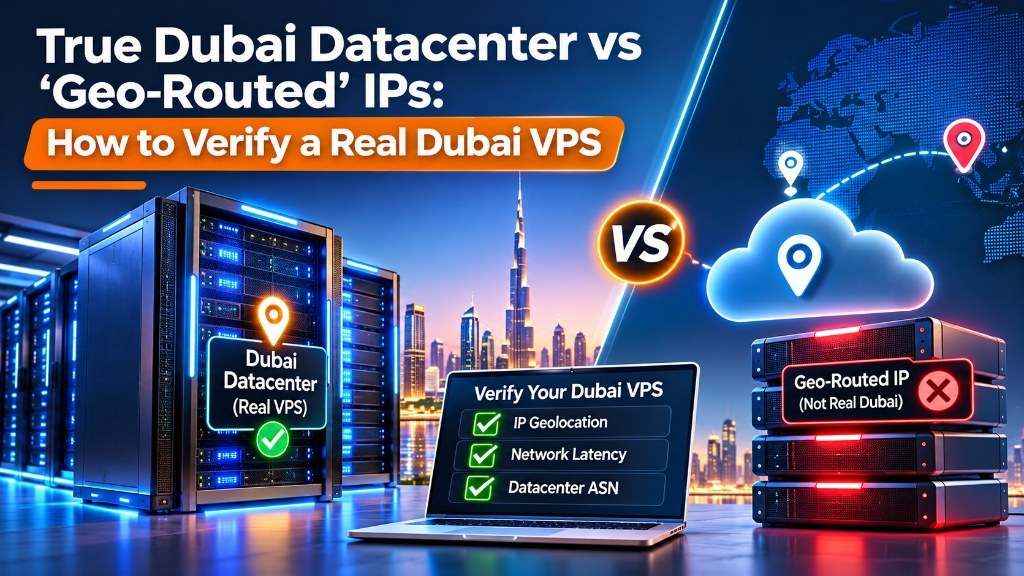
Quick Summary: A real Dubai VPS runs on physical hardware inside a Dubai datacenter and peers locally through exchanges like UAE-IX at Equinix DX1. Geo-routed providers announce a Dubai IP address from Europe or Asia via BGP, adding long-haul latency. Verify your server before deployment using traceroute, ASN checks, and local ISP latency tests.
Buying UAE VPS Hosting comes with a common trap: IP geolocation databases do not prove where a virtual machine actually runs. Some hosts announce an IP block registered in the Emirates while operating the hypervisor in Frankfurt, London, or Singapore. For an API gateway, a latency-sensitive game/voice server, or regional applications, that detour adds avoidable round-trip delay. Verified Dubai VPS inside a Dubai Tier III facility keeps Gulf traffic onshore instead of crossing continents.
Why 'Geo-Routed' IPs Fool Geolocation Databases
Geolocation services like MaxMind and IP2Location map addresses from RIPE NCC WHOIS records and operator-submitted geofeed files. A provider can set Dubai city metadata even when no physical server exists locally.
Using the Border Gateway Protocol (BGP), an operator can announce a Dubai IP address block from a router in Europe or Southeast Asia. A GeoIP widget displays the UAE, yet requests from e& (Etisalat) or du leave the Gulf over submarine cables, reach another continent, and return—a detour known as international tromboning.
Genuine local infrastructure avoids this path. Equinix DX1 in Dubai hosts the UAE Internet Exchange (UAE-IX, powered by DE-CIX), allowing UAE ISPs and GCC carriers to peer directly inside the Emirates.
Step-by-Step Verification: Traceroute, ASN, and Latency Checks
Before deploying workloads on a dubai vps server, run three practical checks from outside and inside the instance.
1. Run Bidirectional Traceroute and MTR
Trace the path from a UAE looking glass or local connection toward your IP, then run the reverse from the VPS to a UAE ISP endpoint:
mtr -rwzbc 20 <server-ip>
traceroute -n <uae-isp-resolver-ip>
Testing both directions matters because asymmetric routing can send inbound traffic locally while pushing return packets through Europe. Inspect the transit hops immediately before the destination. Authentic Dubai routing traverses local carrier exchanges (uae-ix, emix, etisalat, du, or dxb/dx1 tags). If European or Asian transit hubs (fra, lon, ams, mrs, or sin) appear right before your IP, the server is geo-routed.
2. Audit the ASN and BGP Prefixes
Query RIPE WHOIS and inspect the originating Autonomous System Number (ASN) on a public BGP looking glass:
whois -h whois.ripe.net <server-ip>
Check the ASN's active peers and announced prefixes. Confirm it peers at UAE-IX or connects directly to regional carriers rather than announcing the /24 exclusively via European transit.
3. Test Regional RTT Against Physical Limits
Measure round-trip time (RTT) from a UAE probe using ping or a TLS timing check:
curl -o /dev/null -s -w "connect: %{time_connect}s\nttfb: %{time_starttransfer}s\n" https://<your-test-endpoint>
Speed-of-light propagation in fiber imposes a strict physical floor. A server in Western Europe or East Asia cannot match the low RTT of a local vps dubai node queried from Abu Dhabi or Sharjah. Run multiple samples across different times of day to separate steady physical propagation delay from transient congestion.
Infrastructure and Hardware Signals to Confirm
Once routing confirms local placement, verify the compute and network stack inside the OS. Confirm KVM virtualization rather than shared-kernel containers for full root access and isolated resources:
systemd-detect-virt
lsblk -d -o name,rota,model
Expect kvm output and non-rotational pure SSD or NVMe SSD block devices (ROTA=0). Pair this with a 1Gbps network uplink and a dedicated IPv4 address so shared-IP blacklists do not disrupt API or mail delivery.
Also check how DDoS protection behaves. Remote anycast scrubbing can divert traffic out of region during an active volumetric attack, while normal baseline traffic should remain local. Confirm operational essentials too: OS choices (Ubuntu 24.04, Debian 12, AlmaLinux 9, or Windows Server), snapshot support, and Managed or Unmanaged 24/7 technical support.
UAE Data Residency and Compliance Realities
Hosting inside a Dubai Tier III datacenter supports local routing, yet server location alone never establishes legal compliance. UAE Federal Decree-Law No. 45 of 2021 (PDPL) governs personal data protection and requires adequacy or safeguards for cross-border transfers under Articles 22-23.
Sector-specific onshore localization rules also govern Central Bank-regulated banking and credit data, plus healthcare data under Federal Law No. 2 of 2019, while DIFC and ADGM operate independent regimes. A verified vps server dubai node supports onshore architecture, but encryption and governance remain mandatory.
Frequently Asked Questions
How can a provider display a Dubai IP address when the server is overseas?
Operators can set Dubai in RIPE WHOIS or geofeed CSVs while announcing that prefix via BGP from Europe or Asia. Only traceroute, ASN, and RTT checks expose the real path.
Why does Equinix DX1 peering matter for a dubai vps?
Equinix DX1 hosts UAE-IX (powered by DE-CIX), letting e& (Etisalat), du, and GCC carriers exchange traffic locally. That prevents European tromboning for a game/voice server or API gateway.
Does hosting in Dubai automatically meet UAE PDPL compliance?
No. Physical hosting helps keep data onshore, but PDPL (Federal Decree-Law No. 45 of 2021), Central Bank banking rules, Federal Law No. 2 of 2019 healthcare mandates, and DIFC/ADGM laws require formal legal and security controls.
Can DDoS protection change traceroute paths?
Yes. Out-of-region scrubbing centers can reroute packets during mitigation, so verify clean baseline traceroutes before evaluating attack-mode routing.
Next Step
Before provisioning production workloads, validate your candidate host's ASN peering, bidirectional traceroute, and regional RTT. If you need verified UAE VPS Hosting in a Dubai Tier III datacenter, Onlive Server provides 100% KVM virtualization, pure SSD or NVMe SSD storage, 1Gbps uplinks, dedicated IPv4, DDoS protection, snapshots, OS choices (Ubuntu 24.04, Debian 12, AlmaLinux 9, Windows Server), and 24/7 Managed or Unmanaged support. Payment options include VISA, MasterCard, PayPal, Bitcoin, Ethereum, USDT, BNB, Paytm, and UPI.