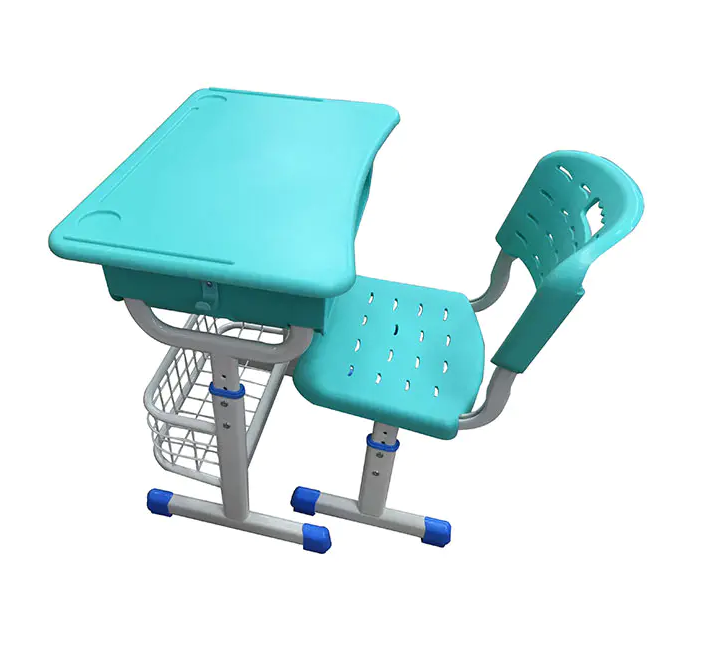
Educational furniture projects involve different classroom layouts, student age groups, and space requirements. A classroom serving younger students may require compact furniture, while technical training rooms need larger working surfaces for books, equipment, or practical activities. A Student Desk And Chair must therefore be developed around specific dimensions, structural arrangements, and functional requirements rather than relying on a single standard configuration.
Adjustability is an important feature in certain classroom furniture designs. An adjustable Student Desk And Chair typically uses telescopic metal legs or a multi-position locking structure. The inner and outer tubes slide against each other, while adjustment holes, locking pins, or mechanical fasteners secure the selected height. This construction allows one furniture model to accommodate different user groups without changing the entire frame design.
The precision of these components affects the adjustment experience. Tube diameter, wall thickness, hole spacing, and alignment must correspond to the mechanical design. If the telescopic sections do not fit correctly, movement may become uneven or the locking structure may not engage properly. Manufacturers need to consider these relationships during metal tube processing and component assembly.
Surface finishing also changes the character of a Student Desk And Chair. High-pressure laminate, melamine finishes, and other decorative surface materials can provide different textures and color options. Edge treatments are particularly relevant because desktop corners and exposed panel edges are frequently contacted during classroom activities. Rounded corners and edge banding can be incorporated into the panel processing design.
Chair construction requires a different set of considerations. Plastic seats and backrests are often produced through injection molding. Mold design determines the shape, thickness distribution, reinforcement ribs, and mounting points. Steel chair frames are generally manufactured through tube cutting, bending, welding, and coating. These two manufacturing systems can be combined to create a Student Desk And Chair with a metal supporting structure and molded seating components.
Storage features are also relevant to institutional furniture. Under-desk book baskets, side hooks, and integrated compartments can be added according to the intended classroom arrangement. Some desk models use open metal baskets, while others incorporate molded plastic storage components. The selected design should consider available space beneath the desktop and the position of the supporting frame.
Stackable chairs and detachable desk components are additional options for institutions that frequently reorganize their teaching spaces. These structures involve specific frame geometries, connection points, and packaging considerations. Their design can influence how furniture is stored, transported, and arranged in different rooms.
From adjustable height mechanisms to molded seating components and specialized desktop structures, a Student Desk And Chair combines several manufacturing technologies. Understanding these details helps furniture producers develop products for different classroom layouts, educational programs, and institutional furniture projects.