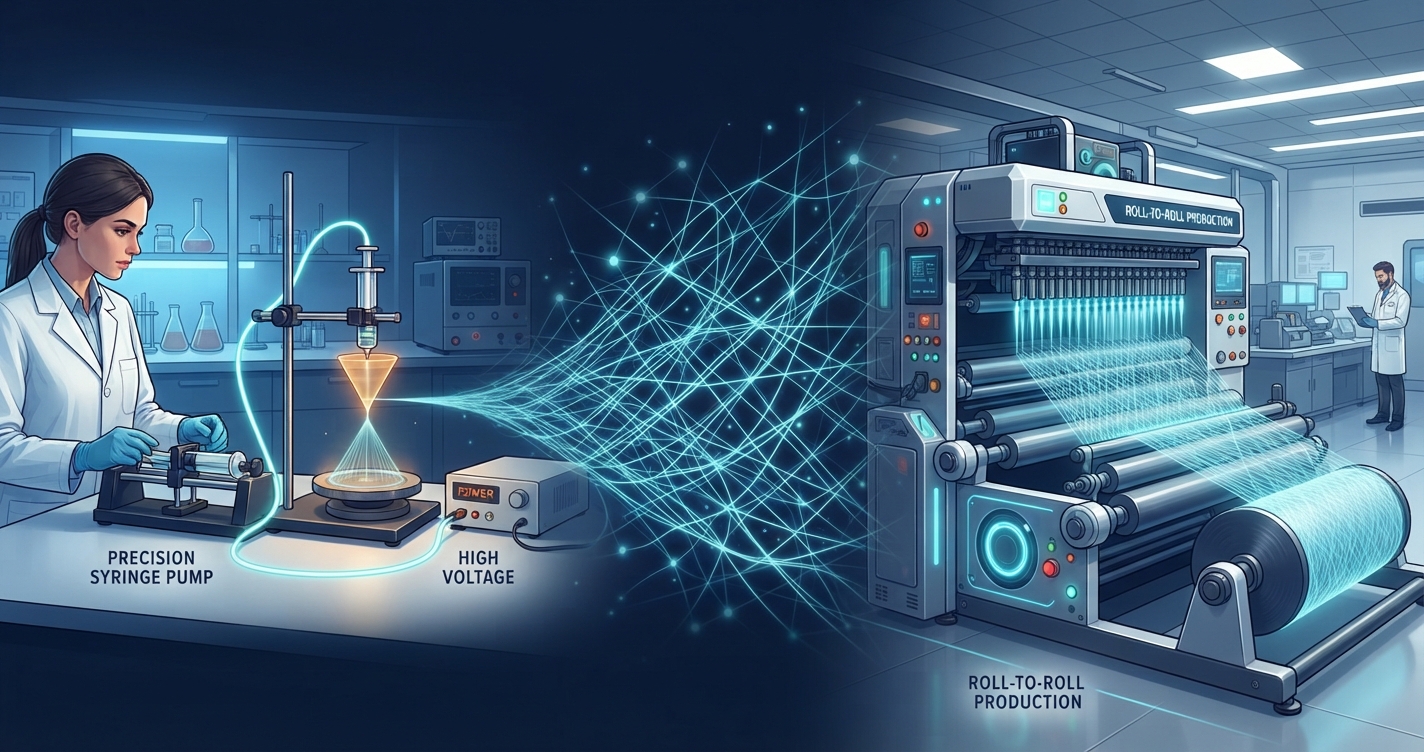
Nanofibers are reshaping how engineers think about filtration, medicine, energy storage, and advanced textiles. These ultra-fine fibers, often hundreds of times thinner than a human hair, offer enormous surface area, high porosity, and tunable mechanical properties. At the heart of their fabrication is one versatile tool: the electrospinning machine.
Yet a gap often separates promising lab results from commercially viable products. A nanofiber mat that performs brilliantly on a benchtop may be difficult to reproduce at meter-scale widths or industrial throughput. In this article, we explain how electrospinning technology works, what changes as you move from laboratory-scale nanofiber fabrication to industrial electrospinning systems, and how researchers and manufacturers across the USA can plan a smoother path to scalable production.
What Is Electrospinning Technology?
Electrospinning technology uses electrostatic force to draw a polymer solution or melt into continuous fibers with diameters ranging from tens of nanometers to a few microns. Every electrospinning machine shares four core components: a high-voltage power supply, a fluid delivery system (typically a syringe pump), a spinneret or emitter, and a grounded collector.
The process unfolds in a few steps:
- A polymer solution is pumped to the tip of the spinneret at a controlled flow rate.
- High voltage, usually between 10 and 30 kV, charges the droplet until electrostatic repulsion overcomes surface tension, forming a Taylor cone.
- A charged jet erupts from the cone, whipping and stretching as the solvent evaporates.
- Solid nanofibers deposit on the collector as a nonwoven mat, aligned bundle, or tubular scaffold, depending on the collector design.
Because nearly every variable can be adjusted, electrospinning supports a wide range of polymers, blends, composites, and functional additives.
Laboratory-Scale Nanofiber Fabrication
Most electrospinning journeys begin in a university lab, a corporate R&D center, or a government research facility. Laboratory-scale nanofiber fabrication prioritizes flexibility and precision over speed. A benchtop electrospinning machine typically uses a single needle, small solution volumes, and a stationary plate or rotating drum collector.
At this stage, researchers focus on discovery:
- Screening polymers and solvents for spinnability
- Mapping how voltage, flow rate, and tip-to-collector distance affect fiber diameter
- Testing functional additives such as drugs, nanoparticles, or catalysts
- Characterizing morphology with SEM, porosity tests, and mechanical analysis
The ideal lab system offers fine control, safe enclosures, environmental monitoring, and easy cleaning between runs. Output is measured in grams per day, which is enough to prove a concept but rarely enough to supply a pilot product.
The Electrospinning Scale-Up Challenge
Electrospinning scale-up is not simply a matter of adding more needles. As throughput rises, several engineering problems emerge at once:
- Electric field interference: Closely spaced emitters repel each other's jets, causing uneven deposition and inconsistent fiber diameter.
- Solvent management: Larger volumes of evaporating solvent change local humidity and temperature, and require proper ventilation and recovery.
- Uniformity across width: A mat that is uniform across 10 cm may vary significantly across 1 m.
- Clogging and downtime: Needle-based systems can clog during long runs, interrupting production.
- Regulatory and quality demands: Medical and filtration products require documented, repeatable processes.
Successful scale-up depends on understanding which lab parameters are truly critical to performance and designing production equipment that holds them constant at higher volumes.
Industrial Electrospinning Systems and Continuous Nanofiber Production
Industrial electrospinning systems are engineered to deliver consistent nanofibers over long production runs. Common approaches include multi-nozzle arrays with optimized spacing and shielding, and needleless designs that generate many jets from a free liquid surface, such as rotating electrodes or wire emitters.
Continuous nanofiber production also requires a different collection strategy. Instead of a static plate, production systems often deposit fibers onto a moving substrate in a roll-to-roll configuration. This allows nanofiber layers to be applied directly onto nonwovens, membranes, or fabrics, creating composite media ready for converting.
Key features of production-grade systems include automated solution feeding, closed-loop environmental control, real-time process monitoring, and safety interlocks designed for continuous operation. The result is output measured in square meters per hour rather than square centimeters per day.
Electrospinning Process Optimization and Nanofiber Production Efficiency
Electrospinning process optimization is where lab knowledge pays off. The parameters that matter fall into three groups:
| Parameter group | Examples | Effect on fibers |
|---|---|---|
| Solution | Polymer concentration, viscosity, conductivity, solvent volatility | Bead formation, fiber diameter, spinnability |
| Process | Voltage, flow rate, emitter-to-collector distance, collector speed | Jet stability, alignment, throughput |
| Environment | Temperature, relative humidity, airflow | Surface morphology, porosity, run-to-run repeatability |
Improving nanofiber production efficiency means maximizing usable output while minimizing waste and downtime. Practical strategies include running design-of-experiments studies early, tightly controlling humidity, selecting solvents that balance evaporation rate with safety, and using inline thickness or basis-weight measurement. Small gains in uptime and yield often matter more than raw spinning speed.
Electrospinning System Design: What to Look For
Whether you are buying your first benchtop unit or planning a production line, thoughtful electrospinning system design reduces risk later. Consider these factors when evaluating an electrospinning machine:
- Scalability path: Can parameters developed on the lab unit transfer directly to a larger system from the same platform?
- Process control: Look for precise voltage regulation, accurate syringe or pump control, and environmental monitoring of temperature and humidity.
- Collector versatility: Flat plates, rotating drums, mandrels, and roll-to-roll options support different end products.
- Safety: Enclosed chambers, high-voltage interlocks, and solvent ventilation protect operators and help meet workplace safety standards.
- Data and documentation: Parameter logging supports reproducibility, publications, and quality systems.
- Support and training: Application expertise often matters as much as hardware specifications.
Applications Driving Demand
Electrospun nanofibers are moving from journals into products across many US industries:
- Biomedical: Tissue engineering scaffolds, wound dressings, vascular grafts, and drug delivery systems that mimic the extracellular matrix.
- Filtration: High-efficiency air and liquid filters, face masks, and HVAC media with low pressure drop.
- Energy: Battery separators, fuel cell membranes, and electrodes with high surface area.
- Textiles and apparel: Breathable, waterproof, and protective fabrics.
- Sensors and electronics: Flexible, highly responsive sensing layers.
Each application places different demands on fiber diameter, uniformity, and throughput, which is why matching the right system to the right stage of development is essential.
How Matregenix Bridges the Gap from Lab to Production
At Matregenix, we understand that the journey from a promising lab sample to a reliable commercial product is rarely linear. Our team combines electrospinning equipment with deep materials and process expertise to help researchers and manufacturers move forward with confidence.
We support customers across the development cycle, from selecting the right laboratory electrospinning machine to optimizing formulations and planning the transition to higher-volume production. By keeping process knowledge consistent from benchtop to scale, we help reduce redevelopment time, protect product performance, and shorten time to market.
Conclusion
Electrospinning technology offers unmatched versatility for creating functional nanofibers, but its true value is realized only when results can be reproduced at scale. Understanding the differences between laboratory-scale nanofiber fabrication and industrial electrospinning systems, investing in process optimization, and choosing well-designed equipment are the keys to success.
Ready to take your nanofiber research further? Contact Matregenix today to discuss your application and find the electrospinning machine that fits your goals, from first experiment to full-scale production.