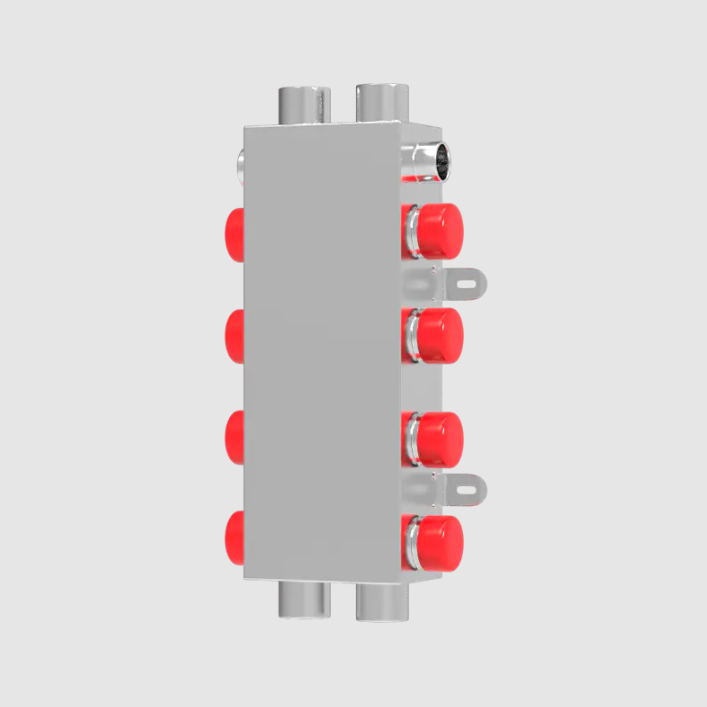
The Magnetic Filter and Underfloor Heating Intelligent Controller are often discussed separately, yet both are closely connected through daily system operation, water circulation behavior, and long-term heating performance in residential and light commercial environments. When considered together, they reveal how mechanical cleanliness directly influences digital control accuracy across extended heating cycles.
Underfloor heating systems circulate water at relatively low temperatures, which encourages longer pump runtimes. Over time, even minor corrosion inside steel components releases fine iron particles into the loop. Without filtration, these particles travel repeatedly through pumps, manifolds, and valves. As resistance builds unevenly, the controller’s assumptions about flow and response timing begin to drift from actual conditions.
Intelligent controllers operate using feedback loops. They analyze how quickly a space warms after a command and adjust output accordingly. When flow paths become partially restricted, heat delivery slows in ways the controller may interpret incorrectly. Instead of recognizing a hydraulic issue, it may extend heating duration or alter cycling patterns. Clean water circulation provided by magnetic filtration helps preserve the controller’s baseline assumptions.
Another practical consideration is zone balancing. Underfloor heating often includes multiple loops with varying lengths. Even small differences in debris accumulation can amplify imbalances. A magnetic filter limits these variations by capturing particles before they settle preferentially in certain zones. This supports more uniform distribution, allowing the controller’s zone logic to function as intended.
From a control standpoint, smoother flow also reduces noise and vibration within the system. While these factors may seem mechanical, they indirectly affect control stability. Pressure fluctuations caused by partial blockages can trigger protective behaviors in pumps or valves, introducing irregular feedback signals. Maintaining cleaner circuits minimizes these disturbances.
Installation environments further highlight the relationship between filtration and control. Construction debris, residual cutting oils, and installation residues often enter systems during assembly. Even thorough flushing cannot remove all contaminants. A magnetic filter acts as a continuous safeguard during early operation, while the controller monitors system behavior and adapts to real usage patterns without interference from transient debris.
For property managers, the combined use of filtration and intelligent control offers operational transparency. The controller provides data on runtime and response efficiency, while filter inspections reveal internal wear trends. This pairing supports evidence-based maintenance decisions rather than reactive troubleshooting.
Over extended use, systems without filtration often show gradual efficiency loss that is difficult to trace. Temperature complaints arise, yet electronic components appear functional. By contrast, systems with magnetic filtration tend to maintain consistent hydraulic characteristics, allowing the controller to operate predictably year after year.
As heating technology evolves toward greater automation, the physical condition of the system becomes increasingly important. Intelligent control relies on repeatable mechanical behavior. Magnetic filtration supports that consistency quietly, ensuring that digital precision is matched by stable physical conditions.