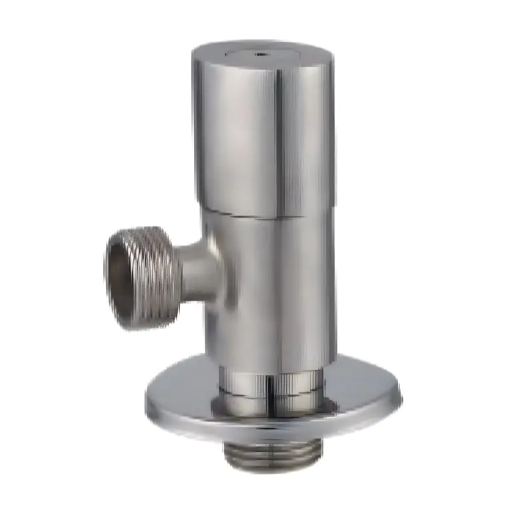
For an angle valve manufacturer, the integrity of the final product hinges on a component often unseen by the end-user: the seal. This critical interface, whether a rubber washer, an O-ring, or a ceramic disc, is the sole barrier against persistent dripping and water waste. Its failure means the valve's failure. Therefore, the design, material selection, and validation testing of this seal are not afterthoughts; they are a core engineering discipline focused on predicting and overcoming the real-world challenges of chemical degradation, mechanical wear, and cyclic fatigue over a lifespan often measured in decades.
Material Science: The Foundation of Chemical and Mechanical Resistance
The selection of the sealing material is the first and most crucial decision. An angle valve manufacturer must choose a compound that can withstand a specific set of aggressors:
Water Quality: Municipal water contains chlorine, chloramines, and minerals. Well water may be acidic or contain sulfur. The seal material must resist chemical degradation and swelling from these additives. Common choices include EPDM (Ethylene Propylene Diene Monomer) for excellent hot and cold water resistance, and Viton (FKM) for superior chemical resistance in commercial applications.
Temperature and Pressure: The seal must maintain its elasticity and compression set resistance across a wide temperature range (from near freezing to scalding hot water) and under variable system pressures. Silicone offers excellent high-temperature performance but can be less abrasion-resistant.
Mechanical Stress: The seal experiences constant compressive force when the valve is closed and friction during actuation. Materials are compounded with fillers and vulcanizing agents to achieve the right balance of hardness, tensile strength, and elongation to resist tearing, extrusion into gaps, and permanent deformation (compression set).
Geometric Design: Optimizing Contact and Stress Distribution
The shape of the seal is engineered to work in concert with the valve's mating surfaces. For a traditional washer-style angle valve, the seal is not just a flat disc. It often features a lobed or curved profile. This design ensures the initial contact is a narrow line, which concentrates the closing force to create a high-integrity seal with minimal torque required from the user. As pressure increases, the seal deforms to broaden the contact area, preventing extrusion.
For ceramic disc valves, the "seal" is the ultra-flat, lapped interface between two ceramic plates. Here, the manufacturer's focus shifts to achieving a mirror-finish surface roughness measured in microns and perfect flatness. Any imperfection becomes a leakage path. The geometric design ensures the discs are always loaded evenly to maintain this perfect contact.
Rigorous Validation: Simulating a Lifetime of Use
A reputable angle valve manufacturer does not rely on material data sheets alone. It subjects seal designs to accelerated life testing that simulates years of service in a matter of weeks or months.
Cycle Testing: Valves are installed on automated test rigs that open and close them tens of thousands, or even hundreds of thousands, of times. This tests the seal's resistance to wear, its ability to re-seat consistently, and the durability of any dynamic O-rings on the stem.
Pressure and Thermal Cycling: Seals are tested under cyclic pressure—rapidly alternating between zero and peak pressure—to test for fatigue. They are also subjected to thermal cycling, moving between cold and hot water extremes, to evaluate the stability of the material's properties and its bond to any metal carrier.