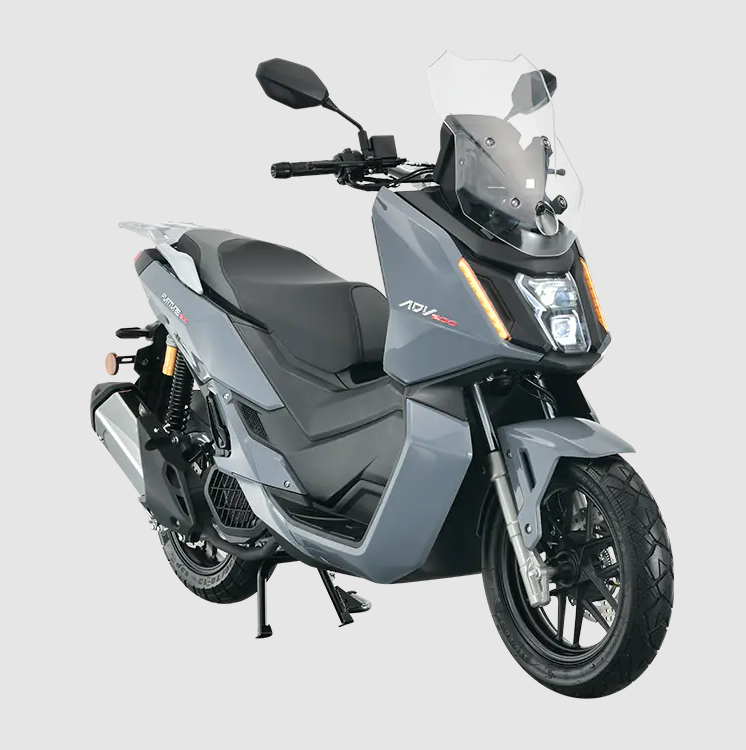
In the evolution of urban mobility, the new design gas scooter represents more than a cosmetic refresh; it embodies a fundamental re-engineering of the rider's experience, with the chassis serving as its foundational pillar. Moving beyond the simple tubular underbone frames of the past, contemporary scooter architecture prioritizes a holistic approach to stability, agility, and structural integrity. This advancement is achieved through strategic geometry, improved materials, and integrated design that collectively address the shortcomings of older models, particularly at higher speeds, during cornering, and under load.
Geometry and Center of Gravity Optimization
A primary focus in a new design gas scooter is the deliberate management of the center of gravity and wheelbase. Older scooter designs often had a high CG due to upright engine placement and elevated fuel tanks, making them feel top-heavy and less planted, especially with a passenger or cargo. Modern frames are engineered to lower mass. This is achieved by positioning the engine lower and further forward and by integrating the fuel tank into the floorboard or a lower section of the body. A lower CG significantly enhances straight-line stability, reduces the tendency for wobble, and increases rider confidence during braking and cornering.
Simultaneously, the wheelbase—the distance between the front and rear axles—is carefully calibrated. A slightly longer wheelbase than older, ultra-compact models contributes to high-speed stability without sacrificing low-speed maneuverability. The rake and trail (the angle of the front forks and the resulting steering geometry) are also optimized. Increased trail can improve straight-line stability and promote self-centering of the handlebars, while careful tuning maintains light steering effort at low speeds for easy urban filtering.
Enhanced Structural Rigidity and Material Use
Older tubular frames, while lightweight, could exhibit flex under stress, leading to imprecise handling feedback and a vague feeling, particularly on uneven roads. The new design gas scooter employs more rigid frame structures. This is accomplished through the use of high-tensile steel or aluminum alloy in perimeter-style frames or twin-spar designs that box critical sections. This increased torsional rigidity ensures that steering inputs are transmitted directly to the wheels without being dampened by frame flex. The result is sharper, more predictable cornering and a feeling of the scooter being a single, solid unit.
This rigidity is often paired with improved suspension systems. Stiffer frames allow suspension engineers to tune the forks and rear shock for compliance and control, rather than having to compensate for chassis flex. Modern suspension with better damping characteristics works in concert with the rigid frame to keep the tires firmly in contact with the road, improving both comfort and grip.