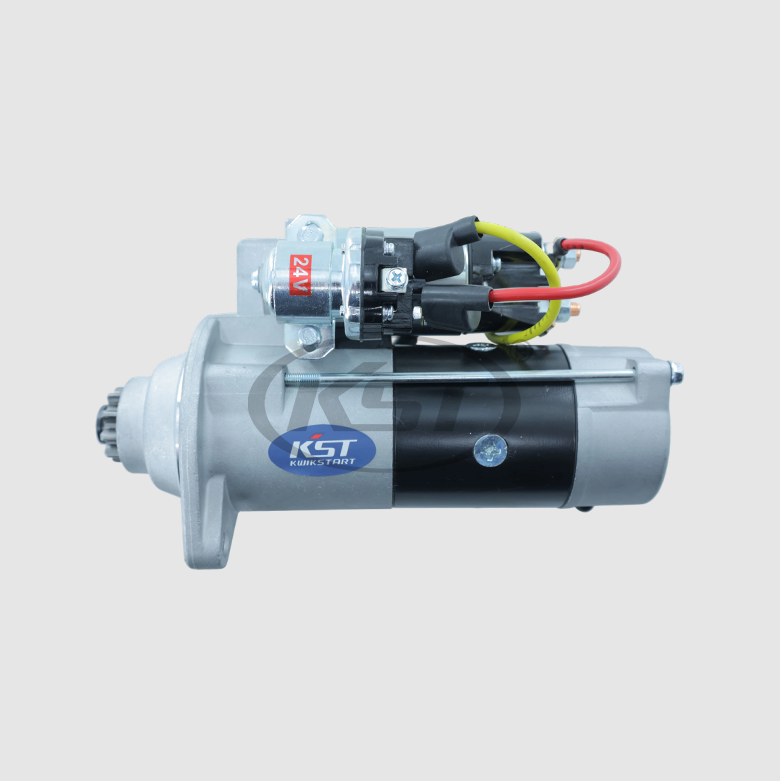
The Gear-Driven Revolution in Engine Starting
In the demanding world of construction machinery, where a failed start can idle an entire crew and cost thousands per hour, the starter motor is a critical component undergoing a quiet revolution. The traditional direct-drive starter, a workhorse for decades, is being increasingly supplanted by a more advanced design: the Permanent Magnet Gear Reduction (PMGR) starter. This shift represents a fundamental rethinking of power delivery, manufacturing complexity, and operational reliability for the construction machinery starter.
Core Design Philosophy: Trading Speed for Torque
The fundamental difference lies in the power transmission path. A traditional direct-drive starter connects the armature (the rotating core) directly to the drive pinion that engages the engine's flywheel. It relies on high current draw to generate sufficient torque, resulting in a relatively heavy, power-hungry unit that spins at high speed but lower torque.
The PMGR starter inserts a planetary gear set between a smaller, lighter permanent magnet motor and the drive pinion. This simple but profound change allows the motor itself to spin at very high RPMs—where permanent magnet motors are most efficient—while the gear reduction (typically between 3:1 to 5:1) multiplies the output torque dramatically at the pinion. The result is a starter that delivers significantly more cranking torque for its size and weight, or equivalent torque with a much smaller, more efficient motor. This is crucial for cold-starting large-displacement diesel engines, especially in low temperatures where oil viscosity is high.
Manufacturing and Material Implications
The production of these two starter types diverges significantly. Manufacturing a traditional direct-drive starter revolves around a heavy, series-wound field coil motor. This involves winding large copper coils around iron pole shoes—a labor and material-intensive process. The unit's weight and bulk are inherent to its design.
In contrast, producing a PMGR starter requires precision in different areas. The core is a compact permanent magnet motor. This eliminates the field coils and their associated copper, but introduces the need for high-strength, heat-resistant rare-earth or ferrite magnets securely bonded within the housing. The planetary gear set is the heart of the assembly, demanding precision machining of hardened steel gears, robust planetary carriers, and high-quality needle bearings to handle immense torque in a small package. While the electronic solenoid and drive mechanism remain similar, the overall assembly is more modular and requires tighter tolerances in the gear train. The payoff is a lighter, more power-dense final product.
Performance and Reliability in Harsh Environments
On the job site, the differences become starkly apparent. The PMGR starter's higher efficiency translates to lower current draw from the battery, reducing electrical system strain—a key advantage for machines with high parasitic loads. Its smaller size often provides more installation flexibility in crowded engine bays.
From a durability standpoint, the gear reduction design offers inherent benefits. The high-speed motor experiences less inertial resistance when the pinion first engages the flywheel, reducing the damaging shock often transferred through a direct-drive armature shaft. The separation of the motor from the pinion also allows for better sealing against dust and moisture ingress at the critical drive end. However, the introduction of the gear set adds a new maintenance point; while designed for the life of the starter, contamination from failed seals or extreme abuse can lead to gear wear, a failure mode not present in the simpler direct-drive design.
For a construction machinery starter manufacturer, the move towards PMGR technology represents an alignment with the industry's demands for greater efficiency, reliability, and power density. It showcases how a fundamental re-engineering of a classic component—prioritizing intelligent torque multiplication over raw power—can yield significant operational advantages, keeping heavy equipment starting reliably in the world's toughest conditions.