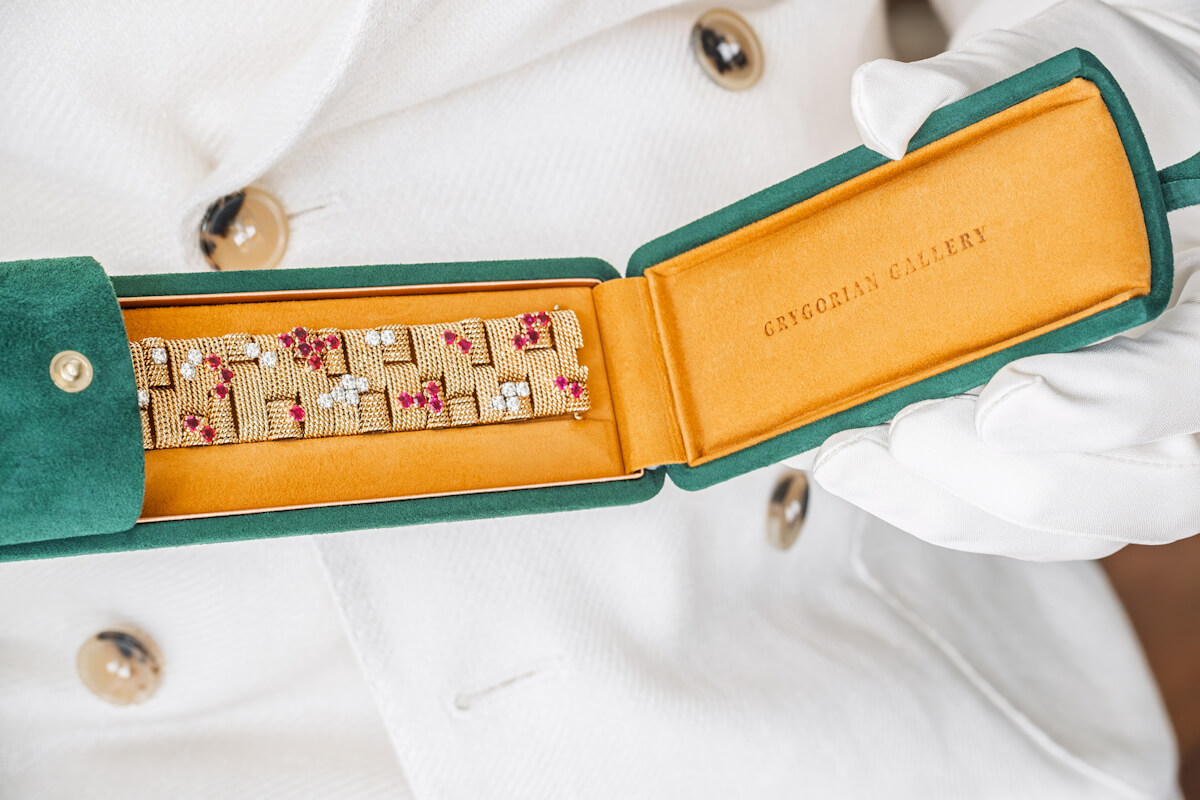
Conventional jewelry appraisal focuses primarily on stones: their carat weight, clarity, color, and cut determine value assessments in most standard contexts. This approach works reasonably well for contemporary pieces where mountings serve functional rather than artistic purposes. Vintage jewelry, however, operates under different valuation logic.
Period mountings frequently represent irreplaceable craftsmanship. Techniques employed by early 20th-century workshops; hand-fabrication methods, proprietary setting styles, and labor-intensive finishing processes; often cannot be economically replicated today. A modest diamond in an original Art Deco platinum mounting from Cartier or Van Cleef & Arpels may command prices that far exceed the stone's independent value. Understanding when and why mountings carry premium worth helps collectors make informed acquisition decisions and avoid the costly error of undervaluing exceptional metalwork in favor of mediocre gemstones.
When Craftsmanship Outweighs Carats
Certain historical periods produced mountings of such complexity that contemporary reproduction costs would exceed original retail prices adjusted for inflation. Edwardian platinum work (1901–1915) exemplifies this phenomenon: the intricate milgrain edges, delicate filigree patterns, and knife-edge settings required hundreds of hours of skilled handwork that modern labor economics render impractical.
Art Deco pieces (1920–1939) present similar valuation dynamics. Geometric precision in calibré-cut stone channels, invisible settings, and architectural metalwork demanded specialized techniques that few contemporary workshops maintain.
Professional observation: Auction results consistently demonstrate this principle. Christie's and Sotheby's records from the past decade show Art Deco brooches with modest center stones (under 1 carat) regularly achieving prices between $15,000 and $40,000 when original Cartier or Boucheron mountings remain intact. Comparable stones in modern settings typically sell for a fraction of these figures.
Mid-century designs from the 1940s and 1950s introduced different value considerations. The bold gold work characteristic of Retro period jewelry (1935–1950) required substantial precious metal quantities; rising gold prices have made these mountings increasingly valuable independent of their gemstone content. A Retro cocktail ring mounting might contain 15–25 grams of 18-karat gold, representing significant intrinsic value before any design premium applies.
Signed pieces from Cartier, Bulgari, Van Cleef & Arpels, and Boucheron demonstrating these valuation principles are available for examination at https://grygorian.com/vintage-jewelry/. The collection includes rings, bracelets, and necklaces where period mountings and house-specific craftsmanship represent substantial portions of total value.
Post-war modernist pieces from houses like Jean Schlumberger for Tiffany or the sculptural work of Andrew Grima also command mounting premiums. These designs prioritized artistic vision over gemstone display; collectors value the complete artistic statement rather than extractable stone worth.
Signature Settings and Proprietary Techniques
Major jewelry houses developed distinctive setting techniques that became identifying characteristics of their work. These proprietary methods, refined over decades and often protected through trade secrets, created mountings with both aesthetic distinction and authentication value. Recognizing house-specific approaches helps collectors identify pieces worth acquiring for their metalwork alone.
Several innovations achieved particular significance in mounting valuation:
- Van Cleef & Arpels' Mystery Setting (Serti Mystérieux): Patented in 1933, this technique conceals all metal prongs beneath precisely cut stones, creating seamless gem surfaces. Genuine Mystery Set pieces require stones cut to house specifications, making original mountings essentially irreplaceable.
- Cartier's Tutti Frutti carved stone settings: The carved emerald, ruby, and sapphire designs popularized in the 1920s and 1930s required custom-shaped bezels for each unique stone. Original mountings accommodate specific carved gems that cannot be substituted.
- Boucheron's Plique-à-jour enamel work: This translucent enamel technique, resembling miniature stained glass, demanded exceptional metalwork skill. Surviving examples in good condition represent rare technical achievements.
- Bulgari's Parentesi and Tubogas constructions: These flexible gold systems, developed mid-century, required specialized manufacturing equipment and techniques that defined the house's identity.
- Schlumberger's sculptural wire work: Jean Schlumberger's organic gold designs for Tiffany used unconventional construction methods that remain difficult to replicate authentically.
Beyond these celebrated examples, countless unsigned period pieces feature setting techniques that have become economically obsolete. Hand-engraved galleries, individually shaped collet settings, and complex multi-level constructions appear in quality vintage work from smaller workshops as well as major houses. The absence of a famous signature does not diminish the mounting's craft value; it simply requires more careful evaluation to recognize.
The Economics of Period Mountings
Supply constraints fundamentally drive period mounting values. Original Art Deco, Edwardian, and Retro pieces exist in finite quantities; no new production enters the market. Stones, by contrast, continue to be mined, cut, and graded daily. This asymmetry creates predictable long-term price dynamics favoring exceptional metalwork.
Labor economics compound the scarcity factor. Skilled benchwork that commanded modest wages in 1925 Paris would require extraordinary compensation today, assuming craftspeople with equivalent abilities could be found at all. Many traditional techniques survive only in conservation workshops or small ateliers serving restoration needs. Commission a faithful reproduction of a complex Edwardian platinum mounting, and the quoted price will likely exceed the cost of acquiring an original period piece at auction.
Comparative analysis: stone replacement versus mounting preservation
Consider a hypothetical scenario involving an Art Deco ring with a damaged 1.5-carat center diamond in an original signed Cartier mounting. Two approaches present themselves: replace the damaged stone while preserving the mounting, or extract value by selling components separately. Market data consistently favors the first option. A replacement diamond of equivalent specifications might cost $8,000–$12,000 wholesale; the intact signed ring, however, could realize $35,000–$50,000 at auction. Separate the components, and the mounting alone (without its intended center stone) becomes difficult to sell except to specialists, while the damaged diamond yields only industrial or recut value. The mounting's contribution to total value, in this representative case, exceeds 70% of the complete piece's worth.
Investment perspective reinforces these principles. Stone prices fluctuate with mining output, synthetic competition, and shifting consumer preferences; high-quality rubies command different premiums today than twenty years ago, and laboratory-grown diamonds have disrupted traditional valuation models. Period mountings, insulated from technological reproduction and bound by absolute scarcity, demonstrate more stable appreciation patterns. Collectors increasingly recognize signed vintage pieces as tangible assets whose metalwork components carry value independent of gemological market cycles.
Evaluating the Complete Picture
Accurate assessment requires examining mounting and stones as interdependent elements rather than separable commodities. The practical challenge lies in determining which component dominates value in any specific piece. Several factors guide this analysis, though professional appraisal remains advisable for significant acquisitions.
Begin evaluation by identifying the mounting's period, maker, and construction quality. Signed pieces from recognized houses carry inherent premiums; unsigned work requires closer examination of fabrication techniques and stylistic indicators. Assess the metalwork independently: examine setting precision, surface finishing, structural integrity, and evidence of period-appropriate construction methods. Original condition matters significantly; heavily repaired or modified mountings lose much of their craft premium.
Common evaluation errors to avoid:
- Prioritizing stone certificates over mounting assessment (a GIA report provides no information about metalwork value)
- Assuming larger stones automatically mean higher total value (a 3-carat commercial-grade diamond in a generic mounting may be worth less than a 0.75-carat stone in a signed Art Deco setting)
- Overlooking mounting damage while focusing on stone quality (worn prongs, thinned shanks, and replaced components diminish overall worth)
- Failing to research comparable auction results for similar period pieces (market data reveals actual mounting premiums more reliably than theoretical calculations)
- Accepting "replacement value" insurance appraisals as market indicators (these documents often overstate stone values while underappreciating period metalwork)
After establishing mounting significance, evaluate the stones within their historical context. Period-appropriate cutting styles (old European cuts, old mine cuts, rose cuts) often complement vintage mountings aesthetically, even when these cuts would score lower on modern grading scales. Replacing an original old European cut diamond with a modern brilliant cut, while technically "upgrading" the stone, may diminish the piece's coherence and collector appeal. The complete picture requires understanding both components and their relationship to each other.
Metalwork as Legacy
Vintage jewelry valuation defies simple formulas. Stones offer quantifiable specifications; mountings present qualitative complexities that require experience, historical knowledge, and market awareness to assess accurately. The collector who understands when craftsmanship outweighs carats gains significant advantage in identifying undervalued pieces and avoiding overpayment for mediocre work carrying impressive certificates.
Practical application of these principles begins with adjusted priorities during acquisition. Examine mountings before requesting stone documentation. Research period-specific techniques and house signatures relevant to your collecting focus. Track auction results for comparable pieces to develop intuition about mounting premiums in different categories. When encountering exceptional metalwork with modest stones, recognize the opportunity rather than the limitation. These pieces often represent the market's most compelling values, combining historical significance, irreplaceable craftsmanship, and appreciation potential that purely stone-centric acquisitions rarely match.