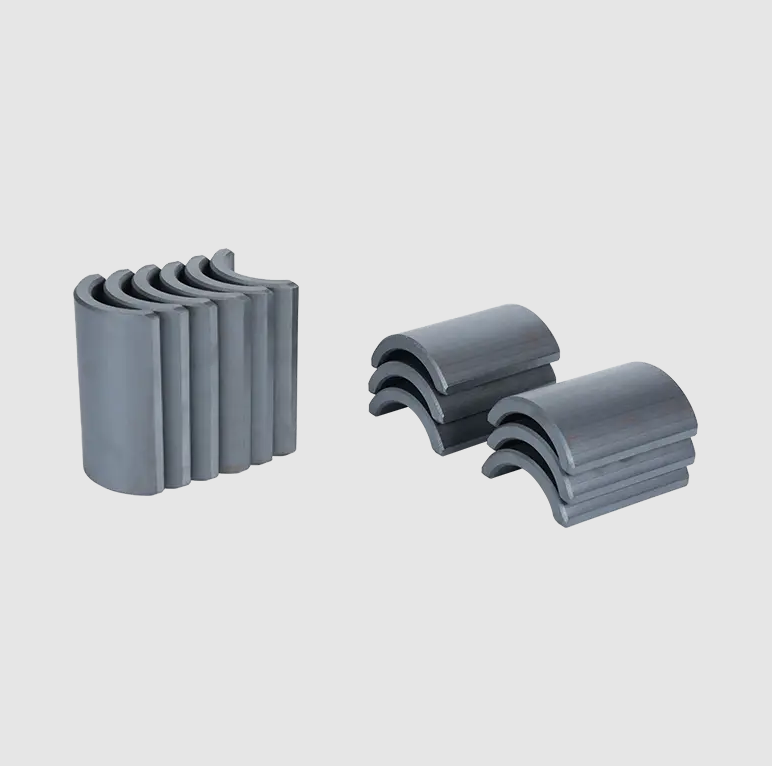
Understanding the Basic Material Definition
Permanent magnetic ferrite, also known as ceramic magnet or hard ferrite, is a metallic oxide magnetic material composed primarily of iron oxide combined with either strontium carbonate or barium carbonate. Unlike soft ferrites used in transformer cores that lose magnetism when current stops, permanent magnetic ferrite retains its magnetic properties after magnetization, making it a true permanent magnet material. The chemical composition is typically represented as strontium ferrite or barium ferrite formulations. Strontium-based ferrites generally offer stronger magnetic properties than their barium counterparts, making them more common in modern applications.
Distinction from Soft Ferrites
It is essential to distinguish permanent magnetic ferrite from soft ferrite materials used in electronic applications. Hard ferrites are characterized by high coercivity and remanence, meaning they resist demagnetization and maintain their magnetic field permanently. Soft ferrites, conversely, have low coercivity and are easily magnetized and demagnetized, functioning as temporary magnets in transformers and inductors. The terminology hard and soft refers to magnetic properties rather than physical hardness, though ferrite magnets are indeed physically hard and brittle ceramic materials.
How Is Permanent Magnetic Ferrite Manufactured
Raw Material Preparation and Calcination
Manufacturing permanent magnetic ferrite begins with carefully proportioned raw materials, typically iron oxide and either strontium carbonate or barium carbonate. These powders are mixed and subjected to a high-temperature chemical reaction called calcination, which forms the ferrite compound. The calcined material must then be milled to reduce particle size, typically below two micrometers, ensuring that each particle becomes a single magnetic domain for optimal magnetic properties. This milling step is critical for achieving the desired coercivity in the final magnets.
Pressing and Sintering Processes
The fine powder is next pressed into shape using either dry pressing or wet pressing techniques. For anisotropic permanent magnetic ferrite, the powder is compacted in the presence of a strong magnetic field that aligns the particles easy axis of magnetization, significantly enhancing the final magnet's performance in that direction. Isotropic ferrites are pressed without magnetic field orientation, resulting in uniform but lower magnetic properties in all directions. After pressing, the green compacts are sintered at high temperatures, fusing the particles into a dense, solid ceramic structure with stable magnetic properties.
Anisotropic vs. Isotropic Grades
The orientation during pressing creates two fundamental types of permanent magnetic ferrite with distinctly different characteristics. Anisotropic ferrites have a preferred direction of magnetization, offering significantly higher magnetic performance when magnetized along that direction. These materials achieve better energy products and are preferred for applications requiring maximum magnetic strength in a specific orientation. Isotropic ferrites have uniform properties in all directions but lower overall magnetic output, making them suitable for applications where magnetic field direction varies or where manufacturing simplicity outweighs maximum performance requirements.
What Are the Key Properties of Permanent Magnetic Ferrite
Magnetic Characteristics
The magnetic properties of permanent magnetic ferrite define its performance in applications. Remanence, the magnetic induction remaining after magnetization, typically ranges from two thousand to four thousand gauss depending on grade. Coercivity, the resistance to demagnetization, is exceptionally high in ferrites, allowing them to withstand opposing magnetic fields without losing strength. The maximum energy product, which measures overall magnetic strength, ranges from one to four megagauss-oersteds, lower than rare earth magnets but sufficient for countless applications where cost matters more than absolute power.
Physical and Mechanical Properties
Permanent magnetic ferrite exhibits distinct physical characteristics that influence its applications. The material is extremely hard and brittle, similar to ceramic tile, making it susceptible to chipping and cracking under mechanical stress. Machining is difficult and typically requires diamond grinding rather than conventional cutting. The density ranges from four point eight to five point one grams per cubic centimeter. Electrical resistivity is very high, effectively making ferrite magnets electrical insulators, an advantage in applications where eddy currents must be minimized.