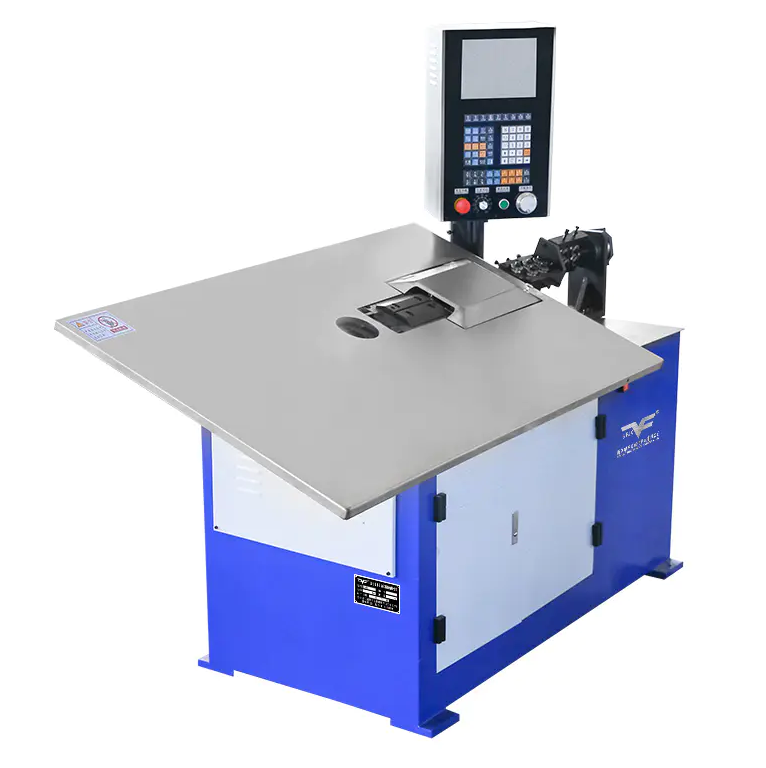
In today’s manufacturing environment, flexibility and efficiency have become decisive factors for long-term competitiveness. As product designs evolve rapidly and customization becomes more common, traditional wire forming equipment often struggles to keep pace. The Camless Wire Bending Machine has emerged as a practical solution for manufacturers seeking adaptable, precise, and digitally controlled wire processing.
Unlike conventional cam-driven machines, camless wire-bending machines rely on servo motors and computer-controlled systems to perform bending operations. This structural difference eliminates the need for mechanical cams, allowing bending parameters to be adjusted directly through software. As a result, manufacturers can switch between different wire shapes and specifications with significantly reduced setup time, making small-batch and multi-variety production more feasible.
One of the core advantages of camless wire-bending machines is their ability to handle complex wire shapes with high consistency. Through programmable control, each bending angle, radius, and sequence can be precisely defined. This level of control supports the production of components used in industries such as automotive, furniture, electronics, construction hardware, and household appliances. From simple hooks to intricate three-dimensional wire forms, the machine delivers repeatable results across production cycles.
Operational efficiency is another key benefit. By removing mechanical cams, camless systems reduce mechanical wear and maintenance requirements. Operators no longer need to manually replace or adjust cams when switching products, which helps minimize downtime and labor intensity. The simplified mechanical structure also contributes to more stable operation over extended production periods.
Digital control systems further enhance usability. Modern camless wire-bending machines are typically equipped with intuitive human-machine interfaces that allow operators to input parameters, store programs, and recall previous production settings. This not only improves workflow efficiency but also reduces dependency on highly specialized mechanical technicians.
From a business perspective, investing in a camless wire-bending machine supports long-term adaptability. As market demands shift, manufacturers can respond quickly without significant tooling changes. This flexibility helps reduce lead times, optimize production scheduling, and better align output with customer requirements.
Overall, camless wire-bending machines represent a forward-looking approach to wire forming. By combining programmable control, reduced mechanical complexity, and production flexibility, they provide manufacturers with a reliable solution for meeting diverse and changing production needs.