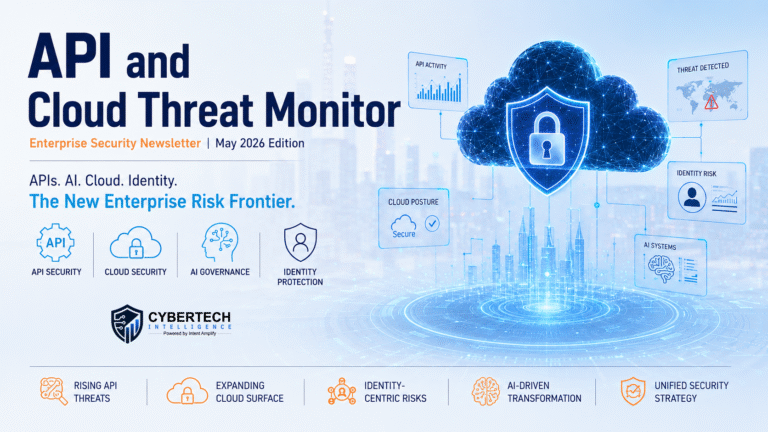
As enterprises accelerate cloud adoption and API-driven innovation, cybersecurity teams face an increasingly difficult challenge: maintaining visibility across dynamic, interconnected environments. APIs and cloud services have become foundational to digital business operations, but they have also expanded the threat landscape in ways traditional security models struggle to address.
This growing complexity has made API and cloud threat monitoring a strategic priority for modern enterprises.
For CISOs, cloud security teams, and DevSecOps leaders, continuous monitoring is essential to identifying hidden vulnerabilities, preventing breaches, and maintaining operational resilience.
Why APIs and Cloud Environments Create New Security Risks
Cloud-native architectures rely heavily on APIs to enable communication between applications, services, and infrastructure.
While this enables flexibility and scalability, it also introduces risks such as:
- Misconfigured cloud assets
- Unauthorized API access
- Identity and access vulnerabilities
- Third-party integration exposure
- Shadow APIs and unmanaged endpoints
As organizations scale across multi-cloud ecosystems, security blind spots often emerge.
Threat actors increasingly target APIs because they provide direct access to sensitive data and backend systems.
Without continuous monitoring, these vulnerabilities may remain undetected until significant damage occurs.
What Is an API and Cloud Threat Monitor?
An API and cloud threat monitor is a security capability that provides visibility, detection, and response across cloud infrastructure and API environments.
Its purpose is to identify:
- Suspicious API traffic
- Unauthorized access attempts
- Credential abuse
- Configuration weaknesses
- Data exfiltration risks
- Runtime anomalies
Rather than relying solely on perimeter defenses, modern monitoring solutions continuously analyze behavior across cloud ecosystems.
This approach strengthens security posture while reducing response times.
Key Features of Effective Threat Monitoring
1. Real-Time Visibility
Security teams need continuous insight into API activity and cloud infrastructure behavior.
Real-time monitoring enables faster detection of anomalies before incidents escalate.
2. Behavioral Analytics
Advanced threat monitoring uses AI and machine learning to detect unusual activity patterns that may indicate malicious behavior.
3. Misconfiguration Detection
Cloud misconfigurations remain one of the leading causes of breaches. Monitoring systems help identify security gaps before attackers exploit them.
4. Automated Threat Response
Modern monitoring platforms automate incident response actions to reduce dwell time and contain risks faster.
5. Compliance and Audit Support
Monitoring tools help organizations maintain compliance with regulatory frameworks through centralized visibility and reporting.
Why Continuous Monitoring Matters in 2026
Cyber threats evolve faster than manual security processes can adapt.
Organizations now operate in environments where:
- APIs constantly change
- Cloud assets scale dynamically
- Third-party integrations increase risk exposure.
- Attackers use automation and AI-driven techniques.
This makes static security models insufficient.
Continuous API and cloud threat monitoring helps organizations shift toward proactive cyber defense rather than reactive incident response.
Final Thoughts
APIs and cloud platforms are essential drivers of business innovation, but they also introduce new cybersecurity challenges that cannot be ignored.
Organizations that invest in comprehensive API and cloud threat monitoring gain better visibility, faster incident detection, and stronger cyber resilience. For enterprise security leaders, monitoring is no longer just a defensive strategy - it is a business imperative in an increasingly connected digital world.