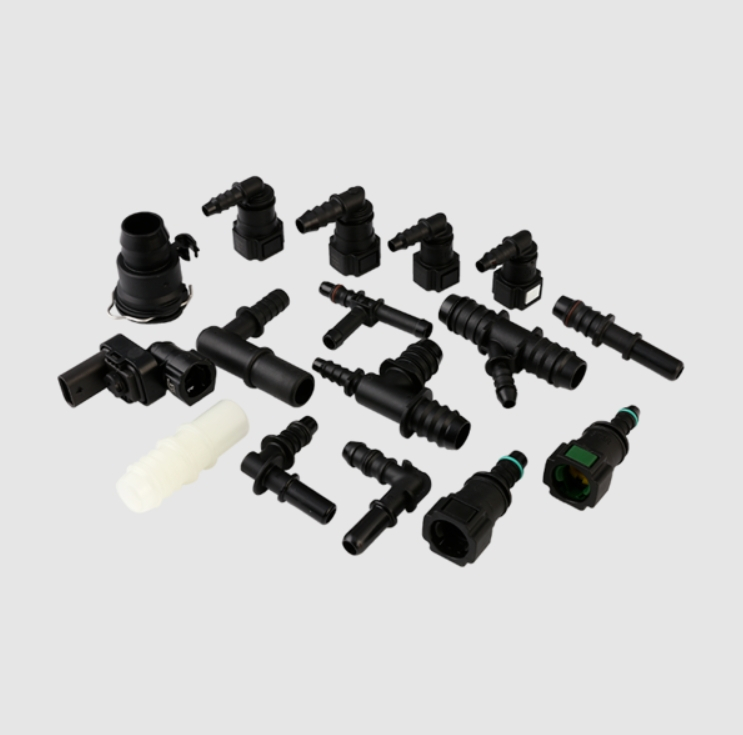
Plastic Automotive Hose Fittings are manufactured through processes designed to create precise dimensions and repeatable component quality. Since these fittings are used in fluid transfer systems, dimensional accuracy and connection consistency can influence their performance during vehicle operation. Manufacturing technology therefore plays an important role in component development.
Injection molding is one of the primary production methods used for Plastic Automotive Hose Fittings. During this process, plastic material is heated until it reaches a flowable condition and is then injected into a mold cavity under controlled pressure. After cooling and solidification, the finished part is removed from the mold.
This manufacturing method supports the production of components with different shapes and structures. Straight connectors, elbow fittings, branch connectors, quick-connect systems, and customized geometries may be produced through molding operations. Integrated features such as clips, locking tabs, and sealing areas can also be incorporated directly into the part design.
Tooling design represents an important stage before production begins. Engineers create molds based on component dimensions, material behavior, and processing requirements. Mold structures may include cooling channels, gating systems, and ejector mechanisms to support manufacturing efficiency.
Material preparation is another important step. Polymer materials sometimes require drying procedures before processing because moisture can influence molding behavior and finished component quality. Controlled material handling can help maintain stable production conditions.
Quality inspection procedures are commonly introduced throughout manufacturing stages. Dimensional measurement systems may verify whether the components match design specifications. Pressure testing can evaluate sealing performance, while visual inspections can identify surface irregularities or molding defects.
Automation technologies are increasingly integrated into production environments. Robotic handling systems may transfer components between manufacturing stages, while monitoring equipment can collect process information during production cycles. Automated inspection systems can also support quality control procedures.
As automotive product designs become increasingly complex, manufacturing methods continue developing alongside them. Plastic Automotive Hose Fittings are expected to benefit from advancements in molding technologies, process monitoring systems, and material innovations. These developments support the production of components that fit changing automotive assembly requirements while maintaining consistent manufacturing standards.