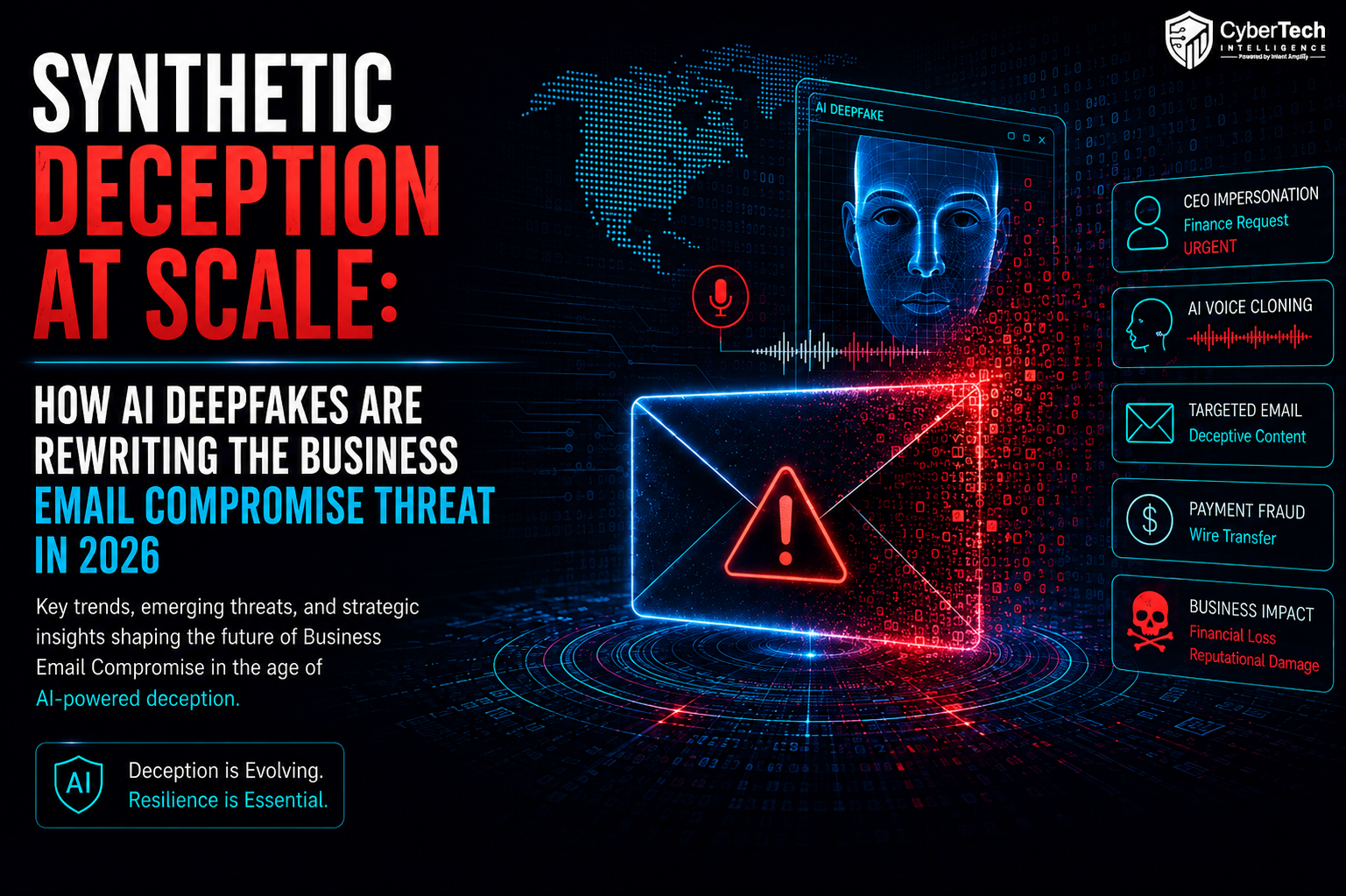
Business Email Compromise (BEC) has long been one of the most financially damaging cyber threats facing enterprises. However, in 2026, the risk landscape has evolved dramatically. Cybercriminals are now weaponizing artificial intelligence to create convincing deepfake content that can bypass traditional trust signals and social engineering defenses.
The rise of AI-generated voice cloning, hyper-personalized phishing, and synthetic executive impersonation is transforming conventional email fraud into a more sophisticated threat category: AI-powered Business Email Compromise (AI-BEC).
For CISOs, security leaders, and enterprise IT teams, understanding how AI deepfakes are reshaping compromise risks is critical to building resilient cyber defense strategies. As we explore the development of these threats, it is important to note how their evolution has redefined the cybersecurity landscape.
The Evolution of Business Email Compromise
Traditional BEC attacks relied heavily on impersonation emails, spoofed domains, and social engineering tactics to trick employees into transferring funds or sharing sensitive data.
Modern AI-driven attacks now leverage:
- Deepfake executive voices
- AI-generated video impersonation
- Hyper-personalized phishing emails
- Synthetic identities for vendor fraud
- Automated multilingual deception campaigns
This evolution dramatically increases attacker credibility and success rates. In comparison to previous methods, AI-generated deception demands new defensive considerations.
Unlike earlier phishing attacks that often contained spelling errors or suspicious formatting, AI-generated communication appears polished, context-aware, and highly convincing.
Why Deepfakes Are Changing the Threat Landscape
Deepfake technology enables cybercriminals to mimic human behavior with alarming precision. By scraping publicly available executive interviews, webinars, podcasts, and social media content, threat actors can train AI models to replicate voices and communication styles.
This creates new attack vectors, including:
1. Executive Voice Impersonation
Attackers can simulate a CEO or CFO requesting urgent wire transfers or confidential information through realistic voice messages.
Because employees are conditioned to trust executive authority, these attacks exploit urgency and hierarchy simultaneously.
2. Synthetic Vendor Communication
Threat actors increasingly impersonate trusted vendors using AI-generated correspondence, making payment diversion schemes harder to detect.
Finance and procurement teams are particularly vulnerable to these attacks.
3. AI-Enhanced Social Engineering
Generative AI helps attackers create personalized emails informed by:
- Company structure
- Employee job roles
- Current business initiatives
- Public executive statements
- Third-party relationships
This amount of contextual awareness considerably boosts phishing effectiveness.
Industries Facing Elevated Risk
While practically every business concerns AI-BEC exposure, a few industries are especially vulnerable:
Financial Services
High-value transactions make banks and fintech organizations attractive targets.
Healthcare
Sensitive patient data and operational urgency create ideal conditions for compromise.
Manufacturing and Supply Chain
Vendor payment fraud can disrupt critical operations.
Technology and SaaS
Privileged access environments increase ransomware and credential theft risks.
For global enterprises, the combination of remote work and digital communication amplifies exposure.
How Organizations Can Defend Against AI-BEC Threats
Security leaders must move beyond legacy phishing awareness programs and adopt multilayered resilience strategies.
Strengthen Identity Verification
Organizations should establish verification protocols for financial approvals and sensitive requests.
Recommended measures include:
- Multi-factor authentication (MFA)
- Call-back verification procedures
- Multi-person approval workflows
- Zero-trust identity models
Deploy AI-Powered Threat Detection
Ironically, AI is also becoming a powerful defense mechanism.
Advanced cybersecurity tools can detect:
- Behavioral anomalies
- Voice inconsistencies
- Suspicious communication patterns
- Deepfake-generated artifacts
These capabilities help reduce successful compromise attempts.
Train Employees for Synthetic Threats
Security awareness programs must evolve beyond phishing basics.
Employees should be trained to recognize:
- Unusual urgency
- Voice-based manipulation attempts
- Payment diversion requests
- Executive impersonation tactics
Human vigilance remains an essential defense layer.
Why This Matters for Cybersecurity Leaders
The introduction of AI deepfakes represents a significant shift in enterprise cyber risk. Traditional trust mechanisms based on email acquaintance and executive authority are proving more unreliable.
Organizations that proactively adjust their security posture will be better positioned to avoid financial loss, operational disruption, and reputational damage.
Final Thoughts
AI deepfakes are fundamentally transforming Business Email Compromise risks by making deception faster, cheaper, and more scalable than ever before. As cybercriminals continue to refine synthetic identity techniques, enterprises must rethink verification, employee training, and threat detection strategies.
In 2026, defending against email compromise is no longer just about identifying suspicious emails - it is about recognizing synthetic deception at scale.