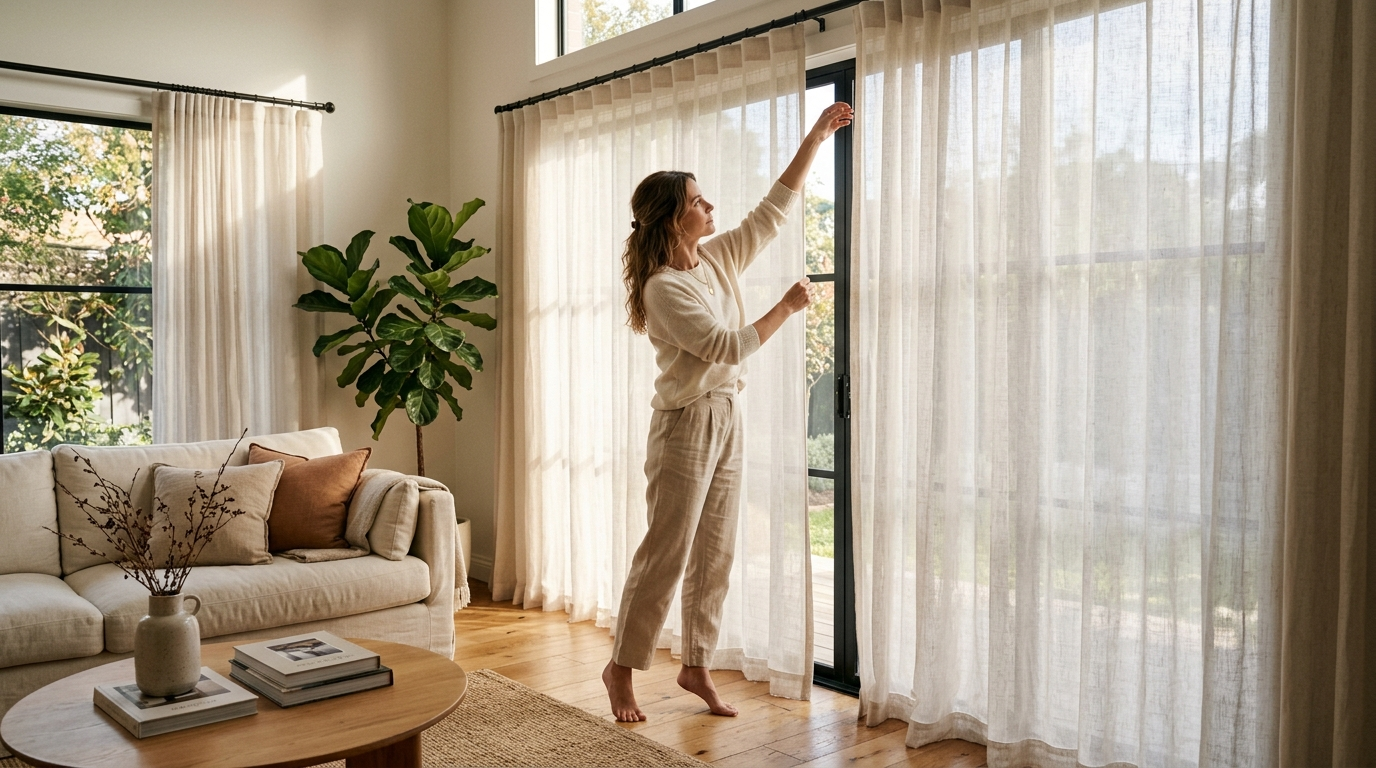
Large windows are one of the best features a home can have — and one of the hardest to dress well. The wrong treatment leaves you with light problems, energy loss, or hardware that buckles under the weight of oversized fabric. The right one makes a dramatic window feel intentional, controlled, and finished.
This guide covers seven treatments that genuinely work for oversized and wide windows, with honest notes on cost, installation difficulty, and when each option falls short. Whether you're dealing with floor-to-ceiling glass in a new build, a bank of bedroom windows, or a panoramic view you'd rather keep private at night, there's a real answer here.
1. Roller Shades: The Cleanest Solution for Large Windows
Roller shades are the default recommendation for large windows for good reason. They're mechanically simple, they don't multiply in complexity as the window widens, and they sit flat against the glass when raised — which means they don't eat into your view or crowd a window with decorative hardware.
The key spec to check before you buy is the maximum width. Most off-the-shelf roller shades top out around 72 inches. For anything wider, you need either custom sizing or a two-shade configuration where two shades meet at center. Both approaches work, but the custom route gives you a cleaner look.
AOSKY's roller shade line runs from $39.99 to $89.99 with custom sizing available from 20 to 98 inches wide and 24 to 98 inches tall. That upper range covers most residential large windows without requiring a split install. Their Eclipse line uses triple-layer fabric to block 99.9% of light — a spec that matters a lot when you're dealing with a west-facing window and afternoon glare. The free-stop cordless mechanism eliminates the cord-and-pulley complexity that often becomes a headache on heavy, wide shades.
2. Cellular Shades for Energy-Efficient Large Windows
Here's where the trade-off math gets interesting. Cellular shades (also called honeycomb shades) cost more than standard roller shades upfront, but they earn that premium back through energy performance. A large, single-pane or older double-pane window is essentially a hole in your insulation. A honeycomb shade changes that calculation.
The cell structure traps air between the fabric and the glass, creating a buffer against both heat and cold. AOSKY's cellular shades claim up to 40% reduction in window heat loss — in line with what the broader industry reports for cellular products. If you're running your HVAC hard every winter, that's a meaningful number. ENERGY STAR regularly identifies window coverings as one of the lower-cost ways to improve a home's thermal envelope, and cellular shades are the product category they point to most often.
One practical note: cellular shades work best on windows where you don't need to raise and lower them constantly throughout the day. The mechanism is smooth, but the fabric can show compression wear over time on windows that get heavy daily use. For a bedroom window you drop at night and raise in the morning, they're excellent. For a kitchen window you adjust six times a day, you might prefer something simpler.
3. Zebra Shades: Flexible Light Control Without Sacrificing Style
Zebra shades (also called transitional shades or banded shades) are underrated for large windows specifically because they solve a problem roller shades don't: what do you do when you want partial light without full exposure?
The mechanism is a dual-layer of alternating sheer and solid horizontal stripes. When you align the solid stripes, you get privacy. When you offset them, the sheer panels overlap and the room fills with diffused light. It's a single shade doing the work of two. For a large living room window, that kind of mid-setting control is genuinely useful — you're not stuck choosing between bright and blackout.
AOSKY's zebra shades are available in six colors (White, Linen, Beige, Grey, Black, Brown) and include a no-drill installation option using adhesive brackets. The no-drill approach is worth noting for renters or anyone working with window trim they don't want to damage. The fabric is imported polyester rated as waterproof, breathable, anti-static, and dustproof — properties that matter for wide windows in kitchens or high-humidity rooms. Pricing runs $36.99 to $89.99 depending on size.
4. Roman Shades: The Tailored Look for Formal Spaces
Roman shades are the highest-effort option on this list, and they're worth it in specific rooms. A dining room with large windows. A home office where the window is a focal point. A primary bedroom where you want something that looks intentionally designed rather than functionally installed.
The trade-off is real. Roman shades are heavier, require more careful measurement, and cost more to make. They also take longer to arrive — AOSKY lists 15 to 30 business days for their Roman shades, compared to 6 to 12 days for most of their other lines. At $79.99 with operation options including cord, cordless free-stop, or motorized, they're competitive with comparable custom roman shades from Smith+Noble or SelectBlinds, though those brands often run higher on large sizes.
For very wide windows, a single Roman shade can become difficult to operate and prone to uneven folding. Most designers recommend either multiple panels across a wide span, or switching to a different product category entirely. Romans work best up to about 72 inches wide; beyond that, the panel approach usually performs better.
5. Window Treatments for Large Windows: Motorized Shades
Motorization stops being a luxury the moment your window is too tall to reach comfortably. A 10-foot window with a cordless shade is fine if you have a step stool. A 14-foot floor-to-ceiling panel with a cordless shade is a genuine daily inconvenience.
Motorized blackout roller shades are the practical answer for high-ceiling rooms, home theaters, and any space where you want to program open/close schedules. They're also the recommended option when children or pets are present. The U.S. Consumer Product Safety Commission has documented cord-related injuries and fatalities in young children — motorized and cordless products eliminate that risk category entirely.
AOSKY offers motorized blackout roller shades in White, Grey, and Black, with smart home compatibility and 99.9% light blocking. Other brands worth considering in this space include Blinds.com's motorized collection and Budget Blinds, which offers professional installation services if you'd rather not manage the wiring yourself. The honest note on motorization: budget for the full system cost. The shade itself is one line item; battery packs, hardwiring, and hub compatibility can add meaningfully to the total.
6. Woven Wood Shades: Natural Texture at Scale
Woven wood shades do something most other window treatments can't: they add organic texture without looking heavy. For a large window in a room that already has a lot of hard surfaces — concrete, tile, lacquered furniture — a woven shade introduces warmth without adding visual bulk.
The material matters more than most buyers realize. Low-quality woven shades warp, fade, and shed within a year. Look for grass and wood fiber constructions rated as fade-resistant, and check whether the product is described as biodegradable and sustainably sourced — not just for environmental reasons, but because those production standards tend to correlate with better construction quality.
AOSKY's woven wood shades are priced at $87.99 to $89.99, made from sustainable grass and wood fibers, and rated as anti-static, dustproof, and fade-resistant. They come in three colors (Straw White, Light Ivory, Warm Oat) with an optional blackout or light-filtering lining upgrade. For large windows in living rooms or bedrooms with natural material palettes, this is the most design-forward option that still ships in a reasonable timeframe.
7. Shangri-La Sheer Shades: Views and Privacy Together
Shangri-La shades (sometimes marketed as silhouette or sheer shades) are the answer when you have a window treatment for large windows problem that's specifically about a view. You want to see out. You also don't want neighbors or passersby to see in during daylight.
The construction is two layers of sheer fabric with horizontal fabric slats suspended between them. Tilt the slats open and you see through clearly. Tilt them closed and the sheer diffuses light while blocking sightlines. It's a more sophisticated version of what a traditional venetian blind does, but with fabric instead of aluminum — which reads much better in residential spaces.
AOSKY offers their Shangri-La Sheer Shades at $59.99 with custom sizing from 23 to 96 inches wide. That width range makes them viable for most large window applications short of full floor-to-ceiling panoramic glass. They're best suited to living rooms, sunrooms, and dining areas where light quality matters as much as privacy.
How to Choose the Right Window Treatment for Large Windows
The short answer: Match the treatment to your primary problem — light control, energy loss, privacy, or aesthetics — and then check maximum width specs before ordering.
For light blocking in large bedrooms: roller shades with blackout fabric or motorized blackout roller shades.
For energy efficiency in living areas: cellular honeycomb shades.
For flexible privacy in high-traffic rooms: zebra shades.
For design-forward rooms where the window is a focal point: Roman shades or woven wood shades.
For floor-to-ceiling glass or hard-to-reach windows: motorized shades.
Custom sizing is non-negotiable for large windows. Standard sizes won't fit, and gaps at the edge of a shade defeat the purpose of installing one. Brands like AOSKY window shades let you enter exact dimensions online in about five minutes, which is the right way to approach this — measure twice, order once. Their free measurement assurance (a one-time free remake within 30 days if sizing is wrong) takes the pressure off, but getting the measurement right the first time is still faster.
Frequently Asked Questions
What window treatment works best for very wide windows?
Custom-sized roller shades or zebra shades are the most reliable choice for very wide windows; both can span up to 98 inches as a single panel from some manufacturers. Beyond that width, a two-shade split installation gives you better control and cleaner operation without hardware strain.
Are cordless shades safe for large windows?
Yes — cordless free-stop mechanisms handle wide, heavier shades well and eliminate the cord-related safety risks documented by the U.S. Consumer Product Safety Commission. For windows above standard reach, motorized shades are a better fit than cordless manual operation.
How do I measure a large window for custom shades?
Measure width at the top, middle, and bottom of the window opening, then use the narrowest measurement. Measure height on both sides and use the longest. Most reputable shade brands provide a detailed measuring guide, and some offer a free remake if your measurements result in a poor fit.
Do cellular shades work on floor-to-ceiling windows?
Cellular shades work on tall windows but can become heavy and difficult to raise manually at extreme heights. Motorized cellular shades solve that problem and add the energy efficiency benefit — a combination worth the higher cost in rooms with significant heat loss.
What's the lead time for custom large window treatments?
Most custom roller, zebra, and cellular shades ship within 6 to 12 business days. Roman shades and woven wood shades typically take 15 to 30 business days. If you're working toward a move-in date or renovation deadline, order the longer-lead items first.
Large windows deserve treatments that fit properly, hold up mechanically, and actually solve your light and privacy problems. Get the measurements right, match the product to the room's function, and don't let aesthetics override practicality. A beautiful shade that doesn't block light when you need it to is just expensive decoration.