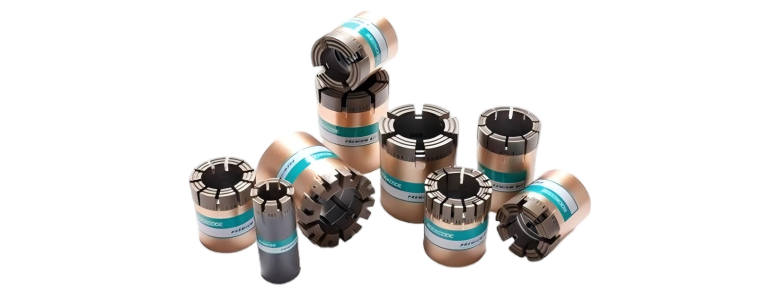
Every drilling program begins with a geological model, but the model is only as good as the core that comes out of the ground. The ground itself decides what tools you can use. Geologic formations dictate every meaningful choice in mining core drilling, from bit matrix hardness to barrel configuration and flushing strategy. Ignoring the rock and buying tools by catalog price is the fastest way to destroy a budget.
Hard Igneous Formations: Granite, Basalt, Gabbro
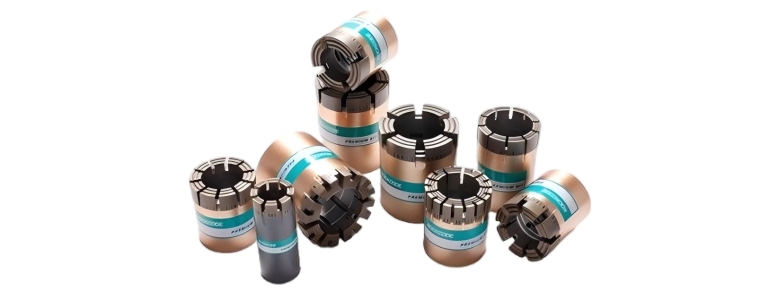
Igneous formations are the reason diamond drilling exists. These rocks cooled from magma, formed crystalline structures, and typically register high on the Mohs hardness scale. Granite and basalt will destroy tungsten carbide inserts in hours. In these conditions, impregnated diamond core bits are the only practical option.
The matrix must be matched to abrasiveness, not just hardness. A fine-grained, competent granite may require a harder matrix to prevent excessive wear. A coarse-grained, fractured basalt may need a slightly softer matrix to maintain diamond exposure without glazing. Weight on bit must be high enough to engage the diamonds, but rotation speed should stay conservative to manage heat. Flushing flow is critical: insufficient water at the bit face causes thermal degradation of both the matrix and the diamonds.【1】
We use specified synthetic diamond grades and adjust hot-press sintering profiles based on the target rock hardness range. For formations between 6.5 and 9.5 on the Mohs scale, our standard matrices balance wear rate against diamond exposure. We supply BQ, NQ, HQ, and PQ wireline sizes, and we provide batch data including matrix hardness and diamond concentration so that drilling contractors can match the bit to the formation rather than guessing.
Sedimentary Formations: Sandstone, Limestone, Shale
Sedimentary rocks present a different problem set. Bedding planes create anisotropy: the drill bit transitions suddenly from soft shale to hard sandstone. Unconsolidated sands and clays may cave or heave. Limestones, especially in karst systems, can hide voids that cause total circulation loss.
In these formations, bit selection is secondary to barrel design. A single-tube barrel may work in hard, cemented sandstone, but in interbedded or soft sequences, a double-tube or triple-tube system protects the core from flushing fluid erosion and mechanical disturbance. Core recovery standards for industrial minerals like limestone and phosphate typically demand above 85%, but in mineralized zones the threshold rises. If recovery drops below acceptable limits, the entire run may need to be redrilled.
Drilling fluid strategy changes here. In shale, inhibitors prevent clay swelling. In loose sand, viscosifiers improve cuttings transport. In karst limestone, lost circulation materials are not optional; they are emergency equipment. The fluid must stabilize the borehole without damaging the formation you are trying to sample.
Metamorphic Formations: Gneiss, Schist, Marble
Metamorphic rocks are unpredictable. Heat and pressure transformed the original rock, creating variable hardness, foliation, and sometimes extreme density. Gneiss can be as hard as granite. Schist may part along planes that break the core into useless fragments. Marble drills smoothly but can dissolve under acidic flushing fluids.
These formations demand versatile tooling. A bit series that covers a wide hardness range reduces the number of bit changes when ground conditions shift unexpectedly. Core orientation tools become important when foliation angle controls structural interpretation. Drilling parameters must be adjusted continuously; a parameter that works in one meter of gneiss may shatter the next meter of schist.
Fractured and Broken Ground
Some of the most expensive meters in mining are drilled through fault zones, breccia, or heavily jointed rock. The problem is not cutting the rock; it is keeping the core intact long enough to retrieve it. In these conditions, triple-tube core barrels with bottom discharge bits are often specified. The outer tube stabilizes the hole. The inner tubes isolate the core from drilling fluid and vibration.
Recovery standards in these zones are difficult to meet. Government exploration guidelines specify that for precious metals and base metals, core recovery should exceed 95%. If the ground is broken, achieving this requires technique, not just equipment. Slow penetration, reduced flushing velocity, and careful rod handling matter more than bit aggressiveness.【2】
Unconsolidated and Soft Formations
Drilling through sand, gravel, or soft clay is not about cutting. It is about sampling without disturbing the material. Standard diamond bits are often inappropriate here. Drag bits or specialized PDC configurations may be used, but the real challenge is borehole stability. Casing while drilling, or at least immediate casing upon completion of a run, prevents collapse.
In soft iron ore or manganese zones, conventional core recovery calculations may not apply because the material is powdery. Programs sometimes switch to non-core methods like DTH in barren intervals, then resume core drilling in the ore zone. This hybrid approach saves cost while preserving the data that matters.
The Manufacturing Link to Field Performance
No geological model can fix a poorly manufactured bit. In hard formations, the bond between diamond and matrix must survive repeated impact and thermal cycling. Hot-press sintering remains the dominant manufacturing method for impregnated bits, but the process parameters separate adequate bits from reliable ones. Research into high-pressure, high-temperature synthesis of new diamond materials has demonstrated that controlled sintering environments improve bond strength and extend bit life.【3】
We do not outsource sintering. When a drilling contractor reports that a matrix is wearing too fast in a specific formation, we can adjust the metal powder blend and run a new batch without the communication delays of a trading company. This matters because geologic formations vary by site, and off-the-shelf specifications do not always fit local ground conditions.
We do not claim to manufacture the only acceptable bits on the market. We do claim that our bits are produced from specified raw material grades, sintered under controlled temperature curves, and inspected for gauge tolerance before shipment. For procurement teams evaluating new suppliers, we provide sample bits for test drilling and report matrix hardness, diamond concentration, and crown profile data with each batch.
→ For more information about ROCKCODE’s Products, please visit: https://www.rockcodebit.com/drill-bits-products
→ Email us at: info@rockcodebit.com
→ Information in this article is for general reference only. For specific drilling projects and drilling bits, please consult qualified professionals. Thank you.