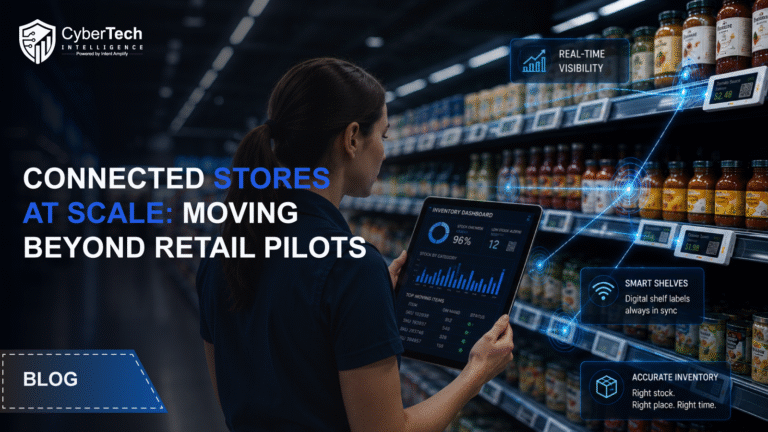
The retail industry has moved beyond experimentation. What began as isolated digital transformation projects and smart store pilots has evolved into a broader movement toward connected retail ecosystems. Retailers are increasingly integrating IoT devices, AI-driven analytics, edge computing, and real-time customer engagement technologies across hundreds or even thousands of locations.
However, many organizations discover that scaling connected retail solutions is far more challenging than launching a successful pilot. Technologies that perform well in a controlled environment often struggle when deployed across diverse store formats, geographies, and operational conditions.
To achieve long-term success, retailers must focus on building scalable, secure, and resilient connected retail infrastructures that deliver measurable business outcomes.
Why Retail Pilot Success Doesn't Guarantee Scale
Many retailers achieve promising results during pilot programs because variables are limited and carefully managed. Once organizations attempt enterprise-wide deployment, new complexities emerge.
Common challenges include:
- Legacy technology integration issues
- Inconsistent network performance
- Device management complexity
- Cybersecurity vulnerabilities
- Data silos across business units
- Employee adoption barriers
Without a strategic scaling framework, organizations often encounter rising costs and diminishing returns despite significant investments.
The key is shifting from project-based thinking to platform-based execution.
Building a Foundation for Connected Retail at Scale
Successful retail transformation starts with infrastructure readiness.
Prioritize Interoperability
Connected retail environments rely on multiple technologies working together seamlessly.
These systems may include:
- Point-of-sale platforms
- Inventory management solutions
- Smart shelves
- Customer engagement tools
- Security systems
- Supply chain platforms
Organizations should prioritize open architectures and standardized APIs to ensure seamless communication across systems.
Interoperability reduces operational friction while enabling future innovation.
Create a Unified Data Strategy
Retailers generate enormous amounts of data every day.
Sources include:
- In-store sensors
- Mobile applications
- Loyalty programs
- Customer transactions
- Inventory tracking systems
When this data remains fragmented, organizations lose visibility into customer behavior and operational performance.
A centralized data architecture enables:
- Real-time analytics
- Better forecasting
- Faster decision-making
- Improved customer experiences
Data consistency becomes increasingly critical as deployments expand.
Security Must Scale Alongside Innovation
Connected stores dramatically increase the number of connected endpoints across the enterprise.
Each smart device introduces potential cybersecurity risks.
Retailers should implement:
Zero Trust Security Models
Trust should never be assumed simply because devices exist within the corporate network.
Zero trust principles include:
- Continuous verification
- Least-privilege access
- Device authentication
- Network segmentation
These measures help reduce attack surfaces across distributed retail environments.
Continuous Device Monitoring
Thousands of connected endpoints require ongoing visibility.
Organizations should establish monitoring programs capable of detecting:
- Unauthorized device activity
- Firmware vulnerabilities
- Configuration drift
- Suspicious network behavior
Proactive monitoring helps prevent operational disruptions and data breaches.
Focus on Operational Scalability
Technology alone does not create scalable retail ecosystems.
Operational processes must evolve simultaneously.
Standardize Deployment Frameworks
Retailers often face inconsistent rollout experiences when stores follow different implementation processes.
Standardized deployment playbooks should include:
- Infrastructure requirements
- Device configuration standards
- Security controls
- Employee training procedures
- Performance benchmarks
Consistency improves deployment speed and reduces operational risk.
Invest in Workforce Readiness
Store employees are still essential to a successful digital transformation.
Even the most advanced connected retail solution will fail if employees do not understand how to use it effectively.
Training should focus on:
- New workflows
- Technology troubleshooting
- Customer engagement enhancements
- Security awareness
Human adoption often determines whether connected retail initiatives deliver expected value.
Measuring Success Beyond Technology Metrics
Many organizations focus heavily on technical performance indicators while overlooking business outcomes.
Retail leaders should evaluate metrics such as:
- Customer satisfaction improvements
- Inventory accuracy
- Store productivity
- Revenue growth
- Loss prevention performance
- Employee efficiency
Technology investments must demonstrate measurable operational and financial impact.
A connected retail strategy should support business objectives rather than simply modernize infrastructure.
Future-Proofing Connected Retail Ecosystems
Consumer expectations continue to evolve rapidly.
Retailers should design architectures capable of supporting emerging technologies such as:
- AI-powered customer experiences
- Autonomous checkout systems
- Computer vision analytics
- Predictive inventory management
- Digital twin environments
Scalable platforms allow organizations to innovate continuously without rebuilding foundational infrastructure.
Flexibility is becoming a competitive advantage.
Final Thoughts
Scaling connected retail solutions requires more than replicating successful pilot programs. Organizations must address interoperability, cybersecurity, workforce adoption, operational consistency, and data integration from the outset.
Retailers that prioritize scalable architecture, strong governance, and business-driven outcomes are better positioned to transform connected stores into sustainable competitive advantages.
The future of retail belongs to organizations that can successfully connect technology, people, processes, and customer experiences at enterprise scale.