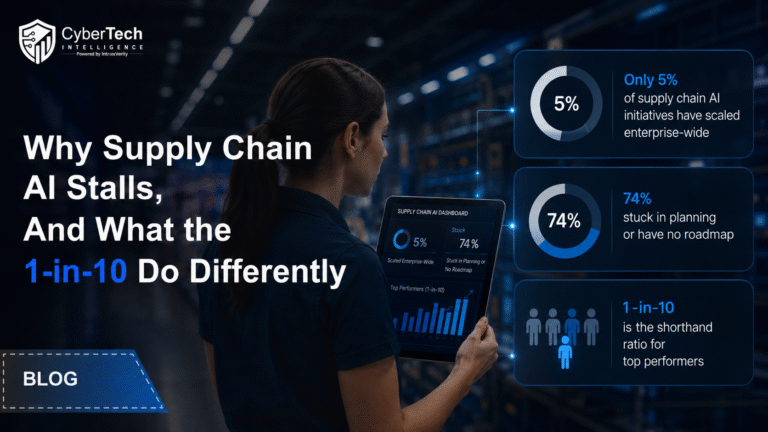
In contemporary supply chain management, artificial intelligence has emerged as one of the most talked-about technologies. Organizations invest millions of dollars into AI-powered forecasting, inventory optimization, logistics automation, and demand planning initiatives with expectations of achieving unprecedented efficiency.
Yet despite significant investments, many supply chain AI projects fail to deliver the promised results.
Industry research consistently shows that while AI adoption is growing rapidly, only a small percentage of organizations successfully scale AI initiatives into measurable business value. Most projects stall during implementation, struggle with adoption, or fail to generate meaningful return on investment.
Understanding why supply chain AI fails is the first step toward achieving sustainable success.
The Gap Between AI Expectations and Operational Reality
Many organizations approach AI as a technology purchase rather than a business transformation initiative.
Executives often expect AI systems to immediately solve longstanding challenges, such as:
- Demand volatility
- Inventory shortages
- Supplier disruptions
- Transportation inefficiencies
- Forecast inaccuracies
However, AI is only as effective as the environment in which it operates.
Poor data quality, fragmented processes, and organizational resistance frequently undermine outcomes before AI can demonstrate value.
The issue is rarely the technology itself.
The Most Common Reasons Supply Chain AI Fails
Poor Data Quality
Data remains the foundation of every AI initiative.
Unfortunately, many organizations struggle with:
- Incomplete datasets
- Inconsistent data standards
- Duplicate records
- Outdated information
- Disconnected systems
When AI models receive inaccurate inputs, predictions become unreliable.
The principle remains simple: poor data produces poor outcomes.
Before implementing advanced AI solutions, organizations must establish strong data governance practices.
Lack of Clear Business Objectives
Many AI projects begin with technology-driven enthusiasm rather than business-driven goals.
Questions often remain unanswered:
- What problem are we solving?
- Which KPI should improve?
- How will success be measured?
- What operational outcome is expected?
Without clear objectives, organizations struggle to evaluate performance and justify continued investment.
Successful AI programs align directly with measurable business priorities.
Overlooking Change Management
Supply chain teams often rely on years of operational experience and established decision-making processes.
Introducing AI-generated recommendations can create skepticism.
Employees may question:
- Model accuracy
- Decision transparency
- Reliability during disruptions
Organizations that neglect change management frequently encounter resistance, reducing adoption rates and limiting value creation.
Human trust remains a critical component of AI success.
What Successful Organizations Do Differently
While many projects fail, some organizations consistently achieve meaningful results.
Their approach differs significantly from the majority.
They Start With Specific Use Cases
Instead of attempting enterprise-wide transformation immediately, successful companies focus on targeted problems.
Examples include:
- Demand forecasting improvement
- Inventory optimization
- Warehouse productivity enhancement
- Transportation route planning
Early wins build confidence and create momentum for broader adoption.
They Prioritize Data Maturity
Organizations achieving strong AI outcomes invest heavily in:
- Data cleansing
- Data integration
- Master data management
- Governance frameworks
They understand that data quality directly influences model performance.
AI readiness begins long before algorithm deployment.
They Maintain Human Oversight
The highest-performing organizations view AI as a decision-support system rather than a decision-replacement system.
Human expertise remains essential for:
- Exception handling
- Strategic planning
- Supplier negotiations
- Crisis management
AI does not replace human intelligence; rather, it enhances it.
This balance often produces the strongest results.
Emerging Challenges in AI-Powered Supply Chains
As the use of AI increases, new problems keep coming up.
Organizations must prepare for:
- Cybersecurity threats targeting AI systems
- Algorithmic bias
- Regulatory compliance requirements
- Explainability expectations
- Third-party AI vendor risks
Strong governance frameworks help mitigate these concerns while maintaining innovation velocity.
Supply chain resilience increasingly depends on secure and trustworthy AI implementation.
The Road to Sustainable AI Success
Organizations should view AI as a long-term capability rather than a quick-fix solution.
Success requires:
- High-quality data foundations
- Clear business objectives
- Cross-functional collaboration
- Workforce enablement
- Continuous model monitoring
Companies that treat AI as an ongoing transformation journey consistently outperform those seeking immediate automation gains.
Final Thoughts
Supply chain AI fails for most companies because they underestimate the importance of data quality, governance, change management, and operational alignment. Technology alone cannot compensate for fragmented processes or unclear business objectives.
Organizations that succeed focus on solving specific business challenges, building strong data foundations, and integrating AI into broader operational strategies.
The future belongs not to the companies investing the most in AI, but to those implementing it with discipline, clarity, and a long-term vision for supply chain excellence.