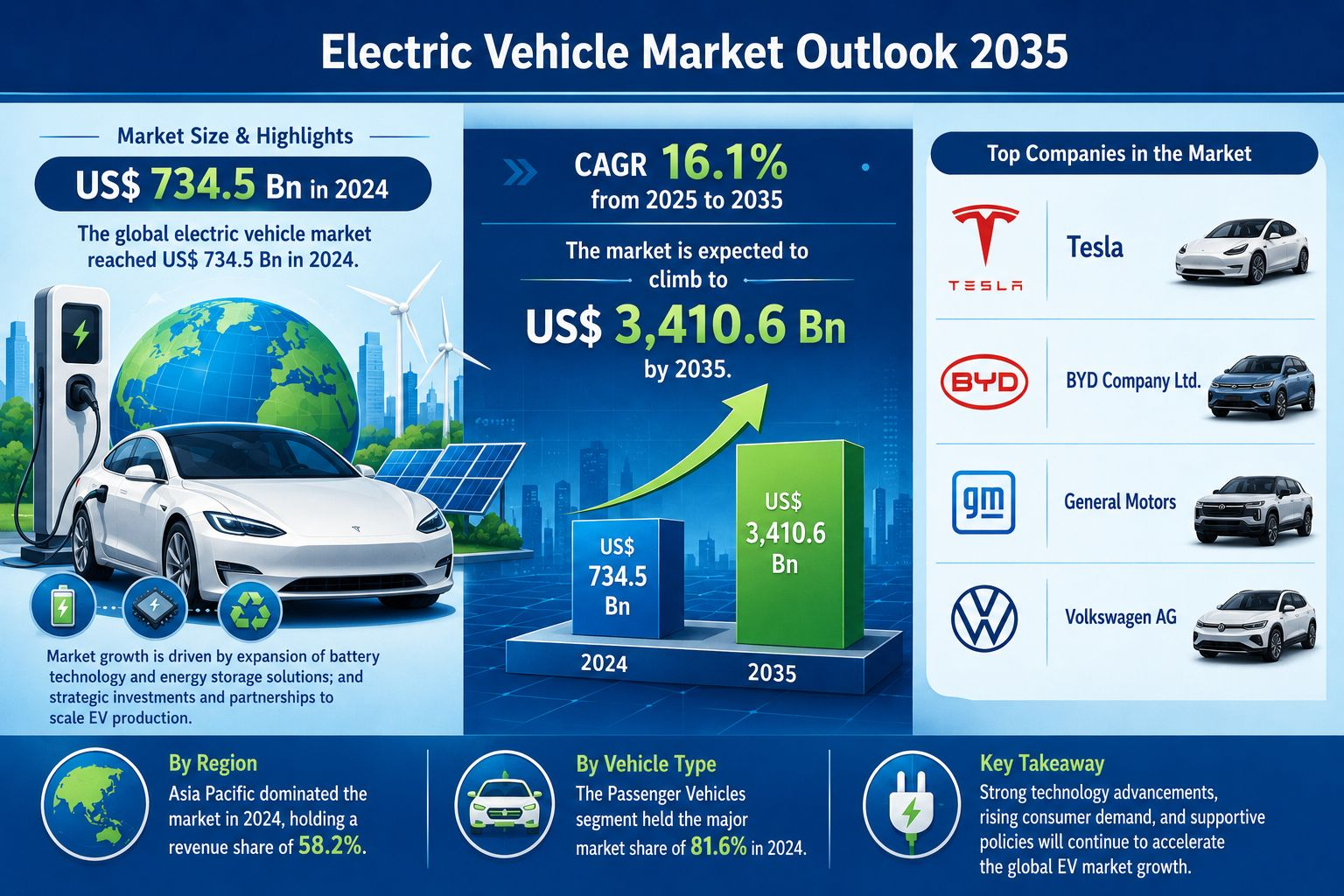
The global electric vehicle (EV) market is undergoing a remarkable transformation as governments, automakers, technology providers, and consumers increasingly embrace sustainable transportation solutions. Valued at US$ 734.5 billion in 2024, the global electric vehicle market is projected to reach US$ 3,410.6 billion by 2035, expanding at a robust CAGR of 16.1% during the forecast period from 2025 to 2035.
The growing emphasis on reducing carbon emissions, improving energy efficiency, and decreasing dependence on fossil fuels has positioned electric vehicles as a cornerstone of the global transition toward cleaner mobility. Advances in battery technology, expanding charging infrastructure, and strategic investments by leading automakers are creating favorable conditions for long-term market growth.
Growing Importance of Electric Vehicles
Electric vehicles utilize electric motors powered by rechargeable batteries or other electric energy storage systems instead of conventional internal combustion engines. These vehicles include battery electric vehicles (BEVs), hybrid electric vehicles (HEVs), plug-in hybrid electric vehicles (PHEVs), and fuel cell electric vehicles (FCEVs).
The applications of EVs extend across passenger transportation, public transit, logistics, ride-sharing services, commercial fleets, and industrial operations. Their ability to reduce greenhouse gas emissions, lower operating costs, and minimize urban noise pollution has made them increasingly attractive to consumers, businesses, and governments alike.
As environmental regulations become stricter and fuel prices remain volatile, electric vehicles are emerging as a practical and sustainable transportation alternative across developed and emerging economies.
Battery Technology Advancements Driving Market Growth
One of the most significant drivers of the electric vehicle market is the rapid advancement of battery technology and energy storage solutions. Continuous improvements in battery chemistry, energy density, charging speed, and safety are helping manufacturers enhance vehicle performance while reducing production costs.
Modern batteries offer longer driving ranges and shorter charging times, addressing two of the most common concerns among EV buyers. The declining cost of lithium-ion batteries has also contributed significantly to making electric vehicles more affordable and accessible.
In addition, innovations in solid-state batteries and next-generation energy storage technologies are expected to further improve vehicle efficiency and reliability. Industry leaders continue to invest heavily in research and development to deliver batteries with greater capacity, improved durability, and enhanced safety features.
These technological developments are expected to play a critical role in expanding EV adoption worldwide over the next decade.
Strategic Investments and Partnerships Fuel Expansion
The electric vehicle market is also benefiting from large-scale investments and strategic partnerships aimed at expanding manufacturing capabilities and strengthening supply chains.
Automakers are increasingly collaborating with battery manufacturers, technology companies, and infrastructure providers to accelerate innovation and reduce production costs. These partnerships support the development of localized manufacturing facilities, secure access to critical raw materials, and enable faster deployment of new EV models.
For example, several leading automotive manufacturers have announced plans to establish dedicated EV production plants, invest in battery gigafactories, and expand charging infrastructure networks. Such initiatives are helping companies scale operations while meeting the growing demand for electric vehicles in global markets.
The trend toward localized production is also reducing supply chain risks and enabling manufacturers to respond more effectively to regional market requirements.
Passenger Vehicles Lead Market Demand
By vehicle type, passenger vehicles dominated the global electric vehicle market in 2024, accounting for 81.6% of total revenue.
The segment's leadership is largely driven by rising consumer awareness of environmental sustainability, attractive government incentives, and the growing availability of affordable electric car models. Improvements in vehicle range, charging convenience, safety features, and digital connectivity have further enhanced consumer confidence in EV ownership.
Automakers are increasingly introducing technologically advanced electric passenger vehicles equipped with smart infotainment systems, autonomous driving capabilities, and connected services. These innovations are helping attract a broader customer base while strengthening market demand.
As urban populations continue to grow and environmental concerns intensify, passenger EV adoption is expected to remain a primary contributor to overall market expansion.
Asia Pacific Remains the Leading Regional Market
Asia Pacific emerged as the dominant regional market in 2024, capturing 58.2% of global revenue.
The region's leadership is supported by strong government incentives, rapid urbanization, extensive manufacturing capabilities, and significant investments in battery production. Countries such as China, India, Japan, and South Korea have established comprehensive policies that encourage EV adoption and support domestic manufacturing.
The presence of major battery suppliers, cost-effective production ecosystems, and strong consumer demand has further strengthened the region's competitive position. Collaboration among automakers, battery manufacturers, and technology companies continues to drive innovation and accelerate EV deployment across Asia Pacific.
As governments in the region intensify their focus on clean transportation and energy transition initiatives, Asia Pacific is expected to maintain its leadership throughout the forecast period.
Industry Trends Shaping the Future
Several emerging trends are expected to redefine the electric vehicle landscape over the coming years. These include advancements in battery chemistry, increased software integration, connected vehicle technologies, and the growing adoption of EVs for commercial transportation.
Manufacturers are increasingly developing platform-based vehicle architectures that enable faster product development and lower production costs. Smart connectivity features, over-the-air software updates, and advanced driver assistance systems are becoming standard offerings in many EV models.
Furthermore, commercial fleet operators are increasingly transitioning toward electric vehicles to reduce operating expenses and comply with environmental regulations. This trend is creating new growth opportunities in logistics, public transportation, and last-mile delivery applications.
Competitive Landscape
The global electric vehicle market remains highly competitive, with major industry participants focusing on product innovation, battery development, charging infrastructure expansion, and strategic collaborations.
Key companies operating in the market include Tesla, BYD Company Ltd., General Motors, Volkswagen AG, BMW AG, Hyundai Motor Group, NIO, and XPENG INC..
These companies continue to invest in advanced battery technologies, connected vehicle ecosystems, and sustainable manufacturing practices to strengthen their market positions.
Outlook
The global electric vehicle market is poised for exceptional growth through 2035, driven by technological innovation, supportive government policies, strategic investments, and growing consumer demand for sustainable mobility. As battery performance improves, charging infrastructure expands, and production costs decline, electric vehicles are expected to become increasingly mainstream across both developed and emerging markets.
With the market projected to exceed US$ 3.4 trillion by 2035, electric vehicles are set to play a pivotal role in shaping the future of global transportation and advancing worldwide sustainability objectives.