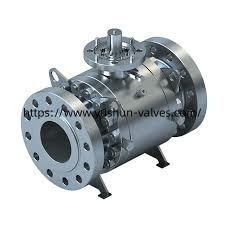
Trunnion Ball Valves are widely applied in high pressure pipeline systems where stable flow control and secure sealing are required under continuous operational stress. These systems often transport oil, gas, and industrial fluids across long distances, requiring equipment that can maintain structural balance and consistent performance even when pressure levels fluctuate. The design characteristics of this type of valve make it suitable for environments where both safety and operational efficiency are important considerations.
One of the key reasons these valves are used in pressurized pipelines is their mechanical support structure. Unlike floating designs, the ball in this configuration is held in place by upper and lower supports, which help distribute pressure forces more evenly. This reduces the load on sealing surfaces and contributes to smoother operation during opening and closing cycles. As a result, operators often experience lower torque requirements, which is beneficial in automated systems and large diameter pipelines.
Another important aspect is sealing stability. In high pressure environments, maintaining tight shutoff performance is critical to prevent leakage and ensure system integrity. The seat design in these valves is typically engineered to respond to pressure changes by enhancing contact between sealing components. This pressure-assisted sealing behavior helps maintain performance consistency over time, even in demanding service conditions.
Durability is also a key factor in pipeline applications. Industrial environments may involve temperature variations, corrosive media, and continuous flow operation. The materials selected for valve construction are often chosen based on compatibility with the transported medium and expected service conditions. Proper material selection helps reduce wear and extends operational reliability, which is an important consideration for long term infrastructure planning.
Flow efficiency is another advantage in pipeline systems. When fully opened, the internal passage allows fluid to move with minimal restriction, helping to reduce pressure drop across the system. This contributes to energy efficiency in pumping operations and supports stable system performance. Engineers often consider this factor when designing large scale transmission networks where energy consumption is a key operational concern.
Maintenance planning is also an essential part of using this type of valve. While designed for long service life, periodic inspection helps ensure that sealing components remain in good condition and that operational performance is maintained. Maintenance intervals may vary depending on service conditions, including fluid type, temperature, and operating frequency. Proper maintenance practices contribute to system safety and reduce unexpected downtime.
In industrial projects, selection criteria for pipeline valves often include pressure rating, size, flow characteristics, and compatibility with control systems. These factors are evaluated together to ensure the chosen equipment meets the technical requirements of the application. Engineers may also consider installation environment, such as offshore platforms, refineries, or long-distance transmission lines, where environmental conditions can influence performance requirements.
Manufacturers like Qifang focus on providing valve solutions that align with these industrial needs. The design approach emphasizes structural reliability and operational consistency, supporting use in different pipeline configurations. By combining engineering experience with application-focused design, such solutions can be adapted to a wide range of industrial systems.For more product information and technical details, visit https://www.yushun-valves.com/product/