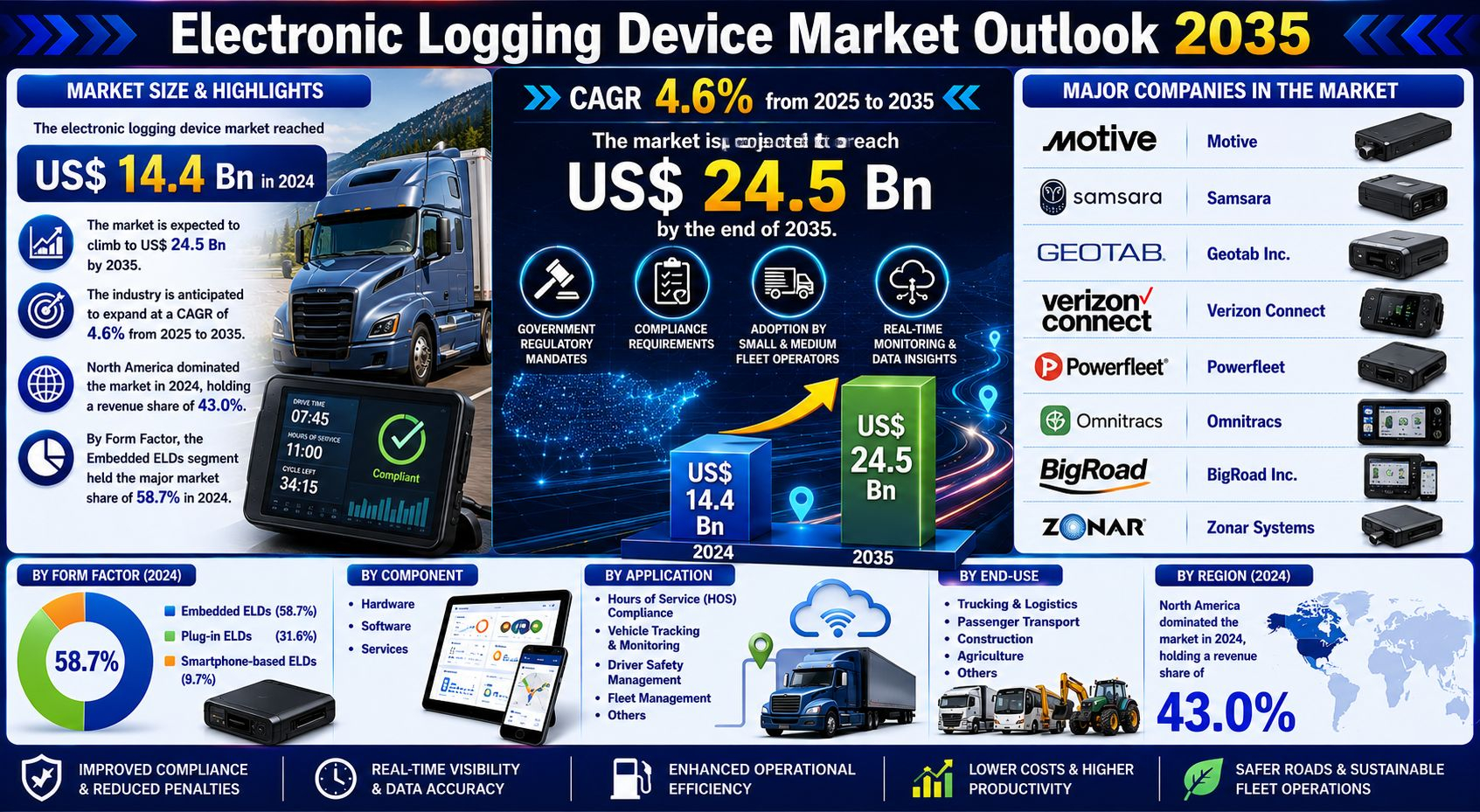
The global electronic logging device market size was valued at US$ 14.4 Bn in 2024 and is projected to reach US$ 24.5 Bn by 2035, expanding at a CAGR of 4.6% from 2025 to 2035. The market growth is primarily driven by government regulatory mandates, increasing focus on driver safety, and rising adoption of electronic logging devices among small and medium-sized fleet operators.
Analysts’ Viewpoint on Global Electronic Logging Device Market
The electronic logging device market continues to witness steady growth due to increasing regulatory requirements related to driver safety, fleet compliance, and transportation efficiency. Governments across North America and Europe have implemented regulations mandating the use of electronic logging devices to accurately monitor drivers’ Hours of Service (HOS), thereby reducing fatigue-related accidents and improving road safety.
The market is also benefiting from the growing integration of telematics, GPS tracking, fleet analytics, and cloud-based transportation management systems. Modern ELD solutions have evolved beyond compliance tools and now serve as comprehensive fleet management platforms capable of providing real-time vehicle tracking, route optimization, fuel monitoring, maintenance scheduling, and driver performance analysis.
Furthermore, increasing adoption among small and medium-sized fleet operators is creating significant growth opportunities. Lower technology costs, cloud-based deployment models, and user-friendly mobile applications have made advanced fleet management solutions accessible to businesses of all sizes. As logistics operations become increasingly data-driven, ELD systems are expected to play a critical role in improving operational efficiency and regulatory compliance.
Electronic Logging Device Market Introduction
Electronic Logging Devices (ELDs) are digital systems designed to automatically record drivers’ Hours of Service (HOS) and other operational vehicle data. These devices connect directly to a vehicle's engine control unit (ECU) and automatically capture driving activity, engine hours, vehicle movement, mileage, and location information.
ELDs have largely replaced traditional paper logbooks, providing transportation companies with more accurate, reliable, and transparent operational records.
Key functions of ELD systems include:
- Hours of Service (HOS) monitoring
- Driver activity tracking
- GPS-based vehicle location monitoring
- Engine diagnostics
- Route optimization
- Fleet management integration
- Compliance reporting
- Driver behavior monitoring
The integration of ELDs with telematics, cloud platforms, and AI-powered analytics has transformed these systems into essential fleet intelligence tools for modern transportation and logistics operations.
Government Regulatory Mandates and Compliance Requirements Driving Market Growth
Government regulations remain the strongest driver for the electronic logging device market.
Transportation authorities across several countries have introduced mandatory ELD requirements to improve road safety, reduce driver fatigue, and ensure compliance with labor regulations.
Key regulatory objectives include:
- Monitoring driver working hours
- Preventing falsification of driving records
- Improving transportation safety
- Reducing fatigue-related accidents
- Enhancing regulatory compliance
The implementation of ELD mandates in the United States and Canada has significantly accelerated market adoption. Similar initiatives are being considered and implemented across various international transportation markets.
By automating recordkeeping processes, ELDs eliminate many manual reporting errors while providing regulators and fleet operators with accurate operational data. Consequently, compliance-driven demand continues to support long-term market growth.
Growing Adoption Among Small and Medium-Sized Fleet Operators
Historically, large fleet operators represented the primary users of electronic logging devices due to greater financial resources and advanced fleet management capabilities.
However, declining hardware costs and the emergence of cloud-based subscription models have enabled small and medium-sized enterprises (SMEs) to adopt ELD solutions more easily.
Benefits driving adoption among SMEs include:
- Improved regulatory compliance
- Reduced paperwork
- Enhanced operational transparency
- Better route planning
- Lower fuel costs
- Improved vehicle utilization
- Enhanced driver accountability
- Simplified fleet management
Cloud-based ELD platforms and smartphone-integrated solutions have significantly lowered implementation barriers, allowing smaller operators to achieve operational efficiencies previously available only to larger fleets.
As transportation SMEs increasingly digitize their operations, ELD adoption is expected to continue expanding globally.
Market Opportunity: AI-Powered Fleet Intelligence and Integrated Telematics
The evolution of ELD systems into advanced fleet intelligence platforms presents substantial growth opportunities for technology providers.
Modern fleet operators increasingly seek integrated solutions capable of combining compliance management with broader operational optimization.
Emerging opportunities include:
- AI-powered fleet analytics
- Predictive maintenance systems
- Driver behavior analysis
- Fuel optimization platforms
- Real-time route optimization
- Advanced telematics integration
- Video-based safety monitoring
- Fleet performance benchmarking
Artificial intelligence and machine learning technologies are helping fleet operators improve decision-making by transforming operational data into actionable insights.
The growing adoption of connected vehicle technologies and smart transportation systems is expected to further strengthen demand for next-generation ELD platforms.
Embedded ELDs Segment Dominates the Market
Based on form factor, Embedded ELDs accounted for approximately 58.7% of global market revenue in 2024.
Embedded ELD systems are permanently integrated into a vehicle's onboard systems and maintain direct communication with the engine control unit (ECU).
Advantages of embedded ELDs include:
- Higher data accuracy
- Improved reliability
- Enhanced regulatory compliance
- Reduced risk of data manipulation
- Continuous connectivity
- Better integration with fleet management systems
These systems automatically record engine performance, vehicle movement, and driver activity without requiring manual intervention.
Due to their strong compliance capabilities and operational reliability, embedded ELDs remain the preferred choice among commercial fleet operators worldwide.
North America Leads the Global Electronic Logging Device Market
North America represented approximately 43.0% of global market revenue in 2024, making it the largest regional market.
The region's leadership can be attributed to:
- Strong regulatory framework
- Mandatory ELD regulations
- Advanced transportation infrastructure
- High telematics adoption rates
- Large commercial vehicle fleets
- Mature logistics and supply chain networks
The United States ELD mandate and Canada's ELD regulations have significantly accelerated adoption throughout the region.
Furthermore, North American transportation companies have been early adopters of advanced fleet technologies, integrating ELD systems with telematics, GPS tracking, route optimization, and vehicle diagnostics platforms.
The increasing focus on operational efficiency, safety compliance, and fleet digitization is expected to support continued market growth across the region.
Competitive Landscape
The electronic logging device market remains highly competitive, with major vendors focusing on:
- Product innovation
- AI-driven fleet analytics
- Cloud-based fleet management solutions
- Strategic acquisitions
- Geographic expansion
- Telematics integration
- Driver safety technologies
Companies are increasingly offering comprehensive transportation management ecosystems that combine compliance, safety, tracking, maintenance, and operational analytics within a single platform.
Key Companies Operating in the Electronic Logging Device Market
Major companies profiled in the market include:
- Motive
- Samsara
- Geotab Inc.
- Verizon Connect
- Teletrac Navman
- Garmin ELD
- KeepTruckin
- Omnitracs, LLC
- GPS Trackit ELD
- Rand McNally
- Gorilla Safety ELD
- BigRoad DashLink ELD
- Azuga Inc.
- Powerfleet
Recent Developments
September 2025
Geotab acquired Verizon Connect's commercial telematics operations across Australia, the United Kingdom, Ireland, Italy, France, Portugal, Poland, the Netherlands, and Germany. The acquisition strengthens Geotab's global fleet management capabilities and expands its presence among small and medium-sized fleet customers.
April 2024
Powerfleet completed the acquisition of MiX Telematics Limited, enhancing its global telematics portfolio and strengthening its position in fleet intelligence, compliance management, and connected vehicle solutions.
Future Outlook
The electronic logging device market is expected to maintain steady growth through 2035, supported by expanding regulatory requirements, increasing transportation digitization, and growing demand for operational efficiency across commercial fleets.
As fleet operators increasingly seek integrated solutions that combine compliance management with advanced analytics and telematics capabilities, ELD platforms will continue evolving into comprehensive fleet intelligence ecosystems.
The adoption of AI-powered analytics, predictive maintenance technologies, connected vehicle systems, and cloud-based fleet management solutions will further strengthen the strategic importance of electronic logging devices within the global transportation and logistics industry.