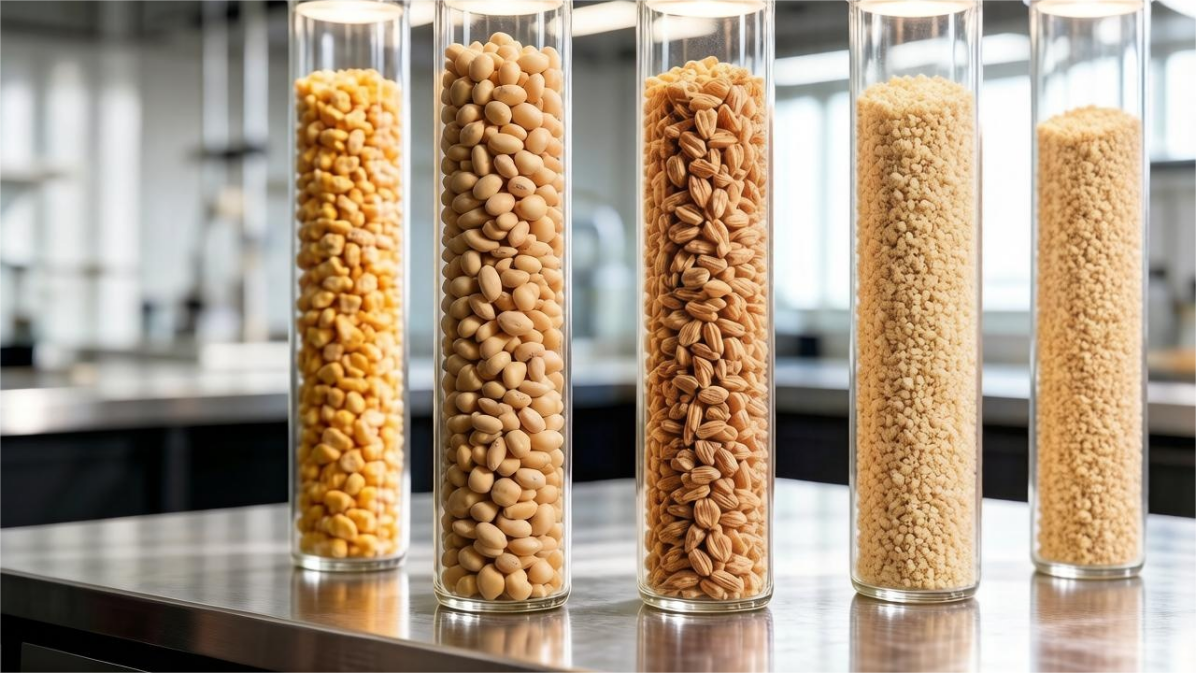
Feed raw materials and their processed products serve as the core carriers of nutrition supply for livestock and poultry. Their quality directly affects the production efficiency of animal husbandry, animal growth performance, and the quality and safety of end products, while profoundly influencing cost control and resource utilization efficiency in the breeding process. In the feed industry system, key nutritional indicators such as moisture, protein, fat, and fiber are core parameters for evaluating feed nutritional value and optimizing formula design. Their detection accuracy and efficiency play a decisive role in every link of the industrial chain. Taking soybean meal as an example, as an important plant-based protein source in the feed industry, if the detection deviation of its protein content exceeds a reasonable range, it will directly cause the protein level in the formula to deviate from the target value, thereby triggering the risk of nutritional imbalance — in mild cases leading to protein resource waste and increased feed costs, and in severe cases inhibiting animal growth performance due to amino acid imbalance and affecting breeding economic benefits.

Feed raw materials must undergo scientific proportioning and processing to be converted into complete compound feed in order to meet the nutritional needs of animals at different growth stages. In this process, precisely mastering the nutritional indicators of raw materials and finished products is the prerequisite for realizing dynamic formula adjustment and ensuring product quality stability.

However, traditional chemical detection methods (such as Kjeldahl method for crude protein, Soxhlet extraction for crude fat, oven drying for moisture, etc.) have significant limitations: On one hand, the sample pretreatment process is cumbersome (requiring multiple steps such as grinding, digestion, and extraction), and the single detection cycle is long, making it difficult to meet the “fast turnover and real-time regulation” needs of feed production. On the other hand, the detection process relies on large amounts of chemical reagents such as strong acids and organic solvents, which not only increases testing costs but also generates nitrogen-containing wastewater, organic waste liquid and other pollutants, posing potential pressure on the environment. In addition, human operation errors in traditional methods (such as titration endpoint judgment deviation and sample weighing error) and fluctuations in detection conditions between batches easily lead to poor result reproducibility, making it difficult to meet the refined quality control requirements of the modern feed industry.

In this context, developing a detection technology that combines rapidity, non-destructiveness, high precision, and environmental friendliness has become the core demand of the feed industry to break through traditional detection bottlenecks and achieve cost reduction, efficiency improvement, and green production. Near-infrared spectroscopy technology, with its advantages of “rapid detection, simultaneous multi-indicator analysis, non-destructive and green”, provides a feasible path to solve the above problems. Its detection efficiency is significantly improved compared with traditional methods, the cost of single sample detection is greatly reduced, and non-destructive screening of raw materials and finished products can be achieved, providing technical support for real-time quality monitoring and formula optimization in the feed production process, which is of great significance for promoting the high-quality development of animal husbandry. At present, near-infrared technology fully empowers feed enterprises to achieve efficient, intelligent, and green quality control, and has become the preferred technology for feed enterprises to realize rapid acceptance and warehousing of raw materials, quality control in the production process, and finished product factory inspection.
Near-infrared light (NIR) is the earliest discovered non-visible light region. Its wavelength lies between visible light and mid-infrared light, with a wavelength range of 780-2,500 nm. The main components in feed products, such as moisture, protein, fat, starch, fiber, and amino acids, contain hydrogen-containing groups (O-H, C-H, S-H, N-H) that have vibrational overtone and combination absorption in this wavelength range. By measuring the characteristic near-infrared absorption spectra of the sample in this region and combining with chemometric software to extract the corresponding chemical information, qualitative or quantitative analysis of these substances can be achieved, realizing raw material identification, nutritional quantification, and production process quality control without chemical reagents, with results available in seconds.

IAS GLOBAL CO., LTD (referred to as IAS ANALYSIS) is located in Wuxi, Jiangsu, the cradle of China’s national industry. It is a high-tech enterprise specializing in the research and development of near-infrared instruments and providing industry-customized solutions. Since its establishment in 2016, with substantial R&D investment and a research team with 50% master’s and doctoral degrees, it has grown into a leading professional near-infrared product and service provider integrating R&D, production, and sales in the industry.

With profound technological accumulation, IAS has launched two flagship near-infrared products, MONET and IAS-7500, in response to the precise detection needs of the feed industry, building a complete product matrix covering different application scenarios and providing professional and efficient near-infrared spectroscopy analysis solutions for quality control in the feed industry.
Product Series Introduction
MONET-Rf: All-round Expert for Flagship Laboratories
For feed laboratories or third-party testing institutions with extremely high requirements for data accuracy and environmental adaptability, MONET is a well-deserved flagship choice. It represents a higher standard of near-infrared technology and is an all-round expert for laboratories to solve full-scenario detection challenges. The Fourier Transform Near-Infrared (FT-NIR) spectroscopy technology adopted by MONET features extremely high signal-to-noise ratio and sensitivity, excellent wavelength accuracy and stability, high resolution, and fast scanning. Given its characteristics of “fast, precise, stable, and sensitive”, this technology has become the preferred choice in the fields of complex sample analysis and industrial process control that require strict detection accuracy and stability.

Ultimate Stability and Long Life: MONET adopts a fully sealed integrated cast aluminum alloy body, with an extremely stable optical-mechanical structure and no complex connecting parts. Combined with an airtight optical path design, it is not only dust-proof and moisture-proof but also resistant to minor changes in the laboratory environment. This robust design gives the instrument a service life of up to 100,000 hours. Combined with a roofless three-dimensional interferometer, it ensures that spectral data maintains extremely high signal-to-noise ratio and reproducibility under long-term continuous operation.
Extraordinary Detection Accuracy and Representativeness: MONET is equipped with a 2D full-area scanning mode, with a sample scanning area of up to 3,300 mm². This design makes sampling representativeness twice that of traditional one-dimensional scanning methods, completely solving detection errors caused by unevenness in feed samples (such as grass powder and pellets). At the same time, MONET has a deep-cooled detection system with a signal-to-noise ratio better than 10,000:1, ensuring the ability to capture weak spectral signals.
Intelligent Model Management: The built-in automatic spectrum standardization system ensures spectral consistency between multiple devices, enabling lossless model transfer. Its data analysis software has a Real-time discrimination function, which can identify sample anomaly risks in real time, making results more controllable.
IAS-7500: Dedicated Custom Expert for Feed Raw Materials and Finished Products
The IAS-7500, tailored for the feed industry, is a near-infrared analyzer capable of handling samples of various forms. Its compact and robust design makes it an ideal choice for real-time analysis in feed laboratories. It is optimized for routine testing processes in feed laboratories and is a powerful assistant for high-throughput sample analysis.

Compact Design and Wide Applicability: The IAS-7500 is compact (weighing only 7.5 kg), saving valuable laboratory space. With configurations of small, medium, and large sample cells, it can flexibly cover various sample forms in the feed industry, such as transparent liquids (e.g., soybean oil, fish oil), powders (e.g., flour, wheat middlings), and fluffy materials (e.g., forage, straw), meeting comprehensive detection needs.
Ultra-fast Detection and High Cost-performance: Following the high-efficiency genes of dedicated products, the IAS-7500 can also complete multi-indicator detection within 1 minute. It adopts advanced MEMS micromirror array + grating spectroscopic principle, combined with high-performance indium gallium arsenide detector, ensuring precise and reliable analysis capability even with low-cost investment.
Excellent Detection Accuracy: It also adopts a large-area scanning mode to enhance sampling representativeness and provide high-quality spectra. It can track changing sample quality in real time and provide reliable core indicator data such as moisture, protein, fat, and fiber for feed raw materials (e.g., corn, soybean meal) and finished products (e.g., compound feed, concentrated feed).
These two near-infrared analyzers truly achieve the combination of “fast” and “accurate”. During analysis, there is no need for complex sample pretreatment — simple grinding and loading is sufficient; no chemical reagents are consumed, and no waste gas or liquid is generated, achieving green and pollution-free detection. With rich sampling accessories, it can adapt to various complex detection scenarios. Whether it is comprehensive analysis for high-precision laboratories, rapid batch testing for bulk raw materials and finished products, or efficient dedicated analysis for multi-form samples, our products can cover the full range of needs in the feed industry.
At present, near-infrared spectroscopy analysis technology is accelerating its evolution toward high stability, high reliability, and intelligence. Combined with Internet of Things (IoT) and Industry 4.0 technologies, the new generation of analytical instruments supports multi-device networking management, cloud data storage, and hierarchical permission control, realizing traceability and remote monitoring of detection data. According to data from the China Feed Industry Yearbook, the configuration rate of rapid detection equipment in large feed enterprises has exceeded 65% and is showing an increasing trend year by year. In the future, with the continuous optimization of chemometric models and the introduction of artificial intelligence algorithms, near-infrared technology will be deeply integrated into feed formula systems, providing core data support for precise nutritional regulation and digital transformation. In the critical stage of the feed industry moving toward high-quality development, near-infrared spectroscopy technology has become an important technical pillar for improving detection efficiency, ensuring product quality, and achieving green production.
IAS has always focused on the R&D of near-infrared spectroscopy instruments and market demand-oriented model development, adhering to the “customer-centric” concept, seizing opportunities for scientific and technological innovation, and continuously promoting the industrial application of near-infrared technology. Through continuous technological iteration and product innovation, IAS is committed to providing the global feed industry with more precise, efficient, and intelligent quality detection tools, empowering the intelligent upgrading of the feed industry, and contributing solid strength to ensuring animal-derived food safety and improving the production efficiency of modern animal husbandry.
https://www.ias-glb.com/industry-news/ias-nir-analyzer-expert-in-rapid-feed-quality-test.shtml