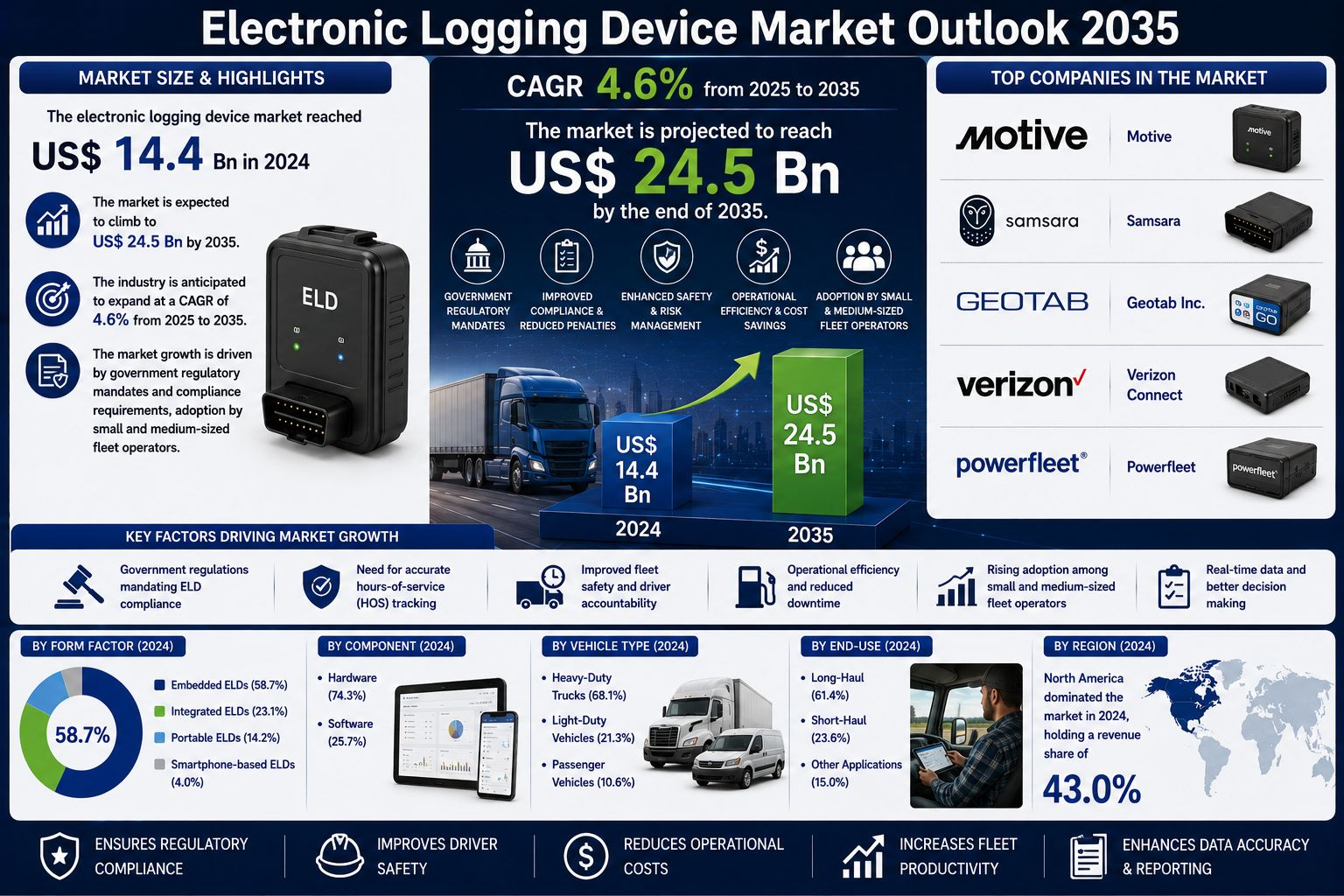
The global Electronic Logging Device (ELD) Market was valued at US$ 14.4 Billion in 2024 and is projected to reach US$ 24.5 Billion by 2035, expanding at a compound annual growth rate (CAGR) of 4.6% from 2025 to 2035.
The market is witnessing steady growth as transportation companies, logistics providers, and fleet operators increasingly adopt digital compliance and fleet management technologies. Government mandates requiring electronic recording of driver Hours of Service (HOS), coupled with the growing need for operational efficiency, vehicle safety, and real-time fleet visibility, continue to drive demand for electronic logging devices worldwide.
The integration of ELDs with advanced telematics, fleet analytics, route optimization platforms, and cloud-based management systems is transforming these devices from compliance tools into comprehensive fleet intelligence solutions.
Regulatory Mandates Continue to Drive Market Expansion
Government regulations remain the most significant growth driver for the electronic logging device industry.
Transportation authorities across North America and other major markets have implemented stringent compliance requirements mandating the use of ELDs in commercial vehicles. These regulations are designed to improve road safety, reduce driver fatigue, enforce fair labor practices, and ensure accurate recording of driver working hours.
Electronic logging devices automatically capture and store Hours of Service (HOS) data, minimizing manual errors and reducing the risks associated with paper-based logging systems.
As regulatory oversight continues to strengthen globally, compliance-driven demand is expected to remain a major contributor to market growth throughout the forecast period.
Small and Medium-Sized Fleet Operators Accelerating Adoption
The increasing adoption of electronic logging devices among small and medium-sized fleet operators is creating significant growth opportunities for market participants.
Historically, ELD adoption was largely concentrated among large commercial fleets due to higher implementation costs and complex system integration requirements. However, advancements in cloud computing, mobile applications, and subscription-based software models have made ELD solutions more affordable and accessible for smaller operators.
Modern ELD platforms provide numerous operational benefits, including:
- Real-time vehicle tracking
- Driver performance monitoring
- Route optimization
- Fuel consumption management
- Maintenance scheduling
- Regulatory compliance reporting
- Fleet productivity analysis
As small and medium-sized enterprises (SMEs) increasingly recognize the operational and financial benefits of fleet digitization, ELD adoption is expected to continue expanding globally.
Fleet Intelligence and Telematics Integration Transforming the Industry
Electronic logging devices are rapidly evolving into comprehensive fleet management ecosystems.
Today's ELD solutions integrate seamlessly with telematics platforms, enabling transportation companies to access real-time operational data and actionable business insights. This integration allows fleet managers to improve vehicle utilization, optimize routes, reduce fuel costs, and enhance overall operational efficiency.
Advanced ELD systems now offer capabilities such as:
- GPS-based vehicle tracking
- Real-time driver monitoring
- Predictive maintenance alerts
- Electronic inspection reporting
- Fuel efficiency analytics
- Driver safety scoring
- Automated compliance management
As digital transformation accelerates across the transportation sector, demand for integrated ELD and telematics solutions is expected to increase significantly.
Vehicle Safety and Operational Efficiency Driving Demand
The growing focus on road safety and fleet productivity is further supporting market growth.
By automatically recording driving hours and vehicle activity, electronic logging devices help reduce fatigue-related accidents while improving compliance with transportation regulations. Fleet operators are increasingly using ELD-generated data to identify unsafe driving behaviors, improve driver training programs, and enhance fleet safety performance.
At the same time, access to real-time operational insights enables organizations to improve dispatching decisions, reduce idle times, optimize routes, and lower operating expenses.
These benefits continue to position ELDs as essential tools for modern fleet management operations.
Embedded ELDs Segment Dominates Global Market
Based on form factor, the Embedded ELDs segment accounted for 58.7% of global Electronic Logging Device Market revenue in 2024, making it the leading segment within the industry.
Embedded ELDs are permanently integrated into a vehicle's onboard systems, allowing direct communication with the engine control unit (ECU) and enabling highly accurate data collection.
The segment's dominance is supported by several advantages:
- Enhanced data accuracy
- Improved regulatory compliance
- Reduced risk of tampering
- Greater operational reliability
- Seamless integration with vehicle systems
- Long-term durability
As fleet operators increasingly prioritize compliance and data integrity, demand for embedded ELD solutions is expected to remain strong throughout the forecast period.
North America Leads Global Electronic Logging Device Market
North America accounted for 43.0% of global Electronic Logging Device Market revenue in 2024, maintaining its position as the largest regional market.
The region's leadership is primarily attributed to:
- Strong regulatory framework
- Mandatory ELD compliance requirements
- Advanced transportation infrastructure
- High concentration of commercial fleet operators
- Early adoption of telematics technologies
- Widespread digitization of logistics operations
The United States and Canada continue to be key contributors to market growth due to established ELD mandates and increasing investments in connected fleet technologies.
The region's mature logistics ecosystem and ongoing focus on transportation safety continue to create favorable conditions for ELD adoption.
Emerging Trends Shaping the Electronic Logging Device Industry
Several important trends are transforming the future of the electronic logging device market:
- Integration of Artificial Intelligence (AI) in fleet analytics
- Cloud-Based Fleet Management Platforms
- Predictive Maintenance Solutions
- Advanced Driver Safety Monitoring
- Real-Time Route Optimization
- Connected Vehicle Ecosystems
- Mobile-First ELD Applications
- Electronic Inspection Reporting
- Fuel Efficiency Optimization Tools
- Subscription-Based Fleet Management Services
These innovations are expected to improve operational visibility while creating new revenue opportunities for technology providers.
Competitive Landscape
The global Electronic Logging Device Market is highly competitive, with leading companies focusing on software innovation, telematics integration, strategic acquisitions, and cloud-based fleet management solutions.
Major companies operating in the market include:
- Motive
- Samsara
- Geotab Inc.
- Verizon Connect
- Powerfleet
- Teletrac Navman
- Garmin ELD
- KeepTruckin
- Omnitracs, LLC
- GPS Trackit ELD
- Rand McNally
- Gorilla Safety ELD
- BigRoad DashLink ELD
- Azuga Inc.
Industry participants continue to invest in AI-powered analytics, connected fleet technologies, compliance automation, and integrated transportation management platforms to strengthen their competitive positions.
Recent Industry Developments
Recent strategic developments continue to shape the competitive landscape:
- In September 2025, Geotab acquired the commercial operations of Verizon Connect's telematics business across several European and international markets, expanding its global footprint and strengthening its small and medium-sized fleet solutions portfolio.
- In April 2024, Powerfleet completed its acquisition of MiX Telematics Limited, reflecting the ongoing consolidation trend within the telematics and fleet management technology sector.
These developments highlight the increasing importance of scale, global expansion, and integrated service offerings in the evolving ELD marketplace.
Market Segmentation
By Components
- Display
- Telematics Unit
- Others
By Form Factor
- Embedded
- Integrated
By Vehicle Type
- Heavy Commercial Vehicles (HCVs)
- Light Commercial Vehicles (LCVs)
- Buses and Coaches
By Service Type
- Entry-Level Service
- Intermediate-Level Service
- High-End Service
By Region
- North America
- Europe
- Asia Pacific
- Latin America
- Middle East & Africa
Market Outlook
The global Electronic Logging Device Market is expected to witness sustained growth through 2035 as regulatory compliance requirements, transportation safety initiatives, and fleet digitization efforts continue to gain momentum.
The increasing adoption of cloud-based fleet management systems, advanced telematics technologies, and AI-driven analytics platforms is transforming ELDs into critical components of connected transportation ecosystems.
As fleet operators increasingly prioritize operational efficiency, safety, compliance, and real-time decision-making capabilities, electronic logging devices will continue to play a vital role in modern commercial transportation and logistics operations worldwide.