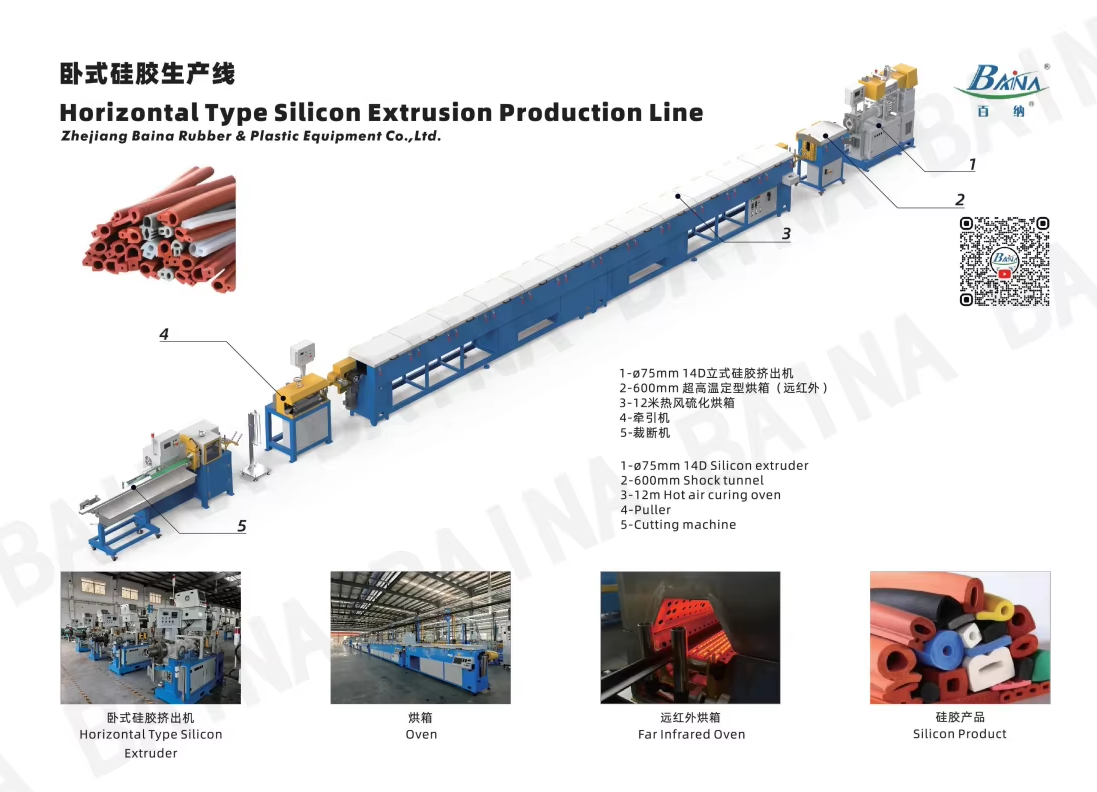
Industrial rubber processing systems are built as integrated mechanical networks rather than standalone machines. Each section contributes to material flow, thermal control, shaping accuracy, and downstream stability. A structured design helps maintain continuous production while reducing variation in rubber profile geometry.
The feeding unit is the starting point. Cold-feed systems commonly use roller mills or screw feeders with torque ratings between 150 Nm and 1200 Nm depending on compound hardness. Hopper design often includes anti-bridging geometry to ensure consistent material intake. Some systems integrate preheating chambers that raise compound temperature to 40°C–80°C before entering the screw barrel, improving plasticity.
The extrusion section forms the core of the system. Single-screw configurations dominate most industrial applications. Screw diameters typically range from 45 mm to 200 mm, with length-to-diameter ratios between 14:1 and 24:1. Compression zones gradually increase pressure from feed to metering section, often reaching 10–30 MPa at the die entrance. Barrel heating is divided into multiple zones, usually 3 to 6, controlled within ±2°C accuracy.
Die heads determine final profile geometry. These precision-machined components compensate for rubber swell by adjusting flow channels and exit dimensions. Multi-profile dies may contain 2–6 outlets, while complex automotive sealing dies can exceed 10 internal flow paths. Stainless steel or hardened alloy steel is commonly used to resist abrasion from filled compounds.
Downstream equipment ensures dimensional stability. Puller units maintain controlled traction, typically between 0.2 m/min and 80 m/min depending on product thickness. Cooling tanks or air-cooling tunnels stabilize material structure. Water bath systems often operate at 15°C–30°C, while air cooling systems rely on controlled airflow of 2–8 m/s.
A rubber extrusion production line integrates all modules through PLC-based coordination. Communication systems synchronize screw speed, puller velocity, and curing temperature to maintain stable output. Modern systems often include touch-screen interfaces with real-time pressure and temperature monitoring.
Curing units vary by product type. Hot air vulcanization tunnels operate between 180°C and 300°C. Microwave systems reduce internal curing time by directly heating molecular structures, while steam curing chambers are used for hollow profiles requiring internal pressure support.
Material selection influences equipment configuration. EPDM requires stable thermal profiles for weather resistance applications. NBR compounds demand oil resistance and moderate processing temperature control. Silicone elastomers require precise low-shear handling due to high elasticity.
Each component plays a role in ensuring consistent extrusion quality. Structural coordination defines overall efficiency, making system design a key factor in industrial rubber manufacturing.