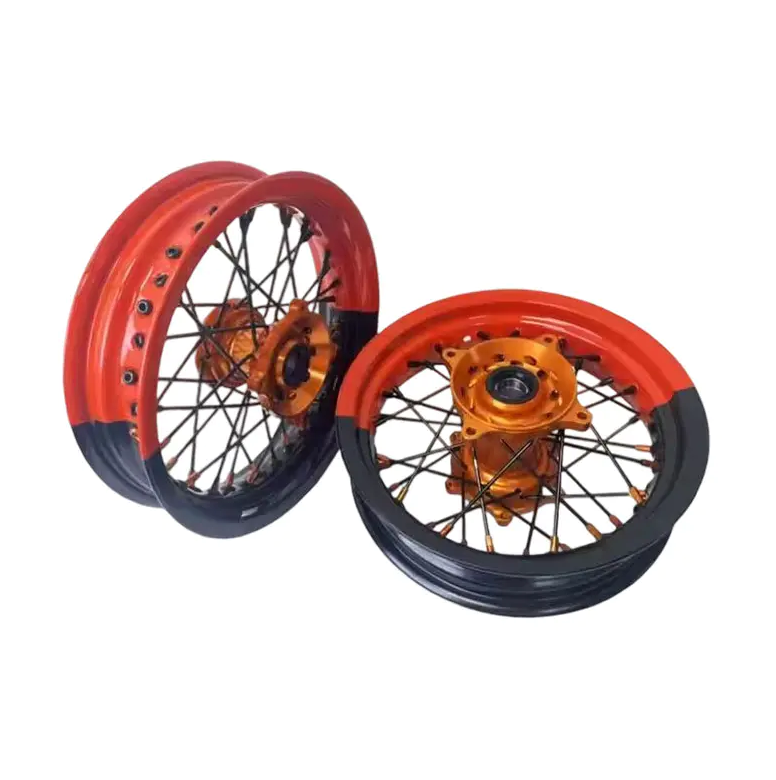
Motorcycle Rim Customization plays a major role in off-road performance where terrain conditions change rapidly and impact loads are significantly higher than paved environments. Dirt, gravel, sand, and rocky paths all place continuous stress on wheel assemblies, requiring rims designed with flexibility, shock absorption, and structural endurance in mind.
Off-road structural demands
Off-road riding introduces vertical impact forces that can exceed 2–4 times the static load of the motorcycle. Unlike smooth asphalt, uneven terrain creates sudden compression cycles that directly affect rim integrity.
Typical off-road rim specifications include:
Rim diameter: 18–21 inches rear / 21 inches front (common dirt and ADV setups)
Rim width: 1.60–2.50 inches (front), 2.15–4.25 inches (rear)
Spoke count: 32–36 high-tension stainless steel spokes
Spoke tensile strength: 800–1200 MPa range
Motorcycle Rim Customization in this segment often prioritizes impact distribution rather than rigidity alone.
Spoked rim dominance in off-road builds
Spoked rims dominate off-road customization because of their controlled flexibility. Instead of transferring full shock force into a rigid structure, spokes distribute energy across multiple tension points.
Key engineering benefits:
Controlled deformation reduces crack formation
Easier repair through individual spoke replacement
Better performance under repeated compression cycles
Hub and rim are connected through angled spoke geometry, typically between 30–45 degrees, improving load transfer efficiency.
Material behavior in harsh terrain
Most off-road rims use aluminum alloy or steel rims with reinforced bead seats.
Common material parameters:
Aluminum alloy hardness: ~70–95 HB
Steel rim tensile strength: ~400–600 MPa
Coating thickness: 80–150 microns anti-corrosion treatment
Mud and water exposure increases corrosion risk, so anodized or powder-coated finishes are frequently used in Motorcycle Rim Customization for off-road applications.
Tubeless conversion systems
Modern off-road builds often integrate tubeless spoke systems. These designs seal spoke nipples internally using rubber sealing layers.
Performance benefits include:
Reduced puncture air loss rate
Easier field repairs
Lower overall wheel weight compared to tube systems
Air pressure for off-road setups typically ranges:
Sand riding: 0.8–1.2 bar
Mixed terrain: 1.2–1.6 bar
Rocky terrain: 1.4–2.0 bar
Lower pressure increases grip but requires rim structures that tolerate deformation without leakage.
Rim strength vs flexibility balance
Motorcycle Rim Customization for off-road use focuses on balancing two competing requirements:
Flexibility for impact absorption
Strength for structural integrity
Too rigid a rim increases fracture risk on rocky impacts, while too flexible a rim can reduce directional stability at higher speeds.
Weight distribution and handling
Reducing unsprung mass improves suspension response on uneven terrain.
Typical weights:
Front off-road spoked wheel: 3.0–4.5 kg
Rear off-road spoked wheel: 4.5–6.5 kg
Lower mass allows suspension systems to react faster to terrain changes, improving traction consistency.
Conclusion perspective
Off-road Motorcycle Rim Customization is centered around shock dispersion, spoke tension engineering, and adaptable material resilience. Unlike street setups, the rim must tolerate unpredictable force directions while maintaining wheel alignment stability across changing terrain conditions.