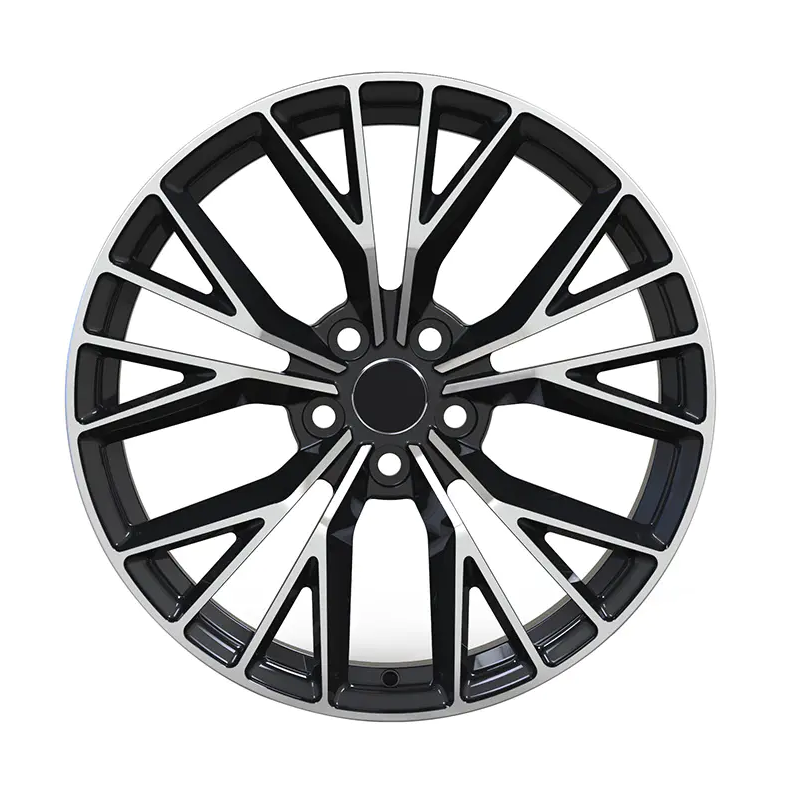
Motorsport environments demand components that can handle extreme lateral loads, repeated thermal cycling, and high-speed impact stress. Within this context, the Monoblock Forged Wheel has become a widely adopted structure due to its combination of reduced mass and high structural integrity.
Track performance begins with unsprung weight. Every kilogram removed from the wheel assembly improves suspension responsiveness. A reduction of approximately 1 kg in wheel mass can be equivalent to removing several kilograms from the vehicle body in terms of dynamic response. Forged construction typically reduces wheel weight by 20%–25% compared to traditional cast structures, depending on size and design geometry.
On a technical level, forging aligns aluminum grain flow along radial stress paths. This alignment improves resistance to deformation during high-G cornering, where lateral forces can exceed 1.2–1.5 times vehicle weight. The Monoblock Forged Wheel distributes these forces evenly across the spoke structure, reducing localized stress concentration points that often initiate fatigue cracks in lower-density materials.
Thermal stability is another critical factor in track environments. Brake temperatures can exceed 500°C during aggressive driving cycles. Wheels must dissipate heat efficiently to prevent brake fade and material weakening. Aluminum forged structures typically exhibit thermal conductivity around 150–170 W/m·K, allowing faster heat transfer away from the braking system.
Finite element analysis (FEA) is commonly used in the design phase. Engineers simulate braking load, curb impact, and acceleration stress. These simulations often reveal that spoke junctions and hub interfaces experience the highest stress intensity. To counter this, Monoblock Forged Wheel designs use variable thickness spokes and hollowed internal structures to reduce mass without compromising load distribution.
Another important factor is rotational inertia. A lighter wheel reduces the energy required to accelerate rotational mass. This improves 0–100 km/h acceleration times and enhances throttle response in mid-range speeds. In racing conditions, this also translates into faster corner exit speeds due to improved drivetrain efficiency.
Impact resistance also plays a role. Track surfaces often include curbs, uneven asphalt patches, and debris. Forged aluminum tends to deform plastically rather than fracture, meaning it bends before breaking. This behavior can allow a driver to maintain control long enough to return to the pit area safely.
However, track usage also introduces fatigue accumulation. Even forged structures experience microstructural stress over time. Testing protocols often involve radial fatigue cycles exceeding 500,000 repetitions under simulated load conditions to ensure long-term reliability.
In endurance racing setups, wheel consistency is just as important as strength. A Monoblock Forged Wheel maintains dimensional stability across temperature changes, reducing imbalance and vibration at sustained high speeds above 200 km/h.
Overall, the track application of forged wheels demonstrates a balance between weight reduction, thermal management, and structural predictability, all of which contribute to consistent lap performance.