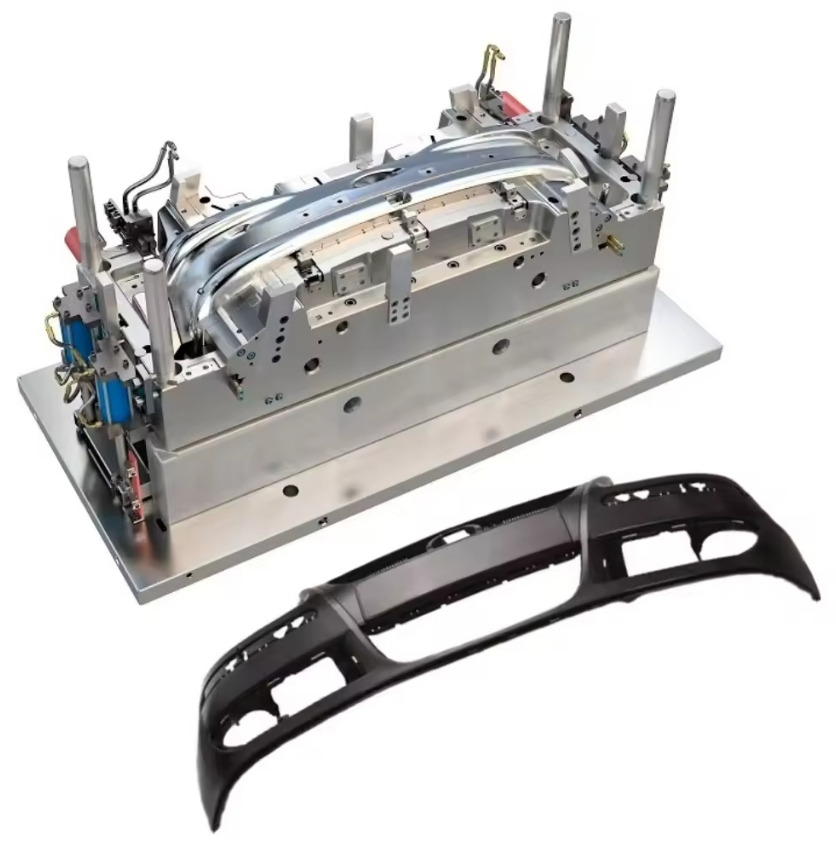
Vehicle exterior systems have shifted strongly toward lightweight engineering, where plastic structures replace traditional metal components in many front-end assemblies. A Front Bumper Molding Manufacturer contributes directly to this transformation by optimizing material usage, structural design, and molding efficiency to achieve lower part mass without reducing functional strength.
Lightweight Polymer Selection Strategy
Front bumper systems are commonly produced using thermoplastic polyolefins (TPO), PP-EPDM blends, and modified ABS materials. These materials typically provide density values between 0.90 g/cm³ and 1.05 g/cm³, significantly lower than steel-based alternatives.
PP-based compounds used in bumper molding usually maintain tensile strength in the range of 20–30 MPa, while elongation at break can exceed 200%, allowing controlled deformation during impact.
A Front Bumper Molding Manufacturer selects polymer grades based on:
Impact resistance at low temperature (down to -30°C)
Melt flow index (10–25 g/10 min for complex geometries)
UV stabilization for long-term exposure
Recyclability for sustainable production cycles
Structural Weight Optimization in Mold Design
Mold design plays a major role in reducing unnecessary material usage. Modern bumper molds integrate:
Ribbed reinforcement structures with 1.5–2.5 mm thickness
Variable wall sections from 2.0 mm to 3.5 mm
Hollow support zones to reduce material density
Localized thickening only at mounting points
By controlling wall thickness variation, a Front Bumper Molding Manufacturer reduces overall resin consumption while maintaining stiffness distribution.
Injection Molding Efficiency and Material Savings
Injection molding efficiency is closely tied to part weight control. A typical bumper production cycle follows:
Injection pressure: 90–140 MPa
Melt temperature: 200°C–240°C
Cooling time: 25–55 seconds
Cycle time: 50–100 seconds
Hot runner systems reduce sprue waste by up to 15%–30%, depending on mold configuration. Balanced flow channels ensure uniform cavity filling, preventing overpacking in localized regions that would otherwise increase part weight.
Reinforcement Without Excess Mass
Instead of increasing thickness, modern bumper systems rely on structural geometry improvements:
Energy absorption ribs designed in honeycomb patterns
Stress distribution channels along horizontal beam zones
Integrated crash boxes using clip-on modular inserts
These structures distribute impact force efficiently while maintaining low mass.
Surface Treatment and Secondary Weight Effects
Even surface finishing influences final weight. Paint layers typically add 80–120 µm thickness per coat system. A Front Bumper Molding Manufacturer often coordinates molding precision to reduce excessive primer usage caused by surface defects.
Conclusion
Weight reduction in bumper systems is not achieved through material alone but through combined control of polymer selection, mold structure, and processing parameters. A well-developed Front Bumper Molding Manufacturer integrates these engineering factors to achieve lighter, stable, and functional automotive exterior components.