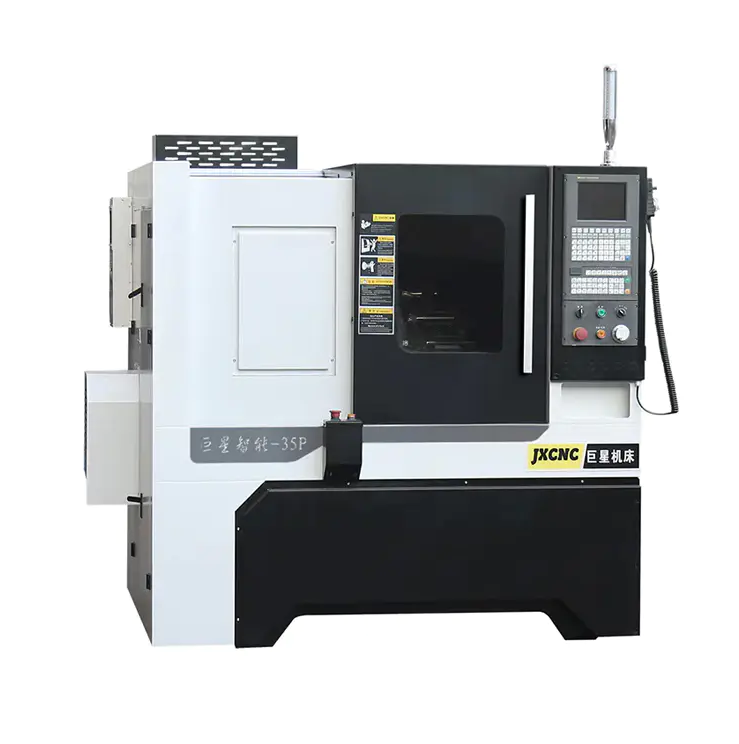
Mold manufacturing demands high precision, stable repeatability, and consistent surface quality across long production cycles. A Linear Guide CNC Machine plays an important role in this field due to its ability to maintain controlled axis motion while handling complex cavity machining and multi-step finishing processes.
Compared with conventional sliding guide systems, linear guide technology introduces rolling contact that reduces friction and improves responsiveness under dynamic cutting loads. This becomes especially important in mold industries where fine detail and dimensional stability are required.
Precision Structure for Mold Geometry
Mold cavities often include deep pockets, sharp edges, and fine contour transitions. Any deviation in axis movement can affect final part quality.
A Linear Guide CNC Machine typically uses:
Precision ground linear rails (H-class or higher)
Four-row ball bearing guide blocks
Preloaded carriage assemblies
Cast iron machine bed with stress relief treatment
Common machine travel specifications:
X-axis travel: 700–1600 mm
Y-axis travel: 400–900 mm
Z-axis travel: 450–700 mm
Positioning accuracy: ±0.008 mm
Repeat positioning accuracy: ±0.005 mm
These parameters support consistent cavity machining during repeated production runs.
Stability During Complex Cutting Paths
Mold machining often involves multi-directional tool movement. During contouring and finishing, axis coordination must remain stable.
A Linear Guide CNC Machine supports smooth interpolation through:
Reduced friction resistance in guide movement
Servo-driven closed-loop axis control
High rigidity carriage preload
Anti-vibration machine structure
Spindle systems commonly used in mold production:
BT40 or BT50 taper systems
10,000–15,000 rpm spindle speed range
7.5–18.5 kW spindle motor power
Ceramic or angular contact bearings
These spindle configurations help maintain consistent cutting performance during long tool engagement cycles.
Ball Screw and Feed System Coordination
Axis motion precision depends on both linear guides and ball screw transmission.
Typical configurations include:
C3-grade precision ball screws
Diameter range: 32 mm to 50 mm
Lead: 10 mm / 12 mm / 16 mm
Double support bearing system
Pre-tensioned nut structure
Feed characteristics:
Rapid traverse: 24–36 m/min
Cutting feed range: 1–10,000 mm/min
This balance supports both rough machining and fine finishing stages in mold production.
Surface Quality Requirements in Mold Industry
Surface finish directly affects polishing workload after machining.
A Linear Guide CNC Machine contributes to better surface results through:
Reduced vibration during high-speed contouring
Stable tool path accuracy
Consistent axis response under load changes
Thermal stability during long machining cycles
Key influencing factors include:
Tool rigidity and geometry
Spindle balance accuracy
Cooling system efficiency
Servo tuning parameters
Guide rail preload condition
Cooling and Chip Management
Mold machining generates continuous chips and heat buildup.
Common machine features include:
High-pressure coolant system (20–70 bar optional)
Spiral or chain chip conveyor
Internal spindle cooling channels
Automatic lubrication system
These systems help maintain stable machining conditions over extended operation periods.
Application Areas
A Linear Guide CNC Machine is widely used in:
Plastic injection molds
Die casting molds
Rubber molding tools
Precision forming dies
Prototype tooling
Industries include automotive, packaging, consumer electronics, and industrial equipment manufacturing.
Conclusion
Mold production requires controlled accuracy and stable multi-axis movement. A Linear Guide CNC Machine provides low-friction guidance, rigid structural support, and precise motion control, making it suitable for complex cavity machining and repeated production cycles. Proper configuration of spindle, guide rails, and feed systems helps maintain stable machining results across different mold designs.