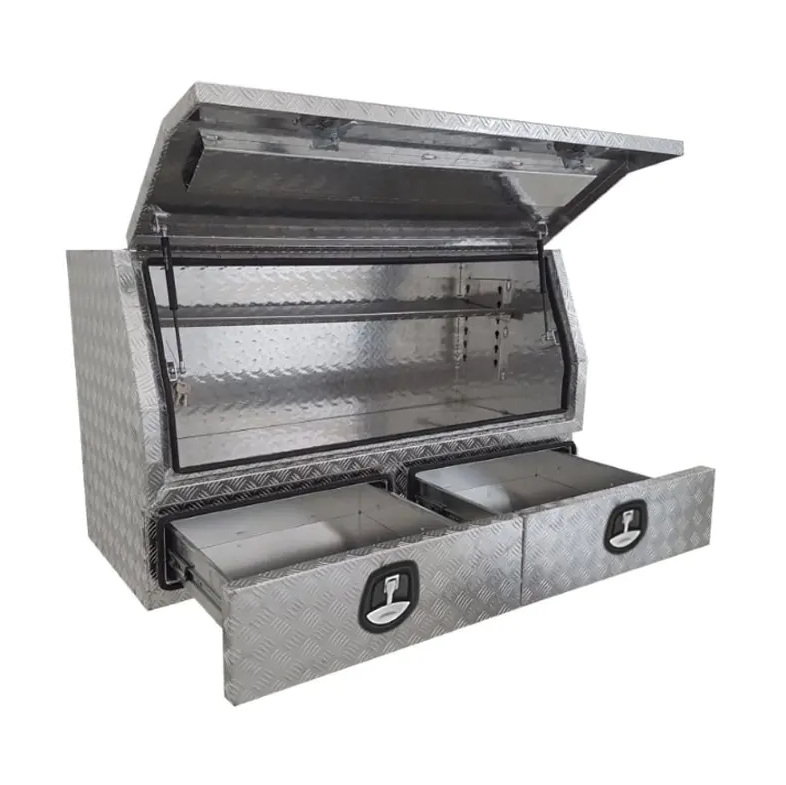
Installation methods for aluminium trailer storage systems are directly related to safety, load stability, and long-term usability. A properly installed Aluminium Trailers Toolbox reduces movement during transport and protects stored equipment from vibration damage. Since trailers are exposed to continuous dynamic forces, mounting structure is as important as the toolbox material itself.
Most aluminium trailer toolboxes are installed using bolt-down systems or bracket-mounted frames. Common bolt sizes include M8, M10, or M12 stainless steel bolts depending on toolbox weight and trailer frame thickness. For medium-sized units weighing between 10 kg and 30 kg, M8 or M10 bolts are usually sufficient when paired with reinforcement washers to distribute load pressure evenly.
The mounting base of a typical toolbox often includes pre-drilled holes or reinforced mounting rails. These rails are welded along the bottom frame and designed to align with trailer chassis beams. Aluminium thickness for these mounting areas generally ranges from 2.0 mm to 3.0 mm, ensuring resistance against deformation caused by constant vibration.
An Aluminium Toolbox with Drawers requires additional structural consideration due to internal weight distribution. Drawer systems can hold between 30 kg and 60 kg per compartment depending on slide quality. When fully loaded, dynamic forces increase significantly during acceleration and braking. To counter this, many installations use anti-vibration rubber pads between the toolbox base and trailer surface.
Underbody mounting is another widely used method, especially for commercial trailers. In this setup, toolboxes are fixed beneath the trailer frame using steel brackets. These brackets are typically powder-coated or galvanized to resist corrosion. Clearance height is carefully measured to avoid ground contact during uneven terrain movement.
For drawbar-mounted installations, positioning is critical. A common design places the toolbox at the trailer tongue, with lengths ranging from 600 mm to 1450 mm depending on trailer size. A typical example includes 950×400×500 mm configurations, which provide balanced weight distribution while maintaining towing stability. Internal volume is optimized by reducing wall thickness to around 2.5 mm without compromising strength.
Locking stability is also influenced by installation quality. Poor mounting can cause lid misalignment, leading to seal failure and water intrusion. Proper alignment ensures that rubber gasket seals remain compressed evenly across all edges. This is especially important in environments exposed to rain, dust, or road debris.
Vibration control is another critical factor. Trailers often experience frequencies between 10 Hz and 50 Hz during highway transport. Without proper reinforcement, this can loosen bolts over time. Thread-locking compounds and spring washers are often used to prevent loosening under continuous vibration cycles.
Cable tie-down integration is also used in some installations. This involves securing the toolbox with additional restraint straps during long-distance transport. While not a replacement for structural mounting, it provides extra safety in extreme conditions.
Overall, correct installation ensures that aluminium trailer toolboxes perform reliably under load stress, vibration, and environmental exposure. When combined with structured storage such as Aluminium Toolbox with Drawers systems, installation quality directly impacts usability and equipment protection.