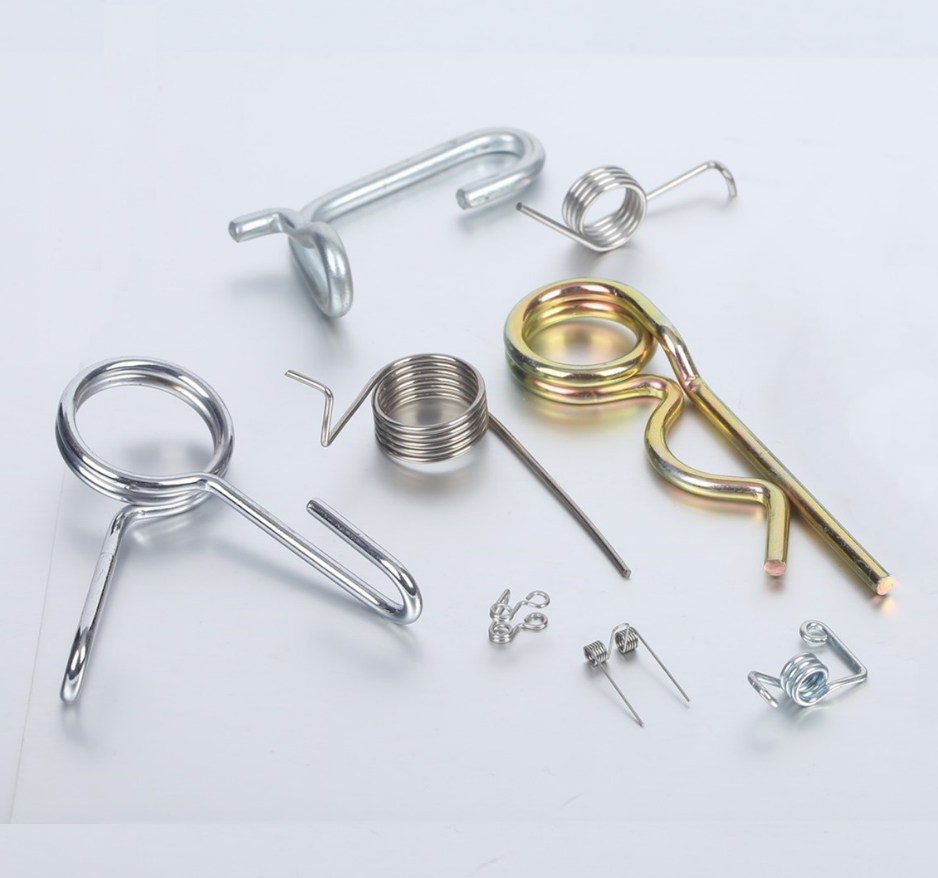
Mechanical springs operating under repeated torsional loading are subject to one of the most critical failure modes in engineering systems: fatigue fracture. In compact rotational assemblies, Double Helix Torsion Springs are often selected because their dual-load-path structure improves stress distribution compared to single-wire torsion elements. However, fatigue failure remains a governing design limitation.
Fatigue occurs when cyclic stress remains below the material’s yield strength but gradually initiates microcracks that propagate over time. In torsional systems, stress is concentrated at coil curvature regions and leg transition points. For double helix configurations, stress is distributed across two intertwined helical wires, reducing localized peak stress but introducing additional geometric interaction zones.
A typical fatigue life assessment begins with stress amplitude calculation:
τ = (K × 32M) / (πd³)
Where τ is shear stress, M is applied moment, d is wire diameter, and K is stress correction factor accounting for curvature effects. In double helix geometry, effective stress is split between helices, lowering peak shear stress per wire segment under equivalent torque load.
Experimental and simulation studies in spring mechanics show that fatigue cracks often initiate at surface imperfections such as tool marks, inclusions, or micro-pits. Once initiated, cracks propagate along maximum shear stress planes, typically oriented at 45° to the wire axis.
Surface condition plays a decisive role in fatigue resistance. Shot peening or controlled surface hardening can introduce compressive residual stress layers approximately 0.05 mm to 0.3 mm deep, significantly delaying crack initiation. Heat-treated spring steel with hardness levels between HRC 42 and HRC 52 is commonly used for fatigue-critical designs.
In Double Helix Torsion Springs, fatigue performance is further influenced by helix synchronization. If the two coils are not geometrically aligned, uneven load sharing occurs, leading to asymmetric stress concentration. Manufacturing tolerances for coil alignment are often controlled within ±0.1 mm to ensure balanced torque distribution.
Residual stress introduced during coiling is another key factor. Cold coiling processes generate internal stress fields that can either improve or reduce fatigue life depending on post-process stress relief conditions. Typical stress-relief heat treatment ranges from 260°C to 420°C, depending on alloy composition.
Fatigue life is commonly evaluated using S-N curves, where stress amplitude is plotted against number of cycles to failure. For spring steels, endurance limits may exist around 40–60% of ultimate tensile strength, though environmental factors such as corrosion can significantly reduce this threshold.
Crack propagation behavior in double helix systems tends to be more gradual due to distributed stress paths. Instead of a single catastrophic failure point, damage may accumulate in one helix before transferring load to the second. This characteristic provides partial redundancy but does not eliminate failure risk.
Environmental effects such as humidity, temperature fluctuation, and chemical exposure accelerate fatigue degradation through corrosion-assisted cracking. Protective coatings such as zinc plating or epoxy layers are commonly applied to extend service life.
Ultimately, fatigue performance in torsional systems is governed by geometry, material purity, surface condition, and load consistency. Double helix structures improve stress distribution efficiency, but proper manufacturing control remains essential to fully realize their mechanical advantages.